
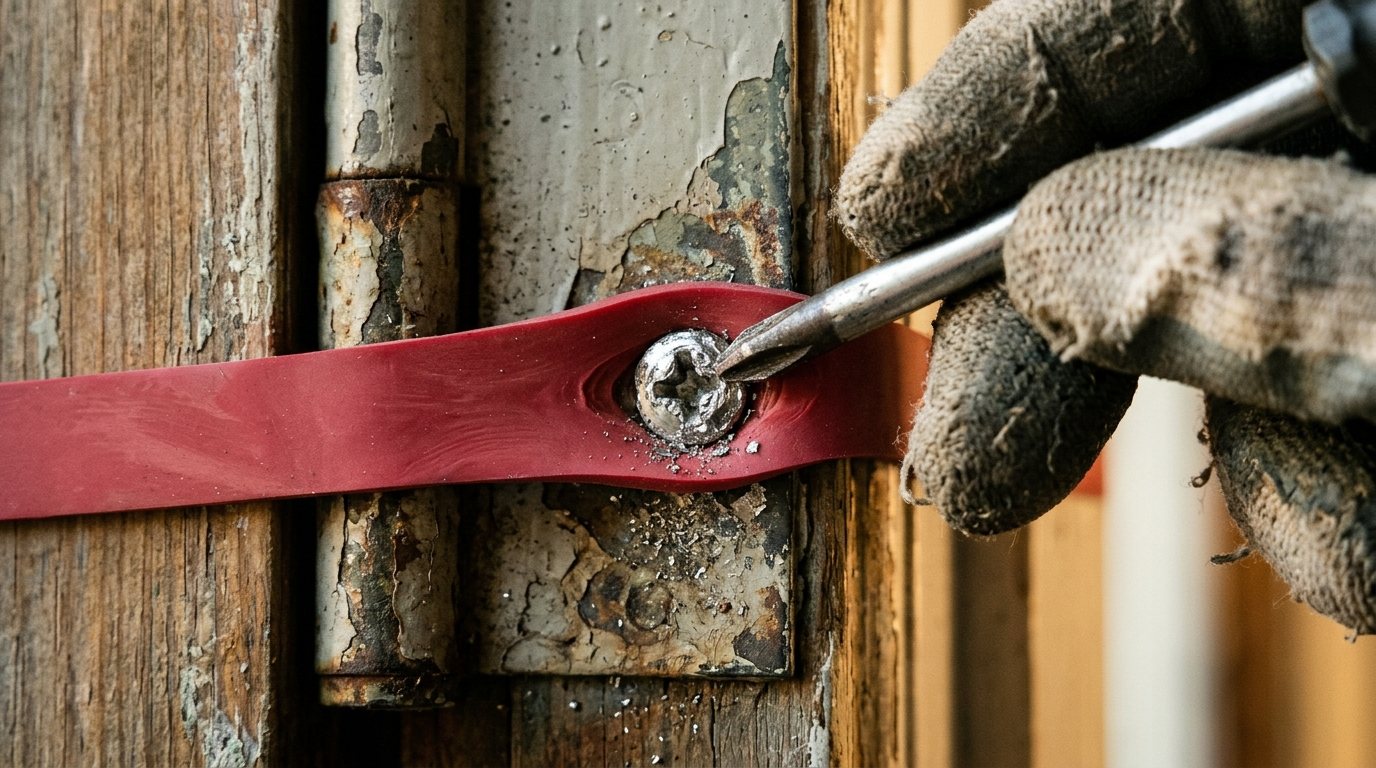
The bit spins, the screw doesn’t, and every turn polishes the head smoother. A stripped screw is one of the most common snags in any repair, whether it holds a door hinge, a cabinet pull, a deck board or an appliance panel.
This guide covers the fixes from gentlest to most aggressive: the rubber band trick, a bigger or different bit, locking pliers, cutting a new slot, a left-hand drill bit and a screw extractor kit, step by step. You will also learn how to handle rusted or broken screws, repair the hole and stop screws from stripping again.
Quick answer: Press a wide rubber band between a fresh, correctly sized bit and the screw head, then turn slowly with heavy pressure. If the head sticks up, clamp it with locking pliers and twist counterclockwise. If neither works, drill into the head with a left-hand bit in reverse, then use a screw extractor at low speed. Wear safety glasses for anything that drills, taps or cuts.
First, figure out what you are dealing with
A stripped head has a rounded-out recess, so the bit cams out (slips up and out) under torque. A seized screw has a good head but is held by rust, paint or thread locker. A broken screw has lost its head entirely. What the screw sits in matters too: wood is forgiving, while metal, plastic and finished surfaces crack or scar more easily.
| Situation | Try first | If that fails |
|---|---|---|
| Head partly stripped, screw not very tight | Rubber band with a fresh bit, or the next bit size up | Left-hand drill bit in reverse |
| Head badly stripped and flush | Screw extractor kit | Cut a new slot or drill off the head |
| Head stands above the surface | Locking pliers | Cut a slot with an oscillating or rotary tool |
| Rusted or painted in place | Penetrating oil, wait at least 15 minutes | Manual impact driver or extractor |
| Head snapped off | Locking pliers on the shank | Extractor, or a plug cutter in wood |
| Near wiring or inside an appliance | Shut off power, then a hand screwdriver | Electrician or appliance technician |
Tools and materials
- Safety glasses
- Screwdrivers and bits in several sizes: Phillips, square, star and slotted
- Wide rubber bands or fine steel wool
- Locking pliers
- Screw extractor kit and left-hand drill bits (cobalt or high-speed steel)
- Variable-speed drill with reverse
- Center punch and hammer
- Oscillating or rotary tool with a metal-cutting blade or disc
- Penetrating oil, clamps, masking tape and a non-contact voltage tester
Safety note: If the screw holds a cover plate, outlet, switch, light fixture or anything inside an appliance, turn off the breaker or unplug the appliance first and confirm the power is off with a non-contact voltage tester. A slipping bit or cutting disc near live wires can cause a shock or fire. Wear impact-rated safety glasses for every drilling and cutting step; OSHA’s eye and face protection overview covers the hazard.
Methods from easiest to most aggressive
Work through these in order. Each step does a little more damage, so starting gentle keeps the harder options open. If a method isn’t biting after a few honest tries, move on.
1. Seat a fresh, correctly sized bit
Many “stripped” screws are really a worn bit or the wrong size. Most household Phillips screws take a #2 bit, but larger screws often need a #3, and a #2 spinning in a #3 recess strips it fast. Try the next size up or a brand-new bit. Use a hand screwdriver so you can feel the grip, push much harder than feels natural and keep the driver perfectly in line with the screw.
2. Use the rubber band trick
Lay a wide, flat rubber band over the head and press the bit through it into the recess. The rubber fills the worn gaps and adds friction. Turn slowly with heavy pressure, and fold the band double if it tears. Steel wool or a scrap of duct tape works the same way. Expect success on partly stripped, loose-ish screws, not fully rounded or rusted ones.
3. Tap the bit deeper (sturdy surfaces only)
A few light hammer taps can seat a bit deeper into a chewed recess. Use a screwdriver whose steel shank runs through the handle, or a manual impact driver, which turns a hammer blow into a burst of turning force. Wear safety glasses, and skip this on tile, glass, electronics and thin panels.
4. Grip a raised head with locking pliers
If the head sits above the surface even a little, clamp locking pliers tightly on the sides of the head, rock them gently to break it loose, then turn counterclockwise. Readjust the jaws as the screw backs out. Mask finished surfaces with tape first, because pliers slip and scratch.
5. Cut a new slot
When the recess is gone but the head is exposed, cut a straight, centered slot across it with an oscillating tool and metal-cutting blade or a rotary tool and reinforced cutoff disc. Cut only as deep as the head is thick, then turn it with a flat-blade screwdriver that fills the slot. Mask the area and wear safety glasses, as discs throw sparks and can shatter. Our guide to using an oscillating tool covers blade choice and control.
6. Try a left-hand drill bit
Left-hand (reverse-spiral) bits cut while the drill runs in reverse. Choose one smaller than the screw shank, set low speed and drill into the center of the head. As the bit bites, friction often spins the screw out. If it doesn’t, you have just drilled the pilot hole for an extractor.
7. Use a screw extractor kit
This is the go-to fix for a screw with no usable recess. The full process is in the next section.
8. Drill off the head as a last resort
Drill into the head with a regular bit about the size of the shank until the head pops off. Lift the part away, then turn out the remaining shank with locking pliers. In wood, a hollow plug cutter can bore around a stuck screw so you can remove it with a core of wood and glue in a matching plug.
How to use a screw extractor, step by step
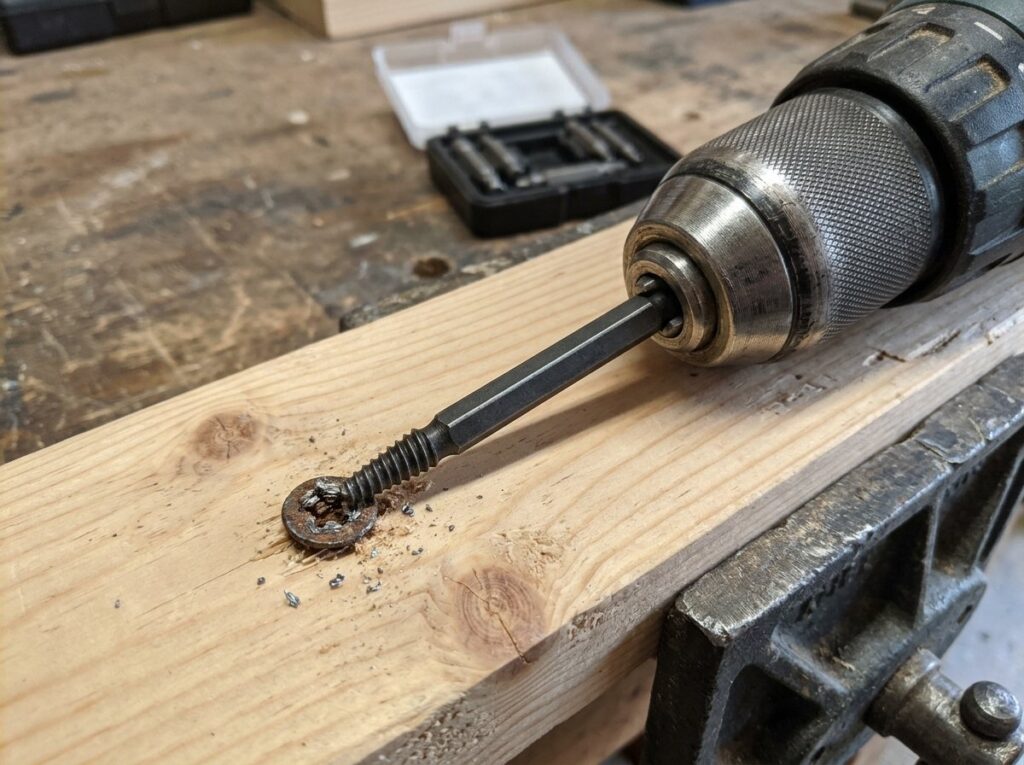
Screw extractors are hardened steel bits with reverse threads or flutes that wedge tighter as you turn counterclockwise. Most home kits are double-ended: one end makes the hole while running in reverse, and the other end is the extractor. Classic spiral-flute extractors use a separate drill bit listed on the kit’s chart.
- Protect yourself and the work. Put on safety glasses. Clamp small parts in a vise so they can’t spin, and never hold a small part in your hand while drilling it.
- Pick the right size. Match the extractor to the screw using the kit chart. Too small won’t grip; too large can split the screw or the material around it.
- Center punch the head. A dimple in the middle keeps the bit from wandering, and a centered hole keeps the extractor from bursting out the side of the screw.
- Drill the pilot hole. Set the direction the kit specifies (double-ended bits run in reverse) and a low speed. Hold the drill in line with the screw and drill only as deep as the instructions say. Add a drop of cutting oil on metal screws.
- Seat the extractor. Flip the bit or switch to the extractor. With the drill in reverse at low speed, press firmly and let it bite. Straight-flute extractors are tapped in lightly with a hammer, then turned with a tap wrench.
- Back the screw out. Keep steady pressure and slow speed. If it binds, stop and add penetrating oil rather than forcing it.
- Release the extractor. Clamp the screw in locking pliers and turn the extractor clockwise to unthread it.
Safety note: Extractors are hard and brittle. Lean on one too hard, or run it in an impact driver it isn’t rated for, and it can snap off inside the screw. A broken extractor is far harder to remove than the original screw, because ordinary bits can’t cut it. Go slow and stop if you feel it flex or bind.
Rusted, painted or broken-off screws
Score paint around the head with a utility knife first. For rust, apply penetrating oil, wait at least 15 minutes and tap the head lightly to help the oil wick into the threads. Thread locker on machine screws softens with heat; a soldering iron tip held on the head for a minute or two is a controlled way to warm it. Never use open flames indoors or heat near gas lines, fuel, plastic or finished wood.
If a screw snapped with some shank showing, grip the shank with locking pliers. If it broke off flush, file it flat, center punch it and use an extractor. A broken screw deep in wood can often stay put; just shift the new screw slightly to one side.
Repair the hole after the screw is out
In wood, glue a few toothpicks or a wood sliver into the hole, let it dry, trim it flush and drive a new screw. A slightly longer or thicker screw also works. For heavy items on drywall, switch to a proper anchor; our guide to hanging heavy things on drywall explains which type. In metal, step up one screw size or re-tap the hole. Always use a new screw rather than reusing the stripped one.
How to prevent stripped screws
Match the bit to the screw
The bit should fill the recess snugly with no wobble. Square and star (Torx) drive screws resist cam-out far better than Phillips, which is why most deck and construction screws use them. Replace bits once the tips look rounded. Our guide to drill and driver bits covers the common drive types.
Set the clutch and keep speed moderate
A drill’s adjustable clutch slips at the set torque, stopping before the head strips. Start at a low number, drive a test screw and raise it one step at a time until the screw sits flush. Impact drivers deliver torque fast, so ease off the trigger as the head seats; see impact driver vs drill for when each tool fits.
Drill pilot holes
Pilot holes reduce the torque needed, which cuts both stripping and splitting. They matter most in hardwood, near board ends and with long screws. To size one, hold the bit in front of the screw: you should see the threads past the bit on both sides, but not the solid core.
Push hard and stay straight
Most stripping happens when the driver tilts or you don’t push hard enough. Keep the tool in line, put your weight behind it and stop as soon as the screw is snug.
When to call a pro
- The screw is inside an electrical panel or wiring you can’t safely shut off.
- It is part of a gas appliance, gas valve, water heater or furnace burner.
- An extractor has broken off inside the screw.
- The fastener is structural, such as a deck ledger, stair stringer or railing post.
- The part is valuable or irreplaceable, like antique furniture.
HomeAdvisor’s handyman cost guide puts typical rates at about $60 to $125 per hour plus materials, and says small jobs of one to two hours often run around $60 to $250. Rates vary by region, so bundle a few small repairs into one visit.
Frequently asked questions
Does the rubber band trick really work?
Yes, on screws that are only partly stripped and not very tight. The rubber fills the worn gaps so the bit can grip. On a fully rounded or rusted screw it usually tears, so move on to a left-hand bit or extractor.
How do you remove a stripped screw without an extractor?
Try a fresh or larger bit, a rubber band, locking pliers on a raised head or a new slot cut with an oscillating or rotary tool. A left-hand drill bit run in reverse also spins many screws out without a kit.
How do you remove a stripped screw from metal?
Apply penetrating oil and wait, then use an extractor or a left-hand cobalt bit at slow speed with a little cutting oil. If the head is exposed, cutting a slot works well. Wear safety glasses, because metal chips and broken bits can fly.
What if a screw extractor breaks off?
Stop drilling. Standard bits can’t cut a hardened extractor, and forcing it makes things worse. A machine shop or experienced pro has specialized tools for it, and in wood you can bore around the screw with a plug cutter and patch the hole.
Why do my screws keep stripping?
The usual causes are a worn or wrong-size bit, too much speed or torque, no pilot hole in hardwood and too little pressure. Switching to square or star drive screws and setting your drill’s clutch fixes most repeat problems.
The bottom line
Start gentle with a fresh bit and a rubber band, then work up to locking pliers, a cut slot, a left-hand bit and finally a screw extractor. Go slow, push hard, keep the tool straight and wear safety glasses for anything that drills or cuts. Then prevent repeats with the right bit, a sensible clutch setting and pilot holes.


