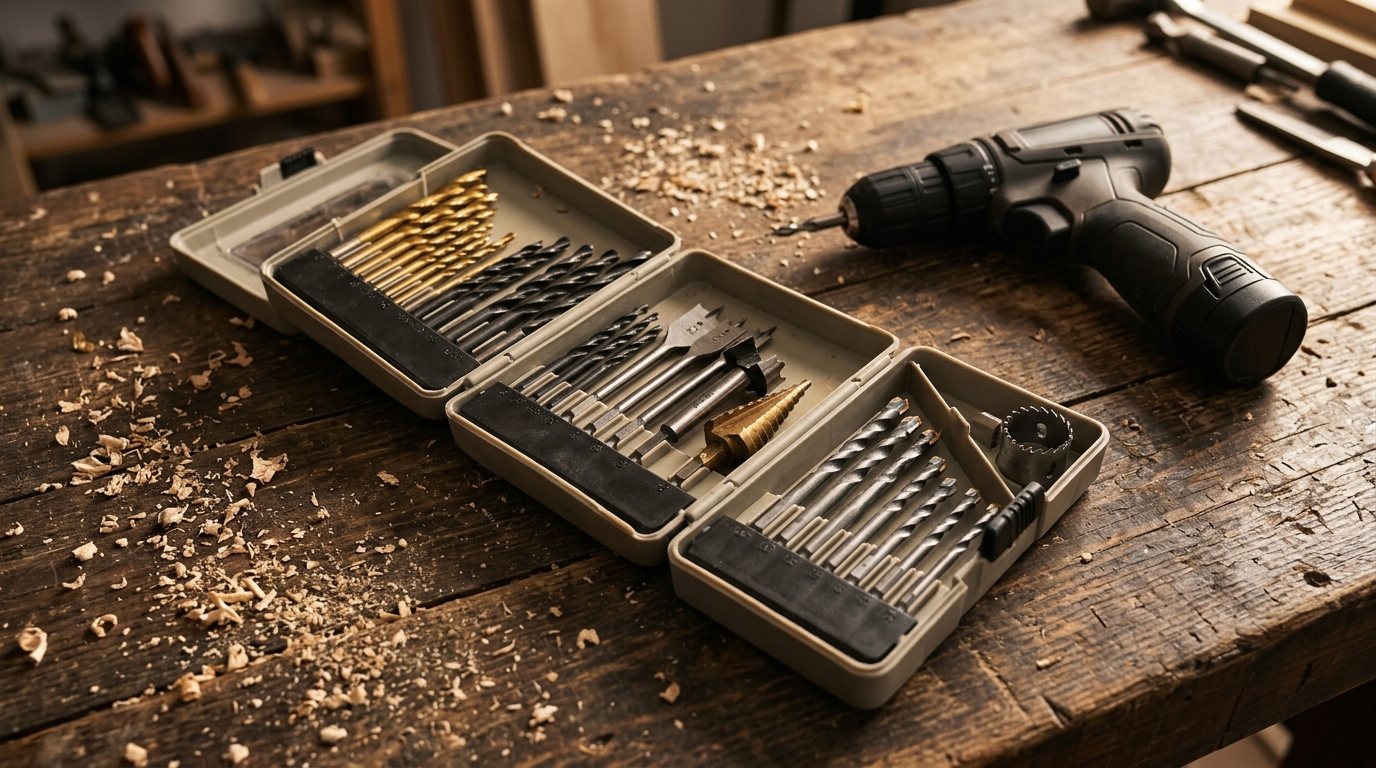
You open a drill bit set and find a dozen shapes and colors: gold bits, black bits, flat paddles, pointy tips and one that looks like a little staircase. Pick the wrong one and the bit wanders, smokes, chips the tile or barely scratches the concrete.
This guide explains the main types of drill bits, what each one is designed for, and how bit materials like HSS, cobalt and carbide differ. You’ll also get a quick table that matches the right bit to the material you’re drilling, plus the speed and safety tips that keep bits sharp and holes clean.
Quick answer: Use twist bits for general holes in wood, plastic and metal, brad-point bits for clean wood holes, and spade bits or Forstner bits for larger wood holes. Drill concrete and brick with carbide-tipped masonry bits, tile with carbide spear-point or diamond bits, and hard metals with cobalt bits. Match the bit to the material first, then slow down as the bit gets larger or the material gets harder.
Drill bit types at a glance
| Material you’re drilling | Best bit type | Bit material | Speed and tips |
|---|---|---|---|
| Softwood, plywood, drywall | Twist or brad-point; spade for big rough holes | HSS or black oxide | Medium to fast; back the board to stop tear-out |
| Hardwood and cabinetry | Brad-point; Forstner for clean, flat-bottom holes | HSS or carbon steel | Slower for large bits; clamp the work |
| Mild steel, aluminum, copper | Twist; step bit for thin sheet | HSS, black oxide or titanium-coated | Slow with cutting oil; center punch first |
| Stainless steel and hard alloys | Twist | Cobalt (M35 or M42) | Slow, steady pressure and cutting oil |
| Concrete, brick, block, stone | Masonry | Carbide-tipped | Hammer mode; pull back often to clear dust |
| Ceramic tile | Tile spear-point or diamond hole saw | Carbide or diamond | Lowest speed, no hammer, keep it wet |
| Porcelain tile, glass, stone tile | Diamond core or diamond hole saw | Diamond | Low speed with water cooling |
| Plastic, PVC, acrylic | Twist or step bit | HSS | Slow so the plastic doesn’t melt or crack |
| Large holes in doors, studs, sheet goods | Hole saw | Bi-metal; carbide or diamond for masonry | Slow, two hands, cut from both sides |
The main types of drill bits
Twist bits
The twist bit is the standard bit in almost every set. Spiral flutes lift chips out of the hole as it spins, and the tip is usually ground at 118 or 135 degrees. A 135-degree split point starts more easily on metal and wanders less, so it’s worth looking for if you drill a lot of steel.
Brad-point bits
Brad-point bits have a sharp center spur and two raised outer spurs. The spur lands exactly on your mark and the outer spurs slice the wood fibers, giving a cleaner hole with little tear-out. They’re the best choice for dowel holes, shelf pins and furniture, but they’re made for wood only.
Spade bits
A spade bit is a flat paddle with a center point. It bores large holes in wood quickly and cheaply, which is why electricians and plumbers use spade bits to run wires and pipes through framing. The exit hole is rough, so clamp scrap wood behind the workpiece if the back side shows.
Forstner bits
Forstner bits cut clean, flat-bottomed holes with smooth walls, and they can overlap holes or drill partway into a board. They’re ideal for concealed cabinet hinges and woodworking. Run them at slow speed, and use a drill press or a steady two-handed grip for larger sizes.
Masonry bits
Masonry bits have a steel body with a wide carbide tip that chips and crushes concrete, brick and block, while broad flutes carry the dust away. They work best in a hammer drill. Bits with an SDS-plus shank fit only rotary hammers, while round or hex shanks fit standard drills and hammer drills.
Hole saws
A hole saw is a toothed cup on an arbor with a pilot bit in the center. It cuts a ring and leaves a solid plug, so it makes large holes for door locks, recessed lights, dryer vents and pipe penetrations. Bi-metal hole saws handle wood, drywall, plastic and thin metal, while carbide-grit and diamond versions cut tile, fiber cement and masonry.
Step bits
A step bit is a cone with stair-step diameters, so one bit drills several hole sizes. It’s excellent for thin sheet metal, electrical boxes and plastic, and it leaves a clean, deburred edge. It isn’t meant for thick material, because each step is only as deep as the step height.
Tile and glass bits
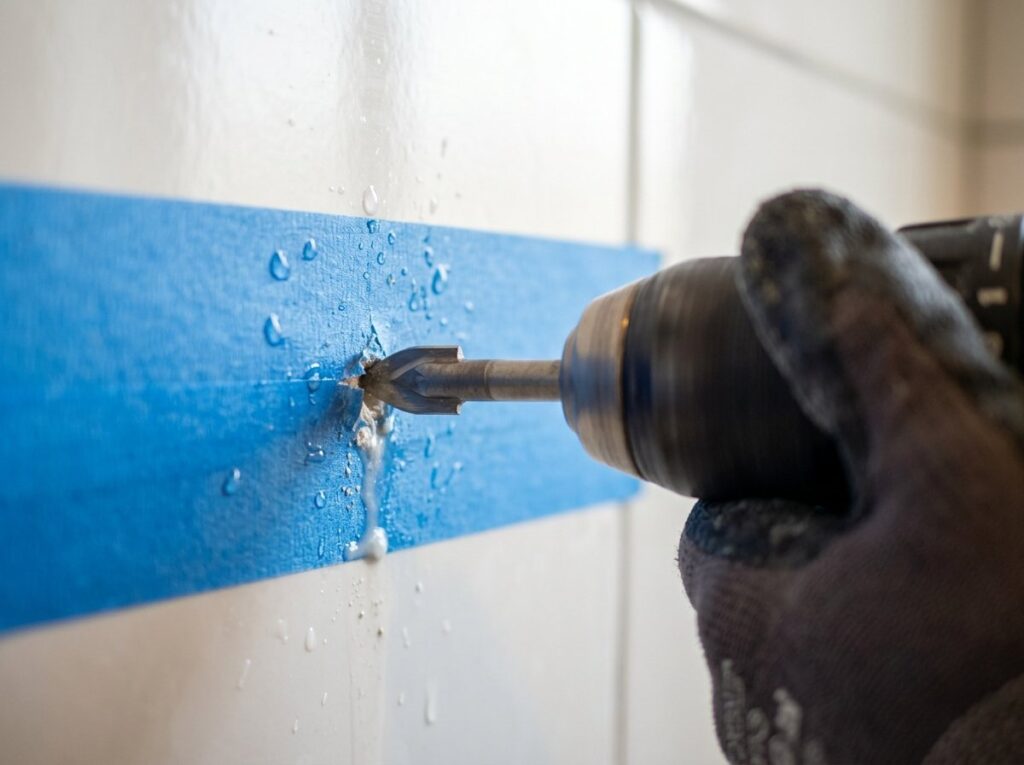
Tile and glass bits have a spear-shaped carbide tip that scrapes through hard glaze without cracking it. For dense porcelain, natural stone and larger holes, diamond core bits and diamond hole saws cut faster and cleaner. Both need low speed, no hammer action and constant water cooling.
Driver bits
Driver bits aren’t for drilling at all, but they’re part of every kit. Phillips, square (Robertson), star (Torx), hex and slotted bits turn your drill or impact driver into a power screwdriver. If you use an impact driver, choose bits marked impact-rated, which are made to flex under the hammering blows instead of snapping. See our guide to impact driver vs drill for when each tool makes sense.
Drill bit materials and coatings explained
The color of a bit usually tells you its material or coating, which decides how well it handles heat. Heat is what dulls bits, especially in metal.
High-carbon steel
The cheapest bits are plain carbon steel. They drill wood and plastic fine but soften and dull quickly if they overheat in metal. They make sense for occasional wood projects only.
High-speed steel (HSS)
HSS holds its edge at higher temperatures than carbon steel and is the standard for general-purpose twist bits. It drills wood, plastic and mild steel well. If the price difference is small, choose HSS over carbon steel.
Black oxide
Black oxide is a surface treatment on HSS bits. It reduces friction, resists rust and helps the bit handle heat a little better than bright HSS, which makes it a good everyday choice for a homeowner’s set.
Titanium-coated
Gold titanium nitride coating adds a hard, slick outer layer that extends bit life in wood and mild metal. The coating is only on the surface, so once you resharpen the bit, the benefit is gone from the cutting edge.
Cobalt
Cobalt bits are HSS alloyed with cobalt throughout, so they keep their hardness even when sharpened. According to this cobalt drill bit buying guide, M35 bits contain 5 percent cobalt and M42 bits contain 8 percent, and more cobalt means more heat resistance. Save them for stainless steel, cast iron and hard alloys, since they’re costly for wood.
Carbide and diamond
Tungsten carbide is extremely hard and is used for the tips of masonry and tile bits. Diamond grit goes one step further for porcelain, glass and stone. Both are brittle, so avoid dropping them or using them on materials they weren’t made for.
Shank types: will the bit fit your drill?
- Round shank: Fits any standard three-jaw drill chuck. Most twist bits use this.
- Hex shank: A 1/4-inch hex shank fits quick-change chucks and impact drivers, and the flats stop the bit from slipping in a regular chuck.
- SDS-plus: A slotted shank that locks into rotary hammers for heavy concrete work. It won’t fit a standard drill.
- Reduced shank: Larger bits with a narrower shank so they fit a 3/8-inch or 1/2-inch chuck.
Tools and materials
- Drill/driver, plus a hammer drill for masonry
- Twist bit set (HSS or black oxide) and driver bits
- Masonry bits and a tile or glass bit if you work on those surfaces
- Center punch, painter’s tape and a marker
- Clamps and a scrap block for backing
- Cutting oil for metal and a spray bottle of water for tile
- Safety glasses, gloves for handling hot bits and a dust mask or respirator
Tips for drilling cleaner, safer holes
- Mark the spot and make a dimple with a center punch on metal, or apply painter’s tape on tile and glass so the bit doesn’t skate.
- Drill a small pilot hole before using a large bit in metal or hardwood.
- Match speed to bit size and material. The cobalt guide linked above suggests small bits can run near 3,000 rpm while larger bits in metal should turn no faster than about 1,000 rpm.
- Let the bit do the work with steady pressure. Pull it back every few seconds to clear chips and dust.
- Cool the bit with cutting oil on metal and water on tile. A bit that turns blue has overheated and lost its hardness.
- Clamp small pieces and keep a firm two-handed grip on large bits and hole saws, which can twist the drill hard if they catch.
Safety note: Drilling concrete, brick, stone and tile releases fine crystalline silica dust. NIOSH warns that breathing too much of it can cause silicosis, an irreversible lung disease. Mist the hole with water or use a vacuum attachment, wear a properly fitted respirator for longer jobs and always wear safety glasses.
When to call a pro
Most drilling is beginner-friendly, but some holes are worth handing off:
- Large holes through floor joists, beams or load-bearing studs, which can weaken framing
- Drilling into a slab foundation or garage floor that may contain post-tensioned steel cables
- Holes in a finished tile shower where plumbing could be behind the wall
- Any glass you aren’t sure is annealed; tempered glass shatters if drilled
- Holes near gas lines or inside electrical panels
For small jobs, a handyman is often the most affordable option. According to Angi, handymen typically charge about $40 to $140 per hour, depending on the job and your area.
Frequently asked questions
What drill bit should I use for wood?
A twist bit works for everyday holes, and a brad-point bit gives cleaner, more accurate holes. Use a spade bit for fast, rough holes larger than about 1/2 inch and a Forstner bit when the hole needs a clean, flat bottom.
Can I use a regular drill bit on concrete?
No. A standard twist bit will dull almost immediately in concrete or brick. Use a carbide-tipped masonry bit, ideally in a hammer drill.
Are cobalt bits better than titanium bits?
For hard metals, yes. Cobalt runs through the whole bit and handles high heat, while titanium is a surface coating that wears off. For wood and mild steel, titanium-coated or black oxide bits are cheaper and work well.
Do I need impact-rated bits for an impact driver?
For driver bits, yes. Standard bits can crack under an impact driver’s rapid blows. Impact-rated driver bits are built to absorb that shock and last much longer.
What size drill bit should I use for a pilot hole?
Choose a bit about the size of the screw’s inner shaft, not the threads, so the threads still bite. For wall anchors, use the exact size printed on the package. You can learn more in our guide on how to hang heavy things on drywall.
Why does my drill bit smoke or go dull so fast?
It’s usually too much speed, too little lubrication or the wrong bit for the material. Slow down, use cutting oil on metal and replace bits that look rounded or blue.
The bottom line
Most homeowners need a good set of HSS or black oxide twist bits, a set of driver bits and a few masonry bits. Add brad-point, spade or Forstner bits for woodworking, a hole saw for locks and vents, and tile or cobalt bits when a project calls for them. If you’re building your kit from scratch, our basic home tool kit guide covers the rest.