Category: Heating & Cooling

AC, furnaces, heat pumps, thermostats and air filters: keep your home comfortable all year.

  • Best Thermostat Settings for Winter (and How Much You Can Save)

    Best Thermostat Settings for Winter (and How Much You Can Save)

    Heating is one of the biggest energy costs in most homes during winter, and your thermostat controls almost all of it. The right settings can keep your family comfortable while cutting your heating bill noticeably, without buying any new equipment. The wrong settings, or constantly fiddling with the temperature, can do the opposite.

    This guide explains the best thermostat settings for winter, a simple schedule you can copy, how to adjust it for heat pumps, babies, pets and older family members, and a few common myths that cost people money every year.

    Quick answer: Set your thermostat to about 68°F (20°C) when you’re home and awake, and lower it 7 to 10 degrees while you sleep or are away. According to the U.S. Department of Energy, turning your thermostat back 7 to 10 degrees for 8 hours a day can save up to about 10% a year on heating and cooling. Never set it below 55°F (13°C) in winter, to protect your pipes.

    Why lowering the temperature saves money

    Your home loses heat to the outdoors all the time, through walls, windows, the roof and air leaks. The bigger the difference between the indoor and outdoor temperature, the faster that heat escapes. When you lower your thermostat, the inside of your home gets closer to the outdoor temperature, so it loses heat more slowly, and your system runs less.

    That’s also why a common belief is wrong: for most furnaces, letting the house cool down and then reheating it uses less energy than keeping it warm all day. The energy you “spend” reheating is less than the energy you saved while the temperature was lower.

    The best winter thermostat schedule

    Here’s a simple, effective schedule for a typical household with a gas or electric furnace. Adjust the times to match your routine.

    Time of daySituationSuggested setting
    Morning (wake up)Home and active68°F (20°C)
    DaytimeEveryone away60 to 62°F (16 to 17°C)
    EveningHome and active68°F (20°C)
    NightSleeping60 to 65°F (16 to 18°C)
    VacationHouse empty55°F (13°C) minimum

    Schedule the warm-up to start about 30 minutes before you wake up or get home, so the house is comfortable when you need it.

    The ideal temperature for sleeping

    Many sleep experts suggest a bedroom temperature somewhere in the low to mid 60s Fahrenheit for good sleep, which happens to line up well with energy savings. Use warmer bedding, flannel sheets or an extra blanket instead of turning up the heat. If one family member runs cold, a heated mattress pad uses far less energy than heating the whole house.

    Adjusting for your situation

    Homes with heat pumps

    Heat pumps work best with small, steady changes. A large setback can trigger expensive auxiliary heat when the system tries to recover quickly in the morning. Keep setbacks to about 2 to 4 degrees, or use a thermostat with adaptive or smart recovery designed for heat pumps, which warms the house gradually using the heat pump instead of the backup strips.

    Babies and young children

    Infants can’t regulate their temperature as well as adults. Keep the nursery at a comfortable, stable temperature, follow your pediatrician’s guidance, and dress the baby appropriately rather than relying on heavy blankets in the crib.

    Older adults and people with health conditions

    Older adults and people with certain medical conditions may be more sensitive to cold. A warmer setting, often around 68 to 70°F during the day, may be more appropriate. Comfort and safety come before savings.

    Pets

    Most healthy dogs and cats handle a cooler house well, but small, short-haired, very young or older pets may need extra warmth. Leave a warm bed or blanket available, and don’t drop the temperature below about 60°F for long periods if your pet is sensitive to cold.

    When you travel

    Set the thermostat to around 55°F (13°C) or a little higher, not off. Turning the heat off completely risks frozen pipes, which can cause far more damage than you’d save.

    Finger adjusting a programmable wall thermostat

    Programmable vs. smart thermostats

    A programmable thermostat lets you set a daily schedule so you don’t have to remember to change the temperature. It only saves money if you actually program it and leave the schedule alone.

    A smart thermostat goes further. Depending on the model, it can learn your routine, adjust automatically when everyone leaves using your phone’s location, let you change settings from anywhere, show your energy use, and send alerts if your home gets too cold. Look for one that’s ENERGY STAR certified and compatible with your heating system. Many utilities offer rebates on smart thermostats, so check before you buy.

    Pro tip: Install your thermostat on an interior wall, away from windows, doors, direct sunlight, lamps and heating vents. A thermostat in a sunny spot or near a drafty door will read the wrong temperature and run your system at the wrong times.

    Common thermostat myths

    Myth: Cranking the thermostat heats the house faster

    Most furnaces deliver heat at the same rate no matter how high you set the thermostat. Setting it to 80°F won’t warm a cold house faster than setting it to 68°F. It just means the system keeps running past your comfort point and wastes energy.

    Myth: It takes more energy to reheat a cold house

    For most furnace systems, the savings from a lower temperature while you’re away or asleep outweigh the energy used to warm the house back up. Heat pumps are the main exception, and the fix is small setbacks or smart recovery.

    Myth: Closing vents in unused rooms saves money

    In many forced-air systems, closing vents increases pressure in the ductwork, which can reduce efficiency and push air out through duct leaks. It’s usually better to keep vents open and manage temperature with the thermostat.

    More ways to stay warm and spend less

    • Seal drafts around doors and windows with weatherstripping and caulk.
    • Run ceiling fans clockwise on low to gently push warm air from the ceiling back down.
    • Open curtains on sunny days to let in free solar heat, and close them at night to hold warmth in.
    • Replace your furnace filter every 1 to 3 months for better airflow and efficiency.
    • Keep humidity comfortable. Slightly humid air feels warmer. Many experts recommend keeping indoor humidity in roughly the 30 to 50% range to balance comfort and avoid moisture problems.
    • Schedule an annual tune-up so your system runs at peak efficiency.

    How to set up a winter schedule in 5 minutes

    If you’ve never programmed your thermostat, or you set it up years ago and forgot about it, here’s a quick way to get a schedule running today.

    1. Write down your routine. Note when the first person wakes up, when the house empties on weekdays, when people get home and when everyone goes to bed. Weekends usually need a separate schedule.
    2. Pick two temperatures. Choose a “comfort” temperature for when you’re home and awake (start with 68°F) and a “setback” temperature for sleep and empty-house periods (start 7 to 10 degrees lower, or 2 to 4 degrees lower with a heat pump).
    3. Enter the time blocks. Most thermostats use four periods: Wake, Leave, Return and Sleep. Set each one to start about 30 minutes before you need the house warm.
    4. Set weekends separately. Many thermostats let you copy weekdays and then adjust Saturday and Sunday.
    5. Live with it for a week. Resist the urge to override it constantly. After a week, adjust a time or temperature by a degree or two if something feels off.

    Signs your thermostat itself is the problem

    Sometimes high bills or uneven comfort aren’t about settings at all. Your thermostat may need attention if the screen is blank or flickering, the temperature it shows doesn’t match a reliable thermometer placed next to it, the heat turns on and off in very short cycles, or the system keeps running after the setpoint is reached. Start by replacing the batteries and gently cleaning dust from inside the cover. If the readings are still off, the thermostat may be badly located or failing, and replacing it is usually an affordable fix. If you’re installing a new one yourself, turn off power to the system at the breaker first and label the wires before disconnecting anything.

    Zoned homes and multiple thermostats

    If your home has more than one thermostat, each controls its own zone. Use that to your advantage: keep living areas at your comfort temperature in the evening and let bedrooms or a rarely used upstairs sit a few degrees cooler. Avoid setting neighboring zones very far apart, though, because the warmer zone will keep losing heat to the cooler one and run more than it needs to.

    Frequently asked questions

    What is the most energy-efficient thermostat setting in winter?

    Around 68°F while you’re home and awake, with a lower setting while sleeping or away, is a widely recommended balance of comfort and efficiency.

    Is 72°F too high for winter?

    It’s not unsafe, and some households prefer it, but every degree higher increases heating costs. Try lowering it a degree at a time and adding a sweater; many people adjust quickly.

    Should I turn the heat off when I leave for work?

    Lower it rather than turning it off. A setback to the low 60s saves energy while keeping pipes safe and making recovery faster.

    What’s the lowest safe temperature for a house in winter?

    Keep it at 55°F or higher to reduce the risk of frozen pipes, and higher if anyone at home is vulnerable to cold.

    Do smart thermostats really save money?

    They can, mainly by automating setbacks you might otherwise forget. Savings depend on your climate, your system and how you used your old thermostat.

    The bottom line

    The best thermostat strategy for winter is simple: about 68°F when you’re home and awake, a 7 to 10 degree setback while you sleep or are away, and never below 55°F. Use smaller setbacks with a heat pump, put comfort first for babies, older adults and sensitive pets, and let a programmable or smart thermostat do the remembering for you. Combined with a few draft-sealing fixes, those settings can make a real dent in your winter energy bills.
  • Heat Pump Not Heating in Cold Weather? Causes and Fixes

    Heat Pump Not Heating in Cold Weather? Causes and Fixes

    Heat pumps have become one of the most popular ways to heat a home, and for good reason: they’re efficient, they cool in summer, and modern models handle cold weather far better than older ones. But when the temperature drops, many owners start to worry. The air from the vents feels lukewarm, the outdoor unit is steaming or covered in frost, and the house struggles to stay comfortable.

    Some of that is completely normal. Some of it is a sign something needs attention. This guide explains how a heat pump behaves in cold weather, how to tell normal from a problem, and the fixes you can safely try yourself before calling an HVAC technician.

    Quick answer: Make sure the thermostat is set to Heat (not Emergency Heat), replace the air filter, check both breakers, and clear snow and ice from around the outdoor unit. Steam and a short pause during a defrost cycle are normal. A unit that stays encased in ice, a fan that won’t spin, or a house that can’t stay warm even with backup heat needs a professional.

    How a heat pump heats your home

    A heat pump doesn’t burn fuel to make heat. It moves heat. Even cold outdoor air contains heat energy, and the outdoor unit uses refrigerant to absorb it and carry it inside, where it’s released through the indoor coil. That’s why heat pumps can deliver more heat energy than the electricity they use.

    The catch is that the colder it gets outside, the less heat there is to capture, and the harder the system works. Older and standard heat pumps lose capacity as temperatures fall and often rely on an auxiliary heat source, usually electric heat strips or a furnace in a dual-fuel system, to make up the difference on very cold days. Newer cold-climate heat pumps are designed to keep working efficiently well below freezing.

    What’s normal in cold weather

    Air that feels lukewarm

    Heat pump air usually comes out cooler than furnace air. A gas furnace might blow very hot air in short bursts, while a heat pump delivers warm air for longer, steadier cycles. If your home holds its temperature, lukewarm air at the vent is normal. Holding your hand right up to the vent is less useful than watching whether the house stays comfortable.

    Long run times

    In cold weather a heat pump may run almost continuously. That’s how it’s designed to work, and it’s often more efficient than frequent starts and stops.

    The defrost cycle

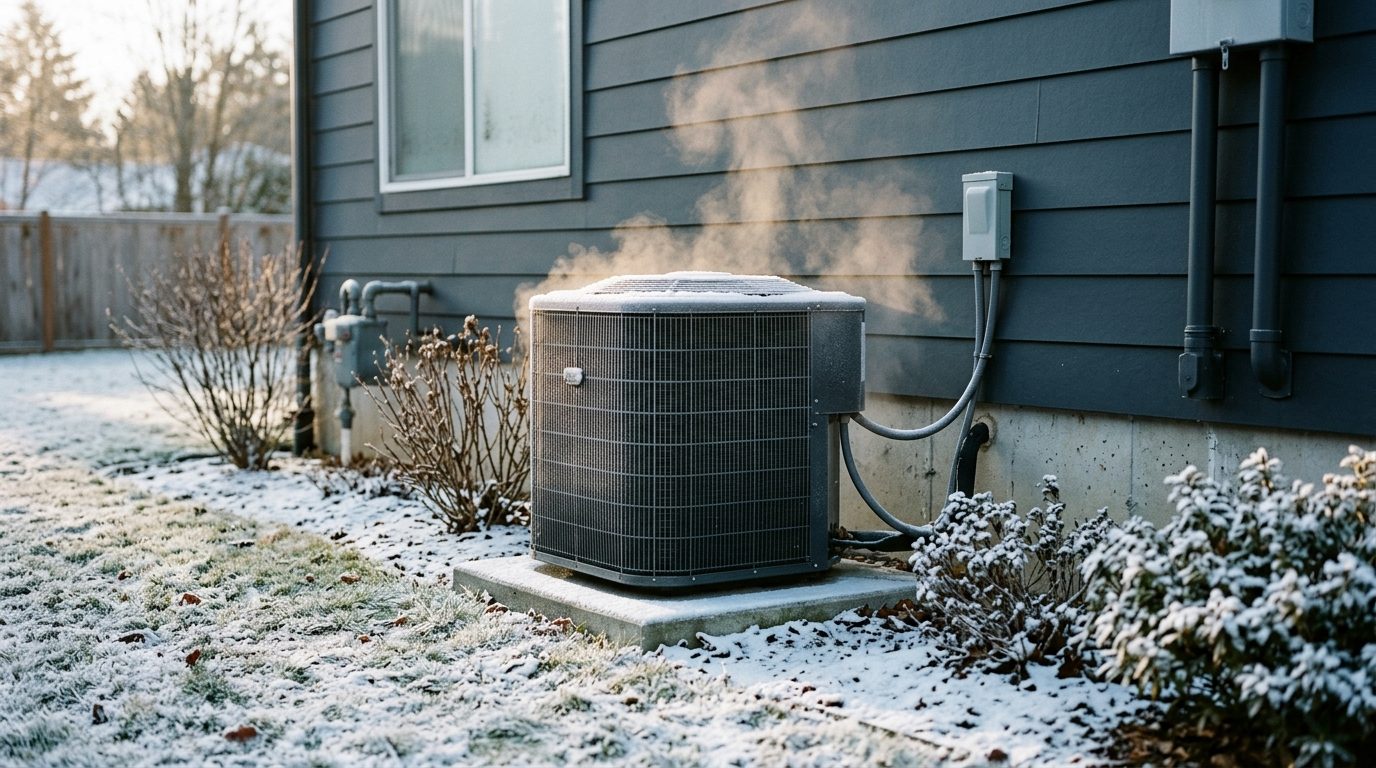
    When it’s cold and humid, frost builds up on the outdoor coil. Every so often, the heat pump switches into defrost mode to melt it. During defrost, the outdoor fan usually stops, you may hear a whoosh, and steam rises from the unit. Inside, the air may feel cooler for a few minutes, and auxiliary heat may switch on. A defrost cycle typically lasts several minutes, after which the system returns to normal heating. This is expected behavior, not a malfunction.

    “Aux heat” on the thermostat

    Seeing “Aux” or “Auxiliary Heat” on your thermostat during defrost, on very cold days, or when you raise the temperature a lot at once is normal. It’s the system’s backup helping out.

    Troubleshooting: 9 things to check

    1. Thermostat mode and settings

    Confirm the thermostat is set to Heat and the setpoint is above the current temperature. Make sure it isn’t set to Emergency Heat (often shown as “Em Heat”). Emergency heat shuts off the heat pump and runs only the backup heat, which works but can be very expensive to run with electric strips. Use it only when the heat pump itself has failed and you’re waiting for a repair.

    2. The air filter

    A clogged filter restricts airflow, reduces heating output and can make the system overheat or freeze up. Check it monthly in winter and replace it when it’s dirty.

    3. Both breakers

    Heat pump systems usually have at least two circuits: one for the outdoor unit and one for the indoor air handler, and sometimes a separate one for the heat strips. Check your panel for tripped breakers and reset any that are off once. If a breaker trips again, stop and call a technician. There may also be a disconnect switch in a box near the outdoor unit; make sure it’s on.

    4. Snow, ice and debris around the outdoor unit

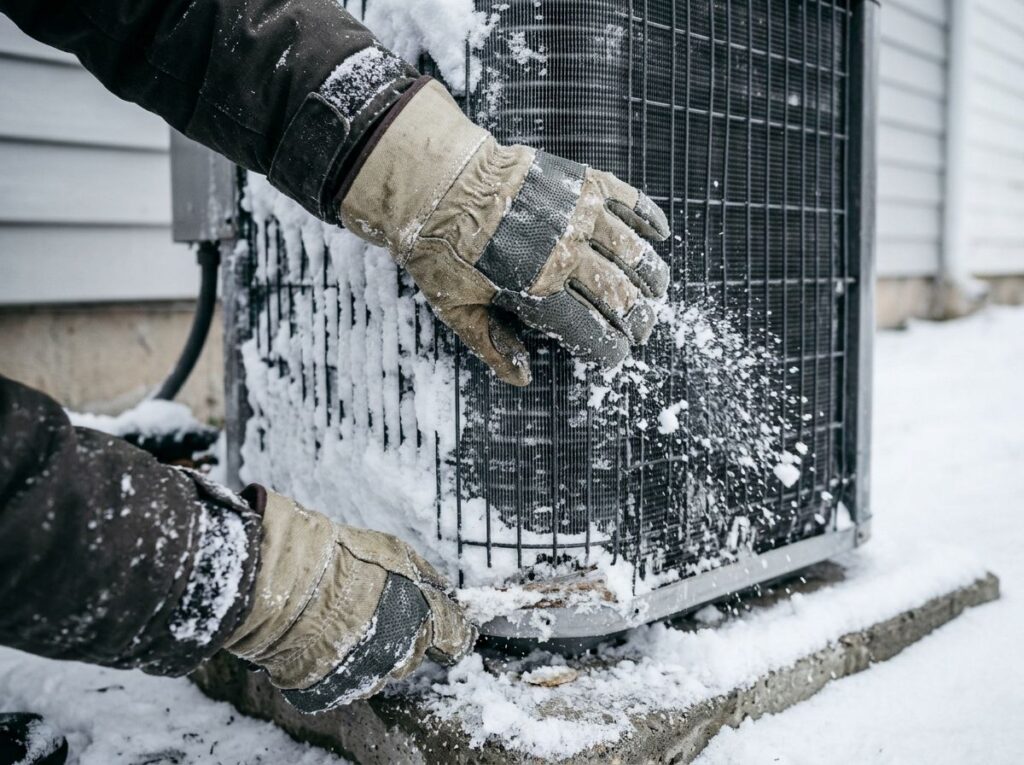
    The outdoor unit needs to breathe. Keep at least a couple of feet of clear space around it and make sure snow isn’t piled against the sides or covering the top. Gently brush away loose snow with a soft broom. Don’t chip at ice with a sharp tool, which can puncture the coil.

    Gloved hands clearing snow away from an outdoor heat pump

    5. Ice that won’t go away

    A light coating of frost that clears after defrost is normal. A unit that stays encased in thick ice for hours, or ice building up on the top of the unit and the fan, is not. To help it, make sure water from the roof isn’t dripping onto the unit, since a gutter overflow can freeze it solid. If ice persists, the defrost control, a sensor or the refrigerant charge may be at fault, and a technician should check it.

    6. The outdoor fan

    Apart from defrost cycles, the outdoor fan should spin when the system is heating. If the compressor hums but the fan doesn’t turn, or the fan is blocked by ice, turn the system off and call for service. Running it that way can damage the compressor.

    7. Supply and return vents

    Walk through your home and make sure vents aren’t closed or blocked by furniture, rugs or curtains. Closing vents in unused rooms can actually reduce efficiency and airflow in many systems.

    8. Thermostat setbacks

    Big temperature setbacks can work against a heat pump. When you raise the temperature by several degrees in the morning, the system may call for expensive auxiliary heat to catch up quickly. If your bills are high, try smaller setbacks of just a couple of degrees, or use a thermostat designed for heat pumps with smart recovery that warms the house gradually.

    9. Drafts and insulation

    A heat pump that keeps up fine on mild days but falls behind on cold ones may simply be losing heat as fast as it makes it. Sealing air leaks around doors and windows and adding attic insulation help any heating system, but they’re especially helpful with heat pumps.

    Normal vs. needs attention

    What you noticeUsually normal?What to do
    Steam rising from the outdoor unitYes, during defrostNothing; it should stop in minutes
    Lukewarm air at the ventsYes, if the home stays warmCheck filter and vents if rooms are cold
    “Aux heat” showing in very cold weatherYesAvoid large setbacks to reduce use
    Thick ice that doesn’t clearNoCheck for dripping water, then call a pro
    Outdoor fan not spinningNo (except in defrost)Turn system off, call a pro
    Breaker trips repeatedlyNoDon’t keep resetting; call a pro
    House can’t stay warm even with aux heatNoCall a pro

    When to call an HVAC technician

    • The outdoor unit stays frozen or the fan won’t run.
    • The system blows cold air continuously, not just during defrost.
    • You hear grinding, loud buzzing or banging from either unit.
    • Breakers trip repeatedly.
    • Your energy bills jump sharply without a change in weather or habits, which can signal the system is relying too heavily on backup heat.
    • You suspect a refrigerant leak. Refrigerant work requires a certified technician in the US, so this is never a DIY job.

    Keep your heat pump healthy all winter

    • Replace or clean the filter regularly, every 1 to 3 months depending on your home.
    • Schedule a professional checkup, ideally in the fall before heating season.
    • Keep the outdoor unit clear of snow, leaves and debris, and keep shrubs trimmed back.
    • Make sure gutters don’t drip onto the unit.
    • Consider raising the unit slightly on a stand if you live where deep snow is common.

    Frequently asked questions

    At what temperature does a heat pump stop working well?

    It depends on the model. Standard heat pumps lose capacity as temperatures fall and often lean on auxiliary heat in freezing weather. Cold-climate heat pumps are built to keep heating efficiently in much lower temperatures. Check your model’s specifications.

    Why is my heat pump blowing cold air?

    Short bursts of cooler air during defrost are normal. If cold air blows continuously, check the thermostat mode, filter and breakers. If those are fine, the system may have a reversing valve, defrost or refrigerant problem that needs a technician.

    Should I use emergency heat when it’s very cold?

    Usually not. The system automatically uses auxiliary heat when it needs help. Emergency heat is meant for when the heat pump is broken, and running it manually can raise your energy bill significantly.

    Is it normal for my heat pump to run all the time in winter?

    Yes, in cold weather long run times are normal and often efficient. Worry only if the home can’t stay at the temperature you’ve set.

    Can I pour hot water on a frozen heat pump?

    It’s not recommended as a routine fix. Let the defrost cycle work, remove the cause of the ice (like a dripping gutter), and call a technician if the ice won’t clear.

    The bottom line

    A heat pump in winter behaves differently from a furnace: cooler-feeling air, long run times, steam and occasional defrost pauses are all part of normal operation. Start with the simple checks, keep the outdoor unit clear, and avoid emergency heat unless the system has truly failed. If the unit stays iced over, the fan stops, or the house can’t stay warm, call a licensed HVAC technician before a small problem turns into a costly repair.

  • Furnace Not Turning On? 10 Fixes to Try Before Calling a Pro

    Furnace Not Turning On? 10 Fixes to Try Before Calling a Pro

    There’s no worse way to start a cold morning than a silent furnace and a house that’s getting colder by the minute. Before you call for an emergency service visit, take a breath. A surprising number of “broken” furnaces are caused by something simple: a thermostat setting, a tripped switch, a clogged filter or a loose access panel.

    This guide walks you through 10 checks to try when your furnace won’t turn on, in the order that solves the most problems fastest. Most of them take a few minutes and need no tools. You’ll also learn what the blinking status light is telling you, and which problems are a clear sign to call a licensed HVAC technician.

    Quick answer: Check that the thermostat is set to Heat and above room temperature, replace its batteries, and make sure the furnace’s power switch and breaker are on. Replace a dirty air filter, confirm the furnace door is closed tightly, and check that the gas valve is open. If the furnace starts and then shuts off, a dirty flame sensor is a common cause.

    First, stay safe

    Safety note: If you smell gas (a rotten egg odor), don’t touch any switches, don’t try to light anything, and leave the house immediately. Call your gas utility or 911 from outside. If your carbon monoxide alarm is sounding, get everyone out and call for help. Don’t attempt any troubleshooting in either situation.

    10 things to check when your furnace won’t turn on

    1. Check the thermostat settings

    It sounds too obvious, but it’s the most common cause. Make sure the thermostat is set to Heat, not Cool, Off or Auto in a way you didn’t expect. Raise the temperature setting at least 3 to 5 degrees above the current room temperature. If you have a programmable or smart thermostat, check that a schedule, vacation mode or an app setting isn’t overriding your choice.

    2. Replace the thermostat batteries

    Many thermostats run on AA or AAA batteries even if they’re wired to the system. A blank or dim screen is the giveaway, but weak batteries can cause problems before the display dies. Swap them for fresh ones and wait a few minutes.

    3. Check the breaker and the furnace switch

    Your furnace needs electricity even if it burns gas, because the blower, igniter and control board are electric. Look at your electrical panel for a tripped breaker labeled “furnace” or “HVAC” and reset it once. Then find the furnace service switch, which usually looks like an ordinary light switch on or near the furnace. It’s easy to flip off by accident, mistaking it for a light. Make sure it’s on.

    4. Make sure the access panel is closed

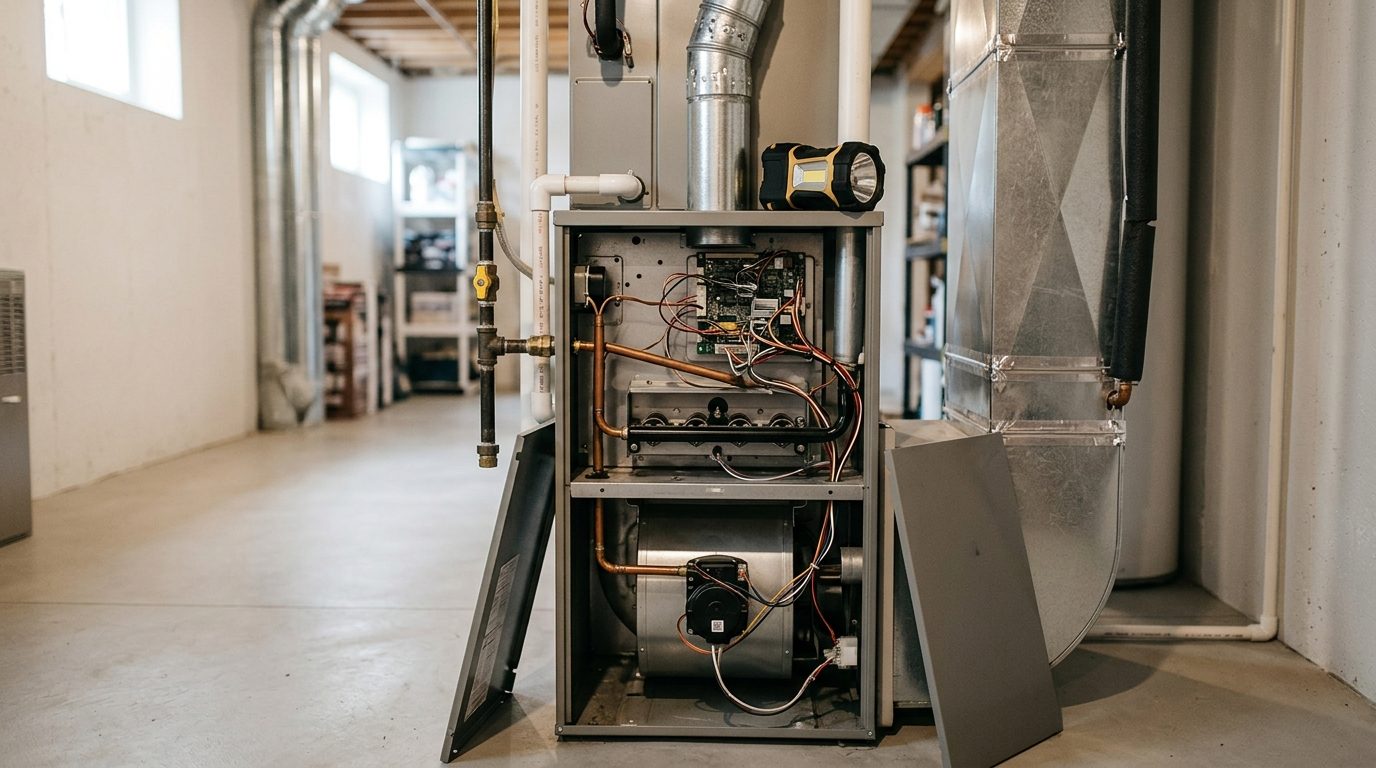
    Most furnaces have a safety switch that cuts power when the front panel is removed. If someone changed the filter and didn’t seat the panel fully, the furnace won’t run. Remove the panel and reinstall it firmly so it pushes in the small switch behind it.

    5. Replace a dirty air filter

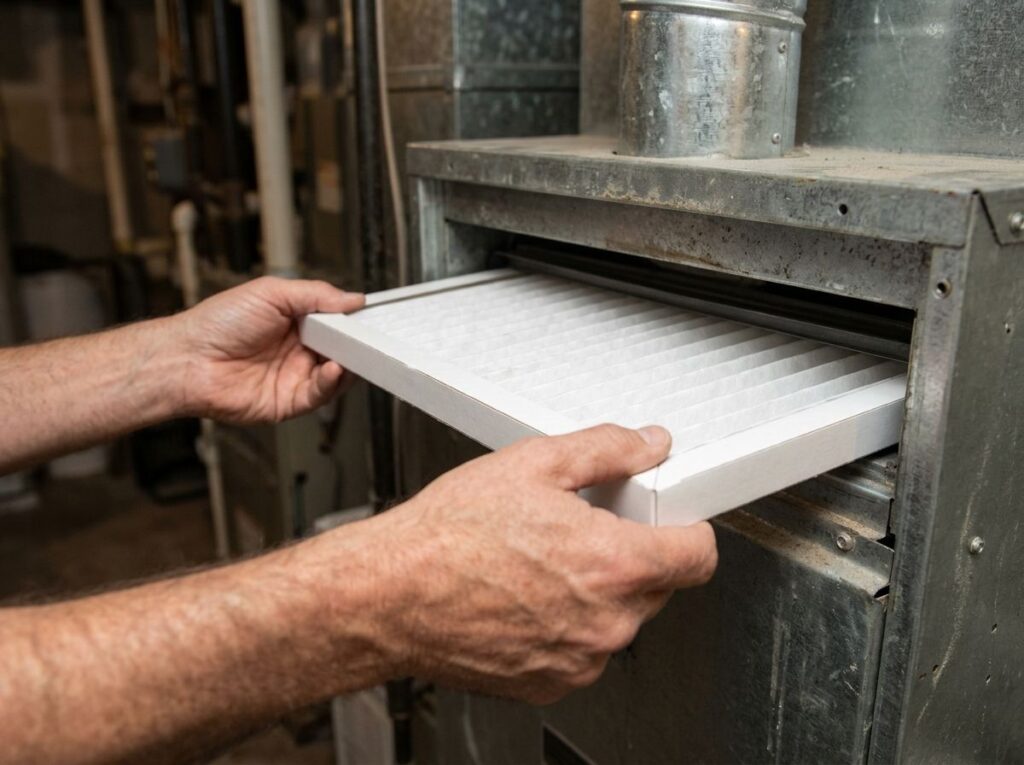
    A clogged filter chokes airflow. The furnace can overheat, trip its high-limit safety switch and shut itself down, sometimes cycling on and off before stopping completely. Slide out the filter and hold it up to a light. If you can’t see light through it, replace it. Note the size printed on the frame and the airflow arrow, which should point toward the furnace.

    Hands sliding a new pleated air filter into a furnace

    6. Check the gas supply

    Find the gas line leading into the furnace and the shut-off valve on it. When the handle is parallel to the pipe, the valve is open. If it’s perpendicular, it’s closed. Also check whether other gas appliances, like your stove or water heater, are working. If none of them are, the problem may be with your gas service, and you should contact your utility.

    7. Read the status light

    Most modern furnaces have a small window on the lower panel where you can see an LED on the control board. Steady or slow blinking usually means normal operation, while a specific pattern of blinks is an error code. The code chart is usually printed on a label inside the furnace door. Write down the pattern, since it can point you or your technician straight to the problem, such as an ignition failure or a pressure switch fault.

    8. Clean the flame sensor

    If your furnace starts, the burners light, and then shut off after a few seconds, the flame sensor is a prime suspect. It’s a thin metal rod that sits in the burner flame and confirms that gas is burning. When it gets coated with residue, the furnace can’t “see” the flame and shuts off the gas as a safety measure.

    1. Turn off power at the furnace switch and close the gas valve.
    2. Remove the access panel and locate the sensor near the burners. It’s usually held by a single screw.
    3. Remove it carefully and gently clean the metal rod with a fine abrasive pad or fine-grit emery cloth. Don’t touch the rod with bare fingers more than you need to.
    4. Reinstall it, restore gas and power, and test.

    If you’re not comfortable working near the burner assembly, this is a quick and inexpensive job for a technician.

    9. Check the condensate line (high-efficiency furnaces)

    High-efficiency furnaces produce water as they run. It drains through a plastic tube, sometimes into a small pump. If the line clogs or the pump fails, a safety switch can stop the furnace. Look for water around the furnace, a full condensate pump reservoir, or a kinked line. Clearing the line, or emptying and cleaning the pump, can get the furnace running again.

    10. Clear the intake and exhaust vents

    High-efficiency furnaces often vent through two plastic pipes on an outside wall or the roof. Snow, ice, leaves or a bird’s nest can block them, and the furnace will refuse to run. After a snowstorm, check these pipes and gently clear any blockage. Never block them with decorations, firewood or snow piles.

    Symptoms and likely causes

    What’s happeningLikely causeWhat to try
    Nothing at all, thermostat blankDead batteries, tripped breakerNew batteries, reset breaker
    Thermostat on, furnace silentSwitch off, panel loose, no powerFurnace switch, reseat panel
    Starts, then shuts off in secondsDirty flame sensorClean flame sensor
    Runs a few minutes, then stopsClogged filter, overheatingReplace filter, open vents
    Blower runs, air is coldIgnition or gas problemCheck gas valve, status light
    Water around the furnaceClogged condensate line or pumpClear line, check pump

    Prevent furnace problems before winter

    • Replace the air filter every 1 to 3 months during heating season.
    • Schedule a professional tune-up every fall, before the first cold snap.
    • Keep the area around the furnace clear of storage, laundry and anything flammable.
    • Keep supply and return vents in your rooms open and unblocked by furniture.
    • Test your carbon monoxide alarms monthly and replace them according to the manufacturer’s guidance.
    • Clear outdoor vent pipes after snow or storms.

    When to call an HVAC professional

    Some problems are not DIY territory. Call a licensed technician if:

    • The furnace locks out repeatedly or keeps tripping the breaker.
    • You hear loud banging, grinding or screeching from the unit.
    • You see soot, scorch marks or a yellow, flickering burner flame instead of a steady blue one.
    • The status light shows an error code you can’t resolve with the basic checks.
    • You suspect a problem with the igniter, gas valve, blower motor, control board or heat exchanger.
    • The furnace is old and needs frequent repairs. A technician can tell you whether repair or replacement makes more sense.

    How furnace ignition works (and why it matters)

    Knowing which type of ignition your furnace uses helps you troubleshoot. Older furnaces often have a standing pilot light, a small flame that burns all the time. If it goes out, the burners can’t light. You can usually see it through a small window, and relighting instructions are printed on a label inside the door. Follow them exactly, and if the pilot won’t stay lit, the thermocouple may need replacing.

    Most furnaces built in the last couple of decades use electronic ignition instead. A hot surface igniter glows bright orange, or an intermittent pilot sparks, only when the furnace calls for heat. A hot surface igniter is fragile and eventually wears out. If you can see the igniter not glowing during startup, or it shows a visible crack, it needs to be replaced, which many homeowners leave to a technician because the part must match the furnace exactly.

    On either type, listen to the startup sequence: the draft inducer fan hums first, then you’ll hear the igniter click or see it glow, the burners light, and finally the main blower kicks on. Noting where that sequence stops is one of the most useful things you can tell a technician.

    Frequently asked questions

    Why does my furnace turn on and then shut off right away?

    The most common reasons are a dirty flame sensor, a clogged air filter that causes overheating, or a blocked vent. Start with the filter, then the flame sensor.

    Is there a reset button on a furnace?

    Some furnaces have a reset button on the blower motor or control board, and turning the power off and on can also reset the control board. Don’t reset a furnace over and over. If it keeps shutting down, something is causing it, and repeated resets can make things worse.

    How long should a furnace last?

    Many gas furnaces last 15 to 20 years with regular maintenance. Annual tune-ups and regular filter changes help it reach that range.

    Can a dirty filter really stop a furnace?

    Yes. Restricted airflow causes the heat exchanger to overheat, and a safety switch shuts the burners off. A new filter is one of the cheapest and most common furnace fixes.

    What temperature should I set my furnace to in winter?

    Around 68°F while you’re home and awake is a common recommendation for balancing comfort and energy use. Lowering it while you sleep or are away saves more.

    The bottom line

    When your furnace won’t turn on, work through the simple checks first: thermostat, batteries, power, panel, filter and gas. Those solve a large share of no-heat calls. If the furnace lights and immediately shuts off, the flame sensor is the next suspect. And if anything involves a gas smell, repeated lockouts or internal parts, call a licensed HVAC pro. Your safety is worth more than the service fee.