
You’ve got a heavy mirror, a floating shelf or a framed print that needs to go up, and the spot you want is nowhere near a stud. You’ve also seen what happens when a cheap plastic anchor lets go: a ragged hole in the drywall and something broken on the floor.
This guide shows you how to hang heavy things on drywall so they stay put. You’ll learn how to use studs first, which anchor types hold how much according to manufacturer data, how to install them properly, and what changes for mirrors, shelves and old plaster walls.
Quick answer: Screw into a stud whenever you can, using a screw long enough to bite at least 2 inches into the wood. Where there’s no stud, use toggle bolts, strap toggles or molly bolts for anything heavier than a light frame, and choose an anchor whose rating is well above the item’s weight. Use at least two fasteners for heavy items and never trust the little plastic anchors that come in the box.
Start with the weight and how it pulls
Weigh the item
Guessing is how anchors fail. Stand on a bathroom scale holding the item, note the number, then weigh yourself without it and subtract. Add the weight of anything that will sit on it, like books on a shelf.
Shear vs pull-out
A mirror hanging flat against the wall mostly loads its fasteners in shear, meaning the weight pushes straight down along the wall. A shelf, coat rack or TV arm also pulls the top fasteners outward, which is called tension or pull-out. Anchors hold far less in pull-out than in shear, so check both numbers on the package.
Leverage matters
The farther the weight sits from the wall, the harder it pries on the top fasteners. A manufacturer of heavy-duty toggles notes in its product data that holding strength drops as the load moves away from the wall. That’s why a deep shelf loaded at its front edge fails sooner than a mirror of the same weight.
Use studs first
A screw driven into a wood stud is stronger and more predictable than any hollow-wall anchor. Use a stud finder, a strong magnet that finds drywall screws, or the other methods in our guide on how to find a stud. Studs are usually 16 inches apart on center, and sometimes 24 inches in newer homes.
Choose a screw long enough to reach at least 2 inches into the wood: about 2-1/2 inches for 1/2-inch drywall, or 3 inches for thicker plaster. Pre-drill a pilot hole so the stud doesn’t split.
When the item is wider than the stud spacing, bridge the studs. A French cleat works well: rip a strip of 3/4-inch plywood at a 45-degree angle, screw one half level into two or more studs and the other half to the back of the item, then hook them together. A wood rail screwed into the studs does the same job for shelves.
Drywall anchor types and what they hold
When a stud isn’t where you need it, the anchor does the work. The figures below are one manufacturer’s published safe loads in 1/2-inch drywall, taken from Cobra Anchors product data. Other brands and sizes differ, so always read the package for the exact anchor you buy.
| Anchor type | Hole needed | Safe pull-out (lb) | Safe shear (lb) | Best for |
|---|---|---|---|---|
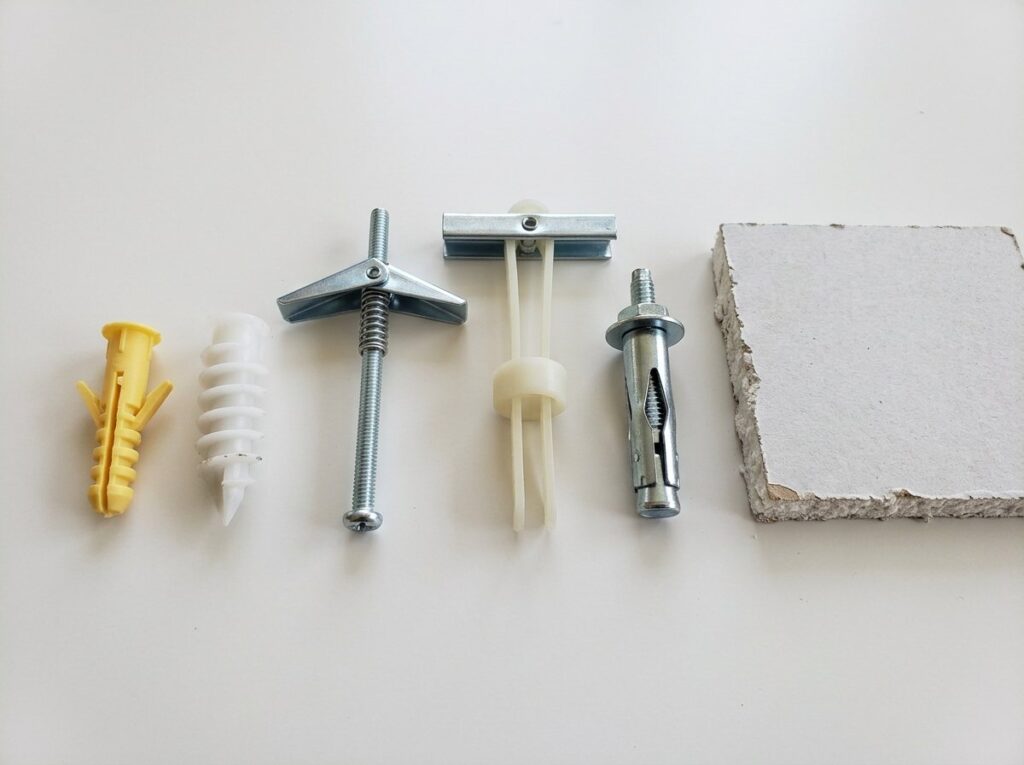
| Plastic expansion (winged, #6 to #12) | 1/4 to 3/8 in | 18 to 37 | 29 to 61 | Light frames, small decor |
| Self-drilling (#6 to #8) | None | 23 to 25 | 52 to 63 | Frames, light mirrors, curtain rods |
| Spring toggle bolt (1/8 to 1/4 in) | 1/2 to 3/4 in | 75 to 118 | 68 to 118 | Heavy mirrors, shelves, cabinets |
| Strap toggle (3/16 to 1/4 in) | 1/2 in | 67 to 74 | 106 to 137 | Shelves, TV mounts, coat racks |
| Molly bolt (1/8 to 1/4 in) | 5/16 to 7/16 in | 75 to 100 | 85 to 100 | Mirrors, towel bars, shelving |
Pro tip: Check whether a rating is a safe working load or a failure load. Some manufacturers publish the weight at which the anchor actually failed in lab tests and recommend using only one quarter of it. A strap toggle that failed at around 240 pounds in 1/2-inch drywall, for example, should carry no more than about 60 pounds.
Plastic expansion anchors
These sleeves expand as you drive a screw, pressing against the hole. Basic ribbed versions without wings are the weakest anchors on the shelf, and they’re the ones bundled with many mirrors and shelves. Use them for light frames and small decor only.
Self-drilling anchors
These have a coarse thread and a sharp tip, so you drive them straight into the drywall with a screwdriver or a drill on low speed. They’re quick and good for light to moderate shear loads, but weak in pull-out. The manufacturer above says not to use its self-drilling anchors on ceilings.
Spring toggle bolts
A spring toggle has folding wings that snap open behind the drywall and spread the load across a wide area. They’re among the strongest options, but they need a big hole, and if you remove the bolt the wings drop inside the wall. Thread the bolt through your bracket before you push the toggle into the hole.
Strap toggles
A strap toggle slides a metal channel through the hole on plastic straps, then locks it in place with a cap that sits flush with the wall. It’s strong in both directions, uses a smaller hole than a large spring toggle, and stays put if you remove the bolt. That makes it a favorite for shelves and TV mounts.
Molly bolts
Molly bolts, also called hollow wall anchors, have a metal sleeve that collapses and flares behind the drywall as you tighten the screw. They hold well in shear and let you remove and reinstall the screw. Match the molly’s grip length to your wall thickness or it won’t set properly.
Tools and materials
- Stud finder or strong magnet
- Tape measure, pencil and a level
- Drill/driver with wood and masonry bits (see our guide to types of drill bits)
- Screwdriver and painter’s tape
- Wood screws, or anchors rated well above your item’s weight
- Safety glasses
How to install a toggle or strap toggle
- Mark both fastener locations, check them with a level and scan the area for wiring and pipes.
- Drill the hole size printed on the anchor package. A hole that’s too big is the most common reason an anchor spins or pulls out.
- For a spring toggle, thread the bolt through your bracket first, then screw on the wings, fold them and push them through the hole.
- For a strap toggle, slide the channel through the hole, pull the straps toward you, slide the cap flush with the wall and snap off the straps.
- Pull outward gently on the bolt or bracket while you tighten so the wings or channel stay snug against the back of the drywall.
- Tighten until snug and stop. Overtightening crushes the drywall and weakens the hold.
Safety note: Wires and pipes often run straight up and down from outlets and switches, so avoid drilling directly above or below them. Use a stud finder with AC detection, stop if you hit metal unexpectedly, and wear safety glasses when drilling overhead.
Hanging specific heavy items
Heavy mirrors
Use two hanging points instead of one center hook. Two points keep the mirror level, split the weight and stop it from tilting. Screw into a stud on at least one side if possible, use a toggle or molly on the other, and choose D-rings on the back of the frame rather than a long wire that lets the mirror swing. For very large mirrors, a French cleat or a pair of heavy-duty brackets is the safest choice.
Shelves
Shelves pull outward, so they need pull-out strength, not just shear. Screw brackets into studs wherever possible and use strap toggles or spring toggles elsewhere. Books add up fast, so weigh a stack and plan for the shelf fully loaded.
TVs and other high-risk items
TVs, wall cabinets and anything over a bed or crib deserve extra margin. For a TV, mount into studs whenever the bracket allows it, and follow our full guide on how to mount a TV on the wall.
Hanging heavy things on plaster walls
Plaster is harder than drywall but brittle, and it often sits on wood lath strips. It cracks if you hammer into it or drive screws without a pilot hole.
- Put painter’s tape over the spot to reduce chipping.
- Drill with a masonry or carbide-tipped bit at moderate speed, without hammer mode.
- Use toggle bolts or strap toggles, which grab behind the plaster and lath. Check the anchor’s grip range, because plaster and lath together are often close to 1 inch thick.
- Skip self-drilling anchors and basic plastic sleeves, which can crumble plaster.
- If you hit wood lath, a screw into the lath works for light items, but heavy items still need a stud or a toggle.
If you damage the wall along the way, our guide on how to patch a drywall hole covers the repair.
Common mistakes to avoid
- Using the bundled plastic anchors that come with mirrors and shelves
- Drilling oversized holes, which leave anchors spinning loose
- Relying on a single fastener for a heavy item
- Overtightening self-drilling anchors until they strip the drywall
- Ignoring leverage on deep shelves and swing-arm brackets
- Forcing an anchor into a spot where you hit a stud instead of just using a wood screw
When to call a pro
Most homeowners can hang mirrors and shelves safely, but call a handyman or carpenter when:
- The item weighs more than about 100 pounds, or hangs from a ceiling
- You’re mounting a large mirror, TV or cabinet above a fireplace, bed or stairway
- Old plaster is cracked, crumbling or bulging away from the lath
- Your walls have metal studs and you’re not sure how to fasten to them
- You find wiring or plumbing exactly where the item needs to go
According to Angi, handymen typically charge about $40 to $140 per hour, depending on the job and your location.
Frequently asked questions
How much weight can drywall hold without a stud?
Drywall alone holds very little; a plain nail is only good for a light frame. With the right anchor, published safe loads in 1/2-inch drywall range from under 20 pounds for small plastic anchors to around 100 pounds or more for large toggle bolts. Check the specific anchor’s rating.
Can drywall anchors hold 50 pounds?
Some can. Spring toggles, strap toggles and molly bolts in common sizes are rated above 50 pounds in shear in 1/2-inch drywall. Use at least two anchors for a 50-pound item so no single anchor carries the full load.
Are toggle bolts stronger than drywall anchors?
Yes, in most cases. Toggles spread the load across the back of the drywall, so they hold much more than plastic or self-drilling anchors, especially in pull-out. The trade-off is a larger hole.
How do I hang a heavy mirror without studs?
Use two toggle bolts, strap toggles or molly bolts rated well above the mirror’s weight, and hang the mirror from D-rings or a cleat. Avoid a single nail or hook in the center.
Can I use drywall anchors in plaster?
Toggle bolts and strap toggles work in plaster if their grip range covers the wall’s thickness. Pre-drill with a masonry bit through painter’s tape, and avoid self-drilling and basic plastic anchors.
The bottom line
To hang heavy things on drywall, start by weighing the item and finding studs. Screw into wood wherever you can, use toggles, strap toggles or molly bolts rated well above the load where you can’t, and spread the weight across at least two fasteners. When the item is very heavy, overhead or over a fireplace, bring in a pro.