The last cut of the season is done and your mower is about to sit in the garage for four or five months. If you just park it and walk away, there is a good chance it will refuse to start in spring, usually because old gasoline has gummed up the carburetor or the battery has drained flat.
This guide covers winterizing a gas push mower, a riding mower and a cordless electric mower: fuel stabilizer versus running dry, ethanol, the oil change, spark plug, deck and blade care, batteries and storage.
Quick answer: For a gas mower, either fill the tank with fresh gas treated with fuel stabilizer and run the engine for about 10 minutes, or run it until it stops from lack of fuel, following your owner’s manual. Then disconnect the spark plug wire, change the oil, clean the deck, sharpen the blade, service the air filter and store the mower somewhere dry. Store cordless mower batteries indoors at a partial charge, and keep riding mower batteries on a maintainer.
Why winterizing a lawn mower matters
Gasoline breaks down surprisingly fast. Briggs & Stratton notes that untreated fuel can begin to degrade in as little as 30 days, and a mower sits far longer than that over winter. As fuel ages it leaves behind varnish and gum that clog the tiny passages in the carburetor.
Ethanol makes the problem worse. Most US gasoline is blended with ethanol, commonly E10 (up to 10 percent), and ethanol attracts moisture, which can cause corrosion and let water settle in the tank. Old oil, a deck caked with wet grass and a neglected battery add to the spring headaches, but all of them are easy to prevent now.
When to winterize your mower
Winterize after your final mow, once you are sure you won’t need the mower again. In much of the US that means late October or November, after the grass stops growing. If you mulch leaves with the mower, finish that first. Pick a dry, mild day, and run the engine briefly before you start, since warm oil drains more easily.
Tools and materials
- Fuel stabilizer and fresh gasoline (E10 or less, or ethanol-free)
- Engine oil of the type in your owner’s manual, drain pan and funnel
- New spark plug and a spark plug socket
- Replacement air filter, or foam filter oil
- Socket for the blade bolt, a block of wood, and a blade balancer or nail
- Metal file or bench grinder
- Plastic deck scraper, stiff brush and garden hose
- Heavy work gloves and safety glasses
- Battery maintainer (riding mowers) and a breathable cover
Safety note: Always disconnect the spark plug wire before you touch the blade or reach under the deck, so the engine cannot fire if the blade turns. Work in a well-ventilated space, keep gasoline away from flames and pilot lights, and let a hot engine cool before you handle the muffler or spark plug.
Step 1: Deal with the fuel
Stale fuel is the main reason mowers won’t start in spring, so this is the most important step. You have two good options, and your owner’s manual may say which one the engine maker prefers.
Option A: Stabilize a full tank
- Add fuel stabilizer to a can of fresh gas at the rate on the bottle, then fill the mower’s tank. Briggs & Stratton recommends storing with a full tank of treated fuel to limit condensation.
- Run the engine for about 10 minutes so the treated fuel reaches the carburetor. Stabilizer only protects the fuel it actually reaches.
Option B: Run the tank dry
- Let the tank run low on your last mow, then run the engine until it stops on its own.
- Try restarting once or twice to burn off the last fuel in the carburetor bowl. If your mower has a fuel shutoff or carburetor drain screw, the manual may tell you to use it.
Running dry avoids stale fuel entirely, while stabilizing is simpler and keeps fuel system seals from drying out. What you should avoid is the middle ground: a half tank of untreated gas left to sit until April.
Ethanol: what to put in the tank
Check the pump label every time you fill a gas can. The EPA states that E15 must not be used in nonroad engines such as lawn mowers and chain saws, and the Outdoor Power Equipment Institute advises fuel with 10 percent ethanol or less. Ethanol-free gas, where available, is a good choice for the storage fill.
Step 2: Change the engine oil
Used oil carries acids, moisture and combustion byproducts that would otherwise sit against engine parts all winter.
- Run the engine for a few minutes to warm the oil, then stop it and disconnect the spark plug wire.
- Drain the oil through the drain plug, or tip the mower over a drain pan if the manual allows it. Always tip a walk-behind mower with the air filter and carburetor side facing up.
- Refill with the grade in your manual. Many walk-behind mowers use SAE 30 or 10W-30 small-engine oil. Check the dipstick and avoid overfilling.
- Take the used oil in a sealed container to an auto parts store or recycling center that accepts it.
Many riding mowers also have an oil filter. Replace it at the same time and check the manual for the larger oil capacity.
Step 3: Replace the spark plug and air filter
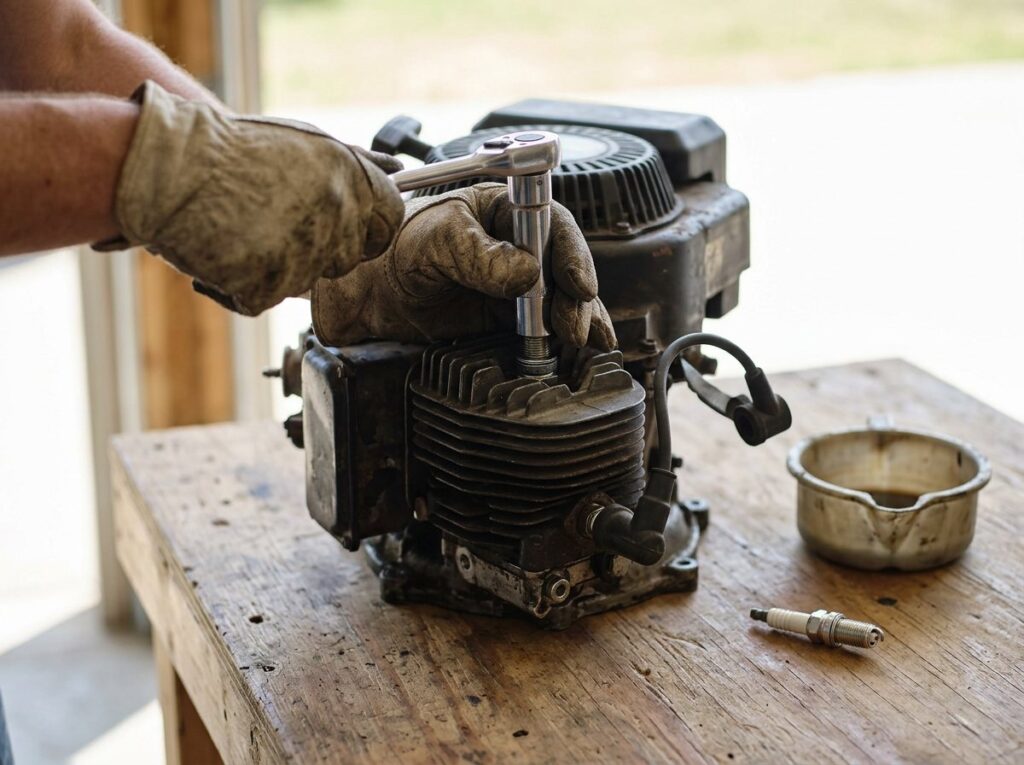
Remove the spark plug with a spark plug socket. If it is black with carbon, oily or worn, replace it, since a fresh plug makes spring starts easier. Check the gap against the manual, thread the plug in by hand, then snug it with about a quarter turn. Leave the wire disconnected until spring. If your manual calls for a little oil in the cylinder before long storage, follow its exact instructions.
Replace a paper air filter if it is dirty or crushed. Foam filters can usually be washed in warm soapy water, dried and lightly re-oiled, depending on the manufacturer.
Step 4: Clean the deck and sharpen the blade
Wet grass packed under the deck holds moisture against the steel all winter and causes rust.
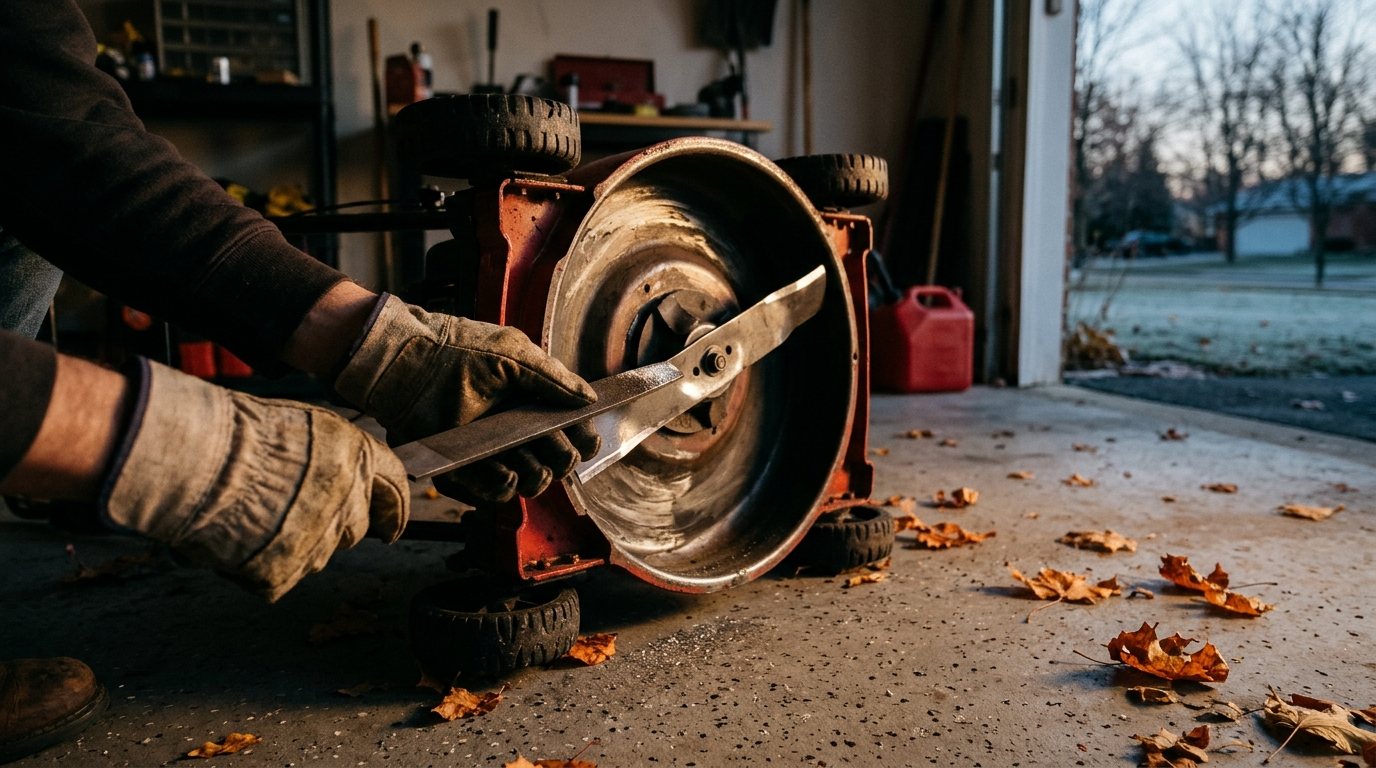
- With the plug wire off and the fuel handled, tip a push mower on its side (air filter up) or remove a riding mower deck as the manual describes.
- Scrape off caked grass with a plastic scraper and brush away the rest. If the deck has a washout port, use it as the manual directs.
- Wedge a block of wood against the blade so it cannot turn, loosen the bolt, and mark the blade’s bottom side so it goes back the right way up.
- Replace the blade if it is bent, cracked or worn thin at the tips. Otherwise, file the cutting edges at their original angle, taking the same amount from each side.
- Hang the blade on a nail or balancer. If one side drops, file a little more off that side, since an unbalanced blade causes damaging vibration.
- Reinstall the blade, tighten the bolt to the torque in the manual, and wipe the underside of the deck with a light coat of oil to slow rust.
Pro tip: Wear heavy gloves whenever you handle the blade, even a dull one. If you hit a rock or stump this season and the mower now vibrates more, have the blade adapter and crankshaft checked before storage.
Step 5: Take care of the battery
Riding mowers and electric-start gas mowers
These usually use small lead-acid batteries that slowly lose charge in storage, and a battery left discharged through a freezing winter can be ruined. Disconnect the negative (black) cable first, then the positive (red), and clean the terminals with a wire brush. Store the battery somewhere cool, dry and above freezing, or leave it in place on a battery maintainer.
Cordless electric mowers
Lithium-ion batteries do not like being stored empty or frozen. Remove the pack and keep it indoors, away from heaters and direct sun. Many guides suggest a partial charge of roughly 50 to 80 percent for storage, but your manufacturer’s instructions take priority. Then brush clippings off the deck and motor vents and sharpen the blade, since there is no fuel, oil or spark plug to deal with.
Step 6: Lubricate, inspect and store
Lubricate wheel bearings, height-adjuster pivots and cables as the manual describes. On riding mowers, check belts for cracks or glazing, grease any fittings and inflate tires to the recommended pressure. Note worn parts so you can order them over winter instead of during the spring rush.
- Keep it dry. A garage or shed is ideal. Outdoors, use a fitted waterproof cover and raise the mower off wet ground.
- Keep it away from flames. Never store a fueled mower near a furnace, water heater or anything with a pilot light.
- Use a breathable cover that keeps dust off without trapping moisture.
- Discourage rodents, which like to nest under engine shrouds and chew wiring.
- Store it level on its wheels so oil does not seep into the cylinder or air filter.
Mower storage is one item on a longer list. Our fall home maintenance checklist covers the other outdoor jobs to finish before the first hard freeze.
Winterizing checklist by mower type
| Task | Gas push mower | Riding mower | Cordless electric |
|---|---|---|---|
| Fuel | Stabilize a full tank or run dry | Stabilize a full tank or run dry | Not needed |
| Oil change | Yes | Yes, plus filter if equipped | Not needed |
| Spark plug | Inspect or replace | Inspect or replace | Not needed |
| Air filter | Clean or replace | Clean or replace | Not needed |
| Deck and blade | Clean, sharpen, balance | Clean, sharpen, check belts | Clean, sharpen, balance |
| Battery | Electric-start models only | Disconnect or use a maintainer | Store indoors at partial charge |
| Storage | Dry, level, away from flames | Dry, tires inflated, covered | Dry, battery stored separately |
Getting the mower ready in spring
When the grass starts growing, reconnect the battery and spark plug wire and check the oil. If you ran the tank dry, add fresh gas. Stabilized fuel should start normally, but it does not last forever, so replace it if the mower sat longer than one winter. If the engine still won’t start, the troubleshooting order is much the same as when a snow blower won’t start: fresh fuel and spark first, then the carburetor.
When to call a pro
Take the mower to a small-engine repair shop if you notice:
- Fuel leaking from the carburetor, fuel line or tank
- Heavy vibration after hitting an object, which can mean a bent crankshaft
- Smoke that does not clear after a minute, or oil soaking the air filter
- Surging, stalling or no start even with fresh fuel and a new plug
- Riding mower electrical faults, transmission problems or slipping belts
LawnStarter puts professional winterization at roughly $100 to $200, and blade sharpening or replacement at about $5 to $40. Shops are usually less busy now than in spring, so booking early often means a faster turnaround.
Frequently asked questions
Is it better to drain the gas or use stabilizer in a lawn mower?
Both work if done properly. Stabilizer circulated through a full tank protects the fuel system and seals, while running dry removes the fuel that would go stale. Follow your owner’s manual, and never leave untreated gas in the tank all winter.
How long can a lawn mower sit with gas in it?
Untreated gasoline can begin to degrade in about a month, so a full winter is too long without stabilizer. Stabilized fuel lasts much longer, but plan to use it up the following season.
Do I need to change the oil before storing my mower?
It is a good idea. Used oil holds contaminants that sit against engine parts all winter, and fresh oil means the mower is ready to go in spring.
Can I leave my lawn mower outside in winter?
It is better not to, because rain, snow and freeze-thaw cycles cause rust and let moisture into the fuel. If you must, use a fitted waterproof cover, raise the mower off the ground and stabilize or drain the fuel.
Should I take the battery out of my riding mower for winter?
Either remove it and store it cool, dry and above freezing, or leave it installed on a battery maintainer. What matters most is keeping it charged, because a dead battery in freezing weather may not recover.
The bottom line
To winterize a lawn mower, deal with the fuel first, then change the oil, refresh the spark plug and air filter, clean the deck, sharpen the blade and store the battery properly. It takes an hour or two and saves you a stubborn pull cord or a repair bill next spring. Add it to your winter home maintenance checklist so it happens every year.