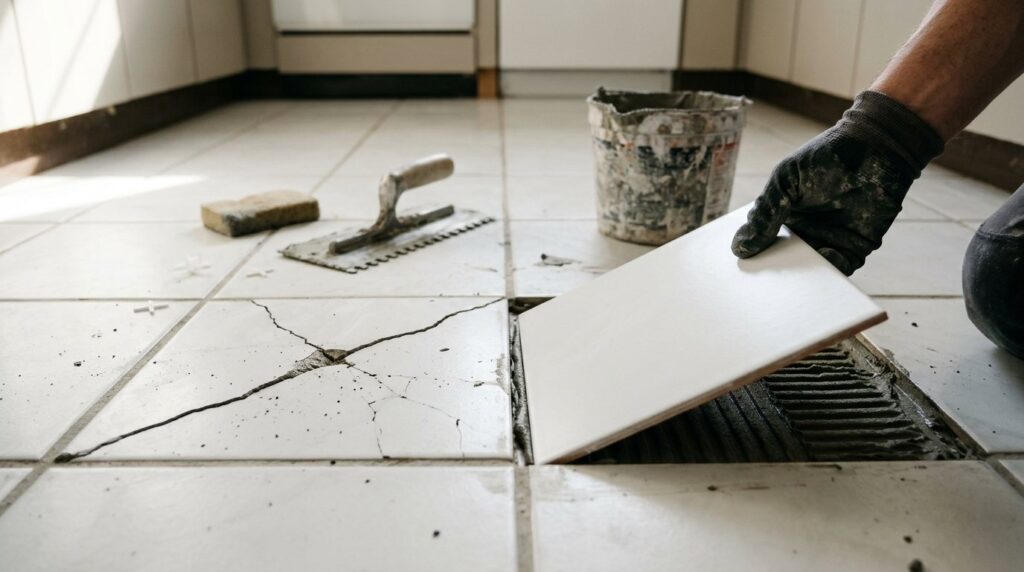
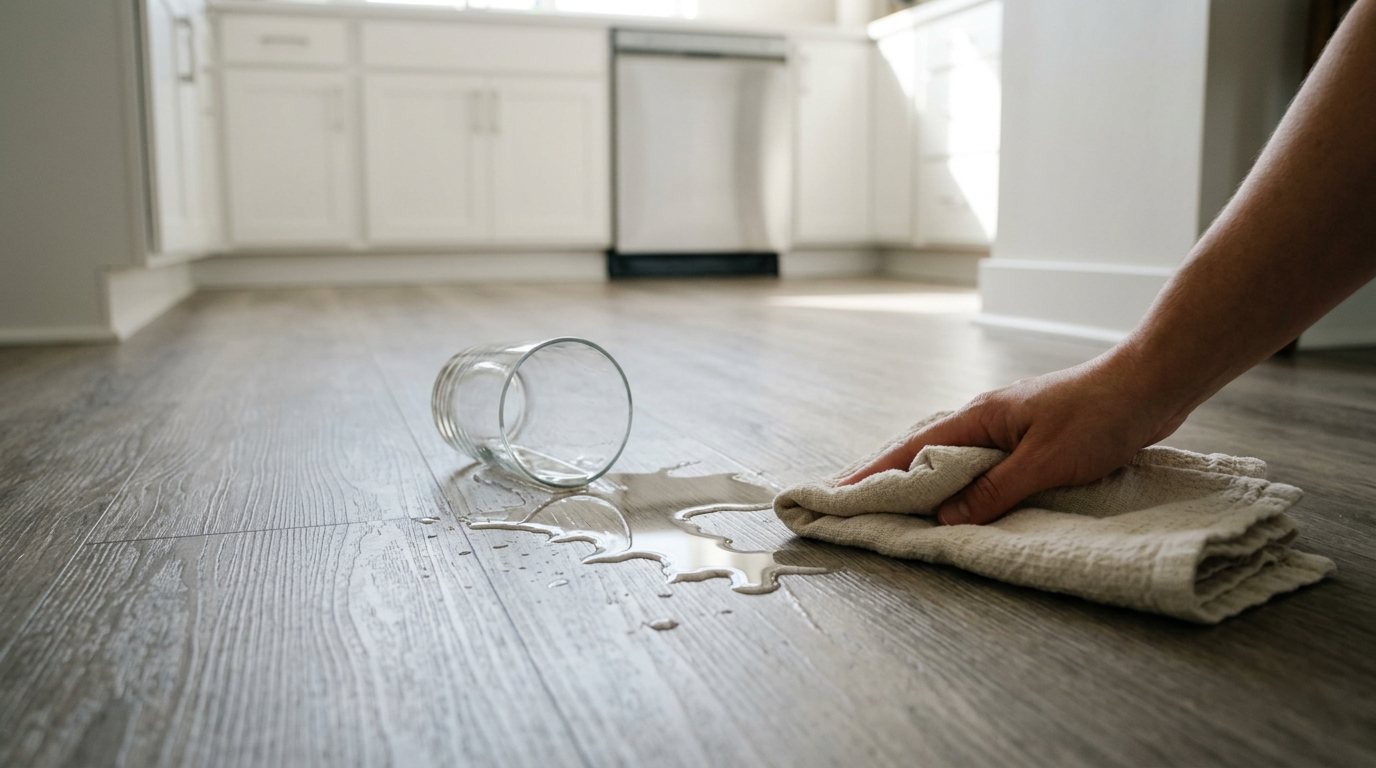
Kitchens and bathrooms are where floors fail first. A dishwasher leak, a toddler’s bath splashes or a toilet that sweats all summer can swell, stain or rot the wrong flooring in a single season. But shopping for “waterproof” flooring is confusing, because nearly every product on the shelf now claims to be water-resistant, spill-proof or waterproof.
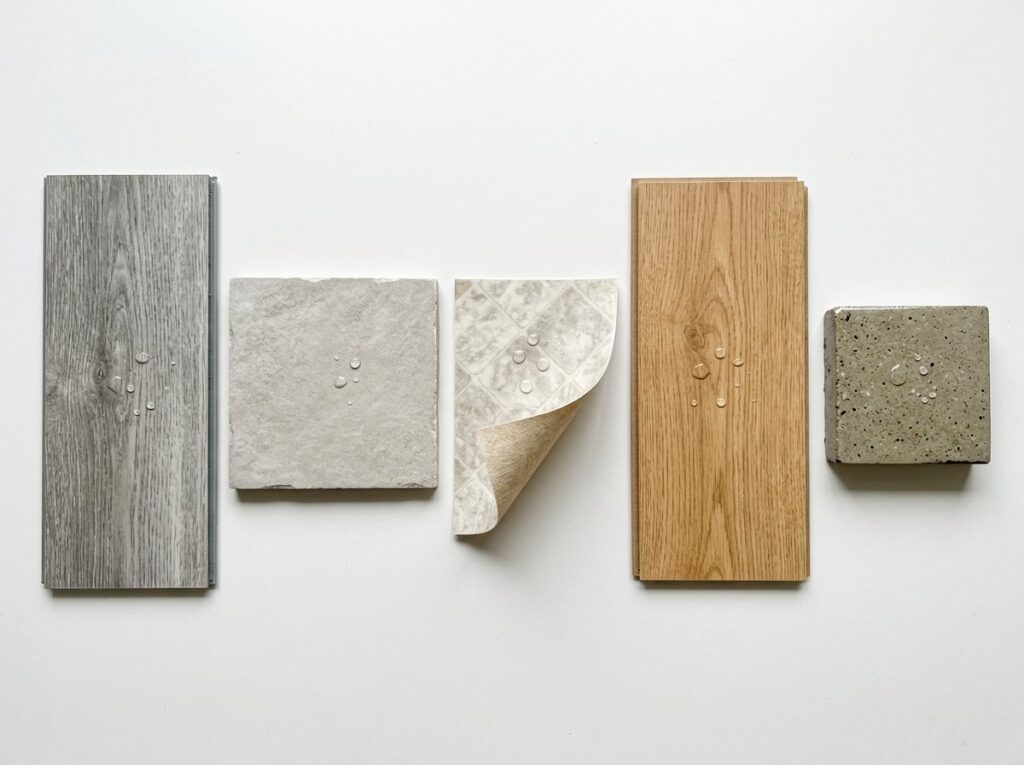
This guide explains what those labels actually mean, compares the five most practical waterproof options (rigid core vinyl plank, porcelain tile, sheet vinyl, waterproof laminate and sealed concrete) with typical costs, and tells you which works best in each room. It also covers the installation details that decide whether water stays on top of the floor or ends up underneath it.
Quick answer: For most kitchens, rigid core (SPC) luxury vinyl plank is the best balance of waterproofing, comfort, cost and DIY ease. For full bathrooms, porcelain tile or sheet vinyl handle standing water best, because tile is unaffected by water and sheet vinyl has few or no seams. Waterproof laminate suits kitchens and powder rooms, and sealed concrete works where you already have a slab.
Waterproof vs water-resistant: what the labels mean
A waterproof floor is made of materials that are not damaged by water, such as porcelain, vinyl or sealed concrete. A water-resistant floor can handle spills for a limited time, usually stated in the warranty, but its core can still be harmed if water sits too long. Many laminates fall in this second group, even when the box says “waterproof,” so read the warranty fine print for how long spills are covered and whether bathrooms are included.
Just as important: a waterproof plank is not a waterproof floor system. Water can still run through seams, around the edges and under the planks of a floating floor, where it can damage a wood subfloor and grow mold. The EPA advises drying water-damaged areas within 24 to 48 hours to prevent mold, which is hard to do when water is trapped under a floor. That is why seams, edges and the subfloor matter as much as the material.
Waterproof flooring options compared
| Flooring | Water performance | Comfort | DIY | Typical cost |
|---|---|---|---|---|
| Rigid core (SPC) LVP | Waterproof planks; seams not sealed | Fairly warm, slight give | Easy | About $3 to $11 per sq ft installed (floating LVP) |
| Porcelain tile | Tile unaffected by water; grout needs sealing; best with a membrane in wet areas | Hard and cold unless heated | Moderate to hard | About $2 to $15 per sq ft for tile, plus about $5 to $14 per sq ft floor labor |
| Sheet vinyl | Few or no seams; very good for standing water | Soft and warm | Moderate | About $0.50 to $2 per sq ft for material |
| Waterproof laminate | Resists spills for a set time; wood-fiber core | Firm, wood-like | Easy | Laminate generally about $3 to $13 per sq ft |
| Sealed concrete | Waterproof surface while sealer is maintained | Hard and cold | Easy to seal an existing slab | Sealing about $0.85 to $7 per sq ft |
Cost figures come from Bob Vila’s vinyl plank and tile cost guides, its laminate vs vinyl and flooring installation cost guides, and HomeAdvisor’s flooring installation guide. Prices vary by region, product quality and how much subfloor prep is needed.
The best waterproof flooring options in detail
Rigid core luxury vinyl plank (SPC)
SPC planks have a dense stone-plastic core that does not swell when wet, a printed wood or stone look, and a click-lock edge that floats over most subfloors. They are comfortable to stand on, quiet with an attached pad and among the easiest floors to install yourself. Bob Vila lists SPC material at about $3.50 to more than $9 per square foot.
The weak point is the seams: a floating floor is not sealed, so water from a big leak can still get underneath. WPC, the softer cousin, is also waterproof and a bit more cushioned, but dents more easily.
Porcelain tile
Porcelain is dense, hard and not harmed by water, which makes it the long-standing choice for bathrooms, especially around showers and tubs. It lasts for decades and comes in every look from wood plank to stone. The trade-offs are a cold, hard surface, grout that needs sealing and cleaning, and a more demanding installation. In wet areas, a waterproofing membrane under the tile protects the subfloor, since grout and mortar are not waterproof by themselves.
Sheet vinyl
Sheet vinyl comes in wide rolls, so a small bathroom or laundry room can often be covered with one piece and no seams at all. That makes it one of the best performers when water actually sits on the floor. It is soft, warm and budget friendly. It does not look as upscale as LVP or tile, and large sheets are awkward to cut and fit, so many homeowners have it professionally installed.
Waterproof laminate
Newer laminates have water-resistant cores, sealed or coated edges and tight joints designed to keep spills on the surface for many hours. They offer laminate’s hard, scratch-resistant surface and crisp wood look, which is appealing in busy kitchens with pets. Because the core is still wood fiber, check the warranty for standing water limits and whether full bathrooms are covered. Our LVP vs laminate comparison goes deeper on the differences.
Sealed concrete
If your kitchen or basement bath sits on a slab, grinding or polishing the concrete and applying a penetrating or film-forming sealer can give you a durable, waterproof surface with a modern look. It costs little when the slab is in good shape, but it is hard and cold underfoot, cracks will show, and the sealer needs to be renewed periodically. It is rarely practical over wood-framed floors.
Floors to avoid in wet rooms
Some popular floors are a poor fit where water is common. Solid hardwood can cup, stain and gray when it stays wet. Standard laminate swells at the seams and does not recover, and carpet in bathrooms traps moisture and odors. Engineered hardwood handles humidity better than solid wood, but most products still are not meant for full baths or laundry rooms.
How to choose: questions to ask
- Will water actually stand on the floor? Tubs, showers and washers point to tile or sheet vinyl; occasional spills allow more choices.
- What is under it? Wood subfloors need more protection from leaks than concrete slabs.
- How long do you stand there? In kitchens, softer vinyl is easier on feet and dropped dishes than tile.
- Who uses the room? Pets and kids favor scratch-resistant, easy-to-clean surfaces.
- Are you installing it yourself? Click-lock planks are the easiest DIY option; tile and sheet vinyl take more skill.
Best choice by room
Kitchens
Rigid core LVP is the top all-round pick: it handles spills and dishwasher drips, is easier on your feet than tile and can run continuously into adjoining rooms. Porcelain tile is the most durable choice if you can live with a harder surface, and waterproof laminate is a good option if scratch resistance from pets matters most. Install cabinets first and run floating floors up to them rather than under them.
Full bathrooms
Choose porcelain tile over a waterproofing membrane, or sheet vinyl, where water from tubs and showers regularly lands on the floor. Rigid core LVP is a reasonable choice if the manufacturer approves it for full baths and you seal the perimeter as the instructions direct. Keep a bath mat outside the tub and dry splashes promptly.
Powder rooms
With no tub or shower, a powder room sees only occasional splashes, so LVP, waterproof laminate or tile all work. Matching the flooring in the adjoining hallway often looks best.
Laundry rooms and basements
Washers leak and basements can flood, so pick a floor that will not be ruined by standing water: sheet vinyl, porcelain tile, rigid core LVP or sealed concrete. Over concrete, test for moisture and use the vapor barrier the flooring maker specifies.
Installation details that keep water out
- Start with a sound, dry subfloor. Replace any soft or stained wood around toilets and tubs before new flooring goes down.
- Follow the instructions for wet areas. Many floating floors require 100 percent silicone caulk at the perimeter, tubs and toilet flange in bathrooms.
- Use a waterproofing membrane under tile in bathrooms and showers.
- Seal grout after it cures, and reseal as the product directs.
- Do not pin floating floors under cabinets or vanities; leave the expansion gap the maker specifies.
- Fix leaks first. A new floor will not survive a dripping supply line or a wax ring that is failing.
Safety note: Wet floors are a slip hazard, especially in bathrooms. Choose tile with a matte or textured surface rated for wet areas, use smaller tiles with more grout lines on shower floors, and put down bath mats with backings the flooring maker approves. Avoid polished, glossy finishes where feet will be wet.
When to call a pro
A flooring or tile pro is worth hiring if:
- The subfloor near the toilet, tub or dishwasher is soft, stained or smells musty
- You are tiling a bathroom and need a waterproofing membrane or a shower floor
- You want radiant floor heat under tile or vinyl
- You are installing large sheets of vinyl or large-format tile
- There is visible mold, which our guide on getting rid of bathroom mold covers for surface growth
HomeAdvisor puts flooring installer rates at about $60 to $120 per hour, and Bob Vila’s tile cost guide lists floor tile labor at roughly $5 to $14 per square foot. Subfloor repairs, membranes and removal of the old floor are usually extra, so ask for an itemized quote.
Frequently asked questions
What is the most waterproof flooring for a bathroom?
Porcelain tile installed over a waterproofing membrane and seamless sheet vinyl handle standing water best. Both keep water off the subfloor better than floating planks, whose seams are not sealed.
Is luxury vinyl plank really waterproof?
The planks are, but the floor is not sealed. Water can seep through seams and edges and reach the subfloor, so wipe up spills, seal the perimeter in wet rooms as the instructions direct and fix leaks fast. For cleaning tips, see how to clean vinyl plank flooring.
Can you put waterproof laminate in a bathroom?
Some products are approved for bathrooms and some are not, so check the warranty. Even approved laminates are better suited to powder rooms than to full baths where water regularly pools near the tub.
What is the cheapest waterproof flooring?
Sheet vinyl is usually the least expensive waterproof floor, with material often around $0.50 to $2 per square foot. Sealing an existing concrete slab can also be inexpensive if the slab is in good condition.
How do I know if the subfloor is already damaged?
Look for soft or bouncy spots near the toilet, tub or dishwasher, a toilet that rocks, dark stains on old flooring, or a musty smell. Any of these mean the subfloor should be checked and repaired before new flooring goes in.
Is SPC or WPC better for kitchens?
Both are waterproof. SPC is denser and resists dents from dropped pans and heavy appliances better, while WPC is a little softer and quieter underfoot. Many kitchens favor SPC for durability.
The bottom line
For most kitchens, rigid core LVP gives you waterproof planks, comfort and easy installation at a moderate price. For full bathrooms, porcelain tile over a membrane or seamless sheet vinyl protects the subfloor best. Whatever you choose, remember that the planks or tiles are only part of the system: a sound subfloor, sealed edges and fast leak repairs are what keep water from doing damage.