
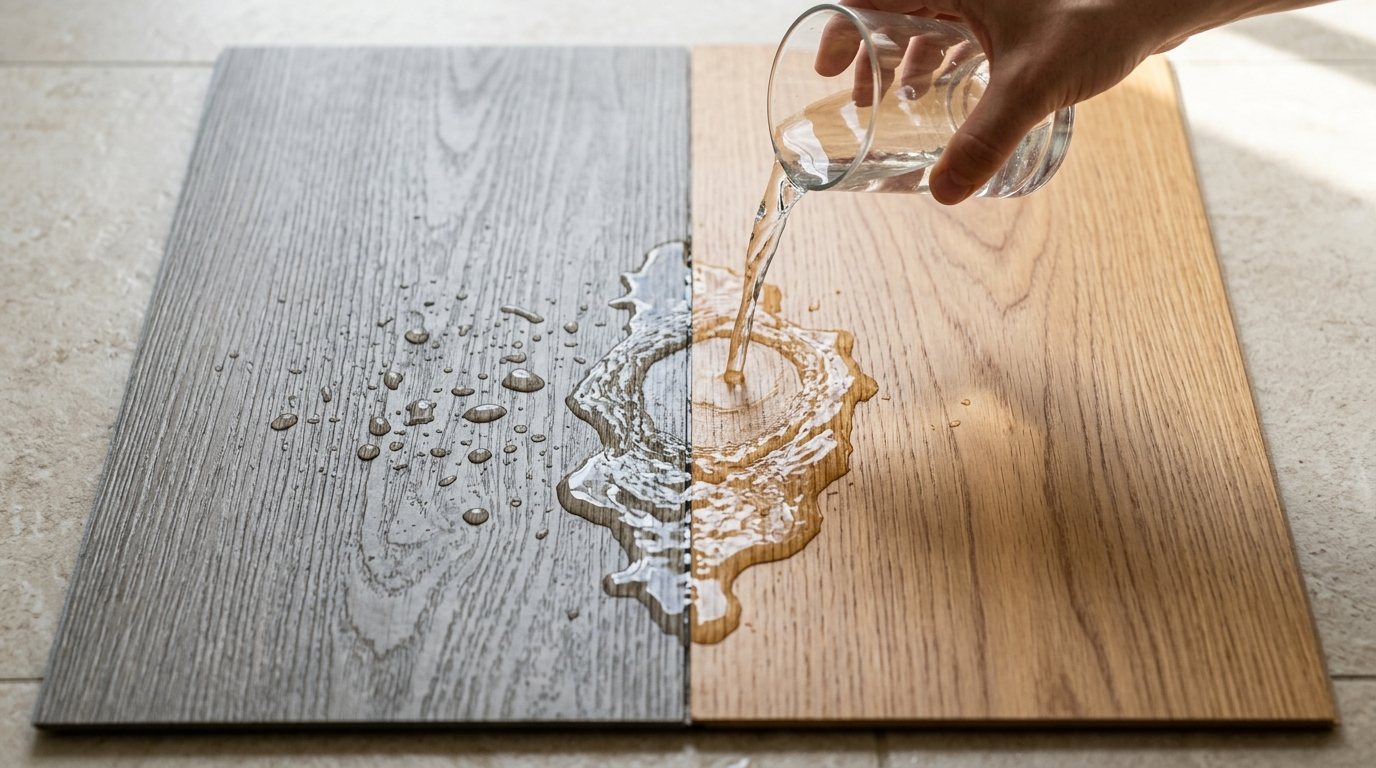
Standing in the flooring aisle, luxury vinyl plank and laminate can look almost identical: both are click-together planks with a realistic wood look, and both cost far less than hardwood. Yet they are made from very different materials, and choosing the wrong one for a kitchen, basement or busy family room can mean swollen seams or a floor that wears out early.
This guide compares LVP vs laminate on the things that actually matter once the floor is down: water resistance, durability, comfort, noise, installed cost per square foot, DIY difficulty and resale. Then it tells you which one to pick for each room in your house.
Quick answer: Choose LVP for kitchens, bathrooms, laundry rooms and basements, because its plastic core is not damaged by water. Choose laminate for dry living areas and bedrooms if you want a harder, more scratch-resistant surface and a more convincing wood look. Installed prices overlap heavily, so decide by room and moisture risk first, then compare specific products.
What is the difference between LVP and laminate?
How luxury vinyl plank is made
LVP is built in layers of PVC. A clear wear layer, measured in mils, sits over a printed design film, and below that is the core. Flexible LVP has a soft vinyl core, while rigid core products use either SPC (stone plastic composite, very dense and stable) or WPC (wood plastic composite, slightly thicker and softer underfoot). Many planks also come with an attached foam or cork pad.
How laminate is made
Laminate has a high-density fiberboard (HDF) core, which is compressed wood fiber, topped with a photographic image layer and a tough melamine wear layer that often contains aluminum oxide. Durability is usually graded with an AC rating; AC3 is a common minimum for busy residential rooms, with AC4 and AC5 aimed at heavier traffic. Because the core is wood-based, laminate behaves more like wood when it gets wet.
LVP vs laminate at a glance
| Factor | LVP | Laminate | Edge |
|---|---|---|---|
| Water resistance | Core is waterproof; spills and splashes do not swell planks | HDF core can swell if water sits in seams; water-resistant lines are better but not immune | LVP |
| Scratch resistance | Good; depends on wear layer thickness | Very good; hard melamine surface | Laminate |
| Dents | Softer products can dent under heavy furniture | Resists dents well, but edges can chip | Laminate (slight) |
| Comfort underfoot | Slightly softer and warmer, especially WPC | Firmer, feels more like wood | LVP |
| Noise | Quieter, especially with an attached pad | Can sound hollow or clicky without good underlayment | LVP |
| Realistic wood look | Very good on quality products | Excellent, with deep embossing and crisp detail | Laminate (slight) |
| Installed cost | About $3 to $11 per sq ft (floating) | About $6 to $14 per sq ft | Overlaps; compare products |
| DIY difficulty | Easier; cuts with a utility knife | Moderate; needs a saw and makes dust | LVP |
| Repairs | Damaged planks can be replaced | Damaged planks can be replaced; water damage usually means replacement | Tie |
| Sun and heat | Can fade or move with big temperature swings | More stable in sunrooms; fades less | Laminate |
Head-to-head comparison
Water resistance
This is the biggest difference. LVP’s core is plastic, so a dishwasher leak or a dog bowl spill will not make the planks swell. Laminate’s fiberboard core soaks up water that gets into the seams or cut edges, and swollen laminate does not shrink back. Many newer laminates are sold as water-resistant or waterproof with sealed edges and limited spill warranties, which helps, but they still are not the best choice where water can sit for hours.
Remember that neither floor is a waterproof barrier for your house. Water that runs under either type can still reach and damage the subfloor, so plumbing leaks need fixing quickly no matter what you install.
Durability: scratches, dents and wear
Laminate’s melamine surface is very hard, so it shrugs off pet claws, grit and chair legs well. LVP’s wear layer is softer; look for at least 12 mil for general home use and 20 mil or more for homes with large dogs, kids or heavy traffic. LVP resists chipping better than laminate, whose edges can chip if something heavy is dropped on them.
Comfort and warmth
Vinyl has a bit of give and feels slightly warmer underfoot, which many people notice in kitchens where they stand for long periods. Laminate feels firmer and closer to real wood. Underlayment helps both, but always follow the manufacturer’s rules: adding a second pad under LVP that already has one attached can void the warranty and weaken the locking joints.
Noise
Laminate is a floating floor of hard material, so it can produce a hollow, clicky sound under hard shoes unless you use a quality acoustic underlayment. LVP, especially with an attached pad, tends to be quieter. If you are installing on an upper floor or in a condo, check for any building rules on sound-rated underlayment.
Cost per square foot installed
Prices overlap more than most people expect. Bob Vila’s vinyl plank cost guide puts floating LVP at roughly $3 to $11 per square foot installed, with materials typically $2 to $7. Its laminate cost guide lists about $6 to $14 per square foot installed for laminate, with labor and underlayment typically $4 to $8 per square foot and material from under $1 for thin 6 mm boards to around $6 for thick 12 mm boards. In practice, a budget laminate will usually cost less than a premium rigid core LVP, and vice versa, so compare the actual products you are considering.
DIY installation
Both install as click-lock floating floors, and both are realistic weekend projects for a careful DIYer. LVP is a little easier because you can score and snap most planks with a utility knife. Laminate needs a saw for most cuts, which means dust and more tools. Either way, subfloor flatness is the step that decides whether the floor lasts; our guide on how to install vinyl plank flooring walks through the prep.
Looks and resale value
Quality versions of both look convincing from standing height. Laminate often wins on texture and grain detail, while LVP has improved quickly and comes in wider, longer planks. Neither is likely to add value the way real hardwood can. For resale, what matters most is that the floor suits the room, looks consistent through the house and is in good condition, which favors LVP in wet areas and either option elsewhere.

Which to choose, room by room
| Room | Better pick | Why |
|---|---|---|
| Kitchen | LVP | Spills, dishwasher and sink leaks; softer to stand on |
| Full bathroom | LVP | Standing water and humidity; laminate is risky here |
| Laundry room | LVP | Washer leaks and drips |
| Basement | Rigid core LVP | Concrete moisture and possible flooding |
| Entry or mudroom | LVP | Wet boots and melting snow |
| Living room, bedrooms | Either | Dry rooms; choose by look, feel and budget |
| Busy home with dogs | Laminate (dry rooms) or thick-wear-layer LVP | Laminate resists claws; LVP handles accidents |
| Sunroom or big south windows | Laminate or high-quality rigid core | Strong sun and heat can fade or move vinyl |
If you want one floor running through the whole main level, including the kitchen and powder room, LVP is usually the simpler choice. For a deeper look at wet rooms, see our guide to the best waterproof flooring for kitchens and bathrooms.
What to check before you buy
Two products in the same category can perform very differently, so read the specs on the box or product page before you compare prices.
- Wear layer (LVP): 12 mil is a reasonable minimum for most homes; 20 mil or more is worth it for pets, kids and entries.
- AC rating (laminate): AC3 or higher for main living areas. Lower ratings suit bedrooms and closets.
- Core type: rigid core LVP (SPC or WPC) hides small subfloor flaws better than flexible vinyl. For laminate, thicker boards (10 to 12 mm) feel more solid and sound less hollow.
- Attached pad: if a pad is built in, you usually cannot add another underlayment.
- Warranty terms: check how long spills can sit, whether bathrooms are covered and what voids the warranty, such as steam mops or missing expansion gaps.
- Room limits: some products are not approved for sunrooms, unheated spaces or below-grade concrete.
Common mistakes to avoid
- Buying on price per box alone. A thin wear layer or low AC rating can show wear in a few years.
- Treating “waterproof” as leak-proof. Planks may survive, but water under them still damages the subfloor.
- Skipping subfloor prep. Dips and humps cause clicking, gaps and broken joints in both types.
- Forgetting the expansion gap. Both floors move. Pinning them under cabinets or tight to walls is a common cause of laminate floor buckling.
- Doubling up underlayment. Use only what the manufacturer allows.
- Using laminate in a full bath because the box says water-resistant.
Pro tip: Order samples of your top two choices and leave them on the floor of the actual room for a few days. Drop keys on them, slide a chair across them, splash water on the seams and look at them in morning and evening light. A sample in your own home tells you more than a showroom display.
When to call a pro
Many homeowners install either floor themselves, but hire a flooring installer if:
- The subfloor has dips, humps or soft spots that need grinding, leveling or replacement
- You are installing over a concrete slab or in a basement and are unsure about moisture testing
- The job includes stairs, which need special nosings and precise cuts
- The floor runs through several rooms and doorways and needs transitions planned
- You are removing old sheet vinyl or tile that may contain asbestos
On that last point, the EPA advises not sanding or tearing out flooring that might contain asbestos and having a trained, accredited professional inspect it before remodeling. Installing new flooring over the old material is often an option. For labor, Bob Vila’s guides put LVP installation at roughly $1 to $4 per square foot on top of materials and laminate labor, including underlayment, at about $4 to $8 per square foot, with subfloor repairs extra.
Frequently asked questions
Is LVP or laminate better for dogs?
Laminate resists scratches from claws better, but LVP handles accidents and water bowls without swelling. For most pet owners, an LVP with a thick wear layer (20 mil or more) is the best all-round choice, especially in kitchens and entries. Keep nails trimmed either way.
Is laminate waterproof?
Standard laminate is not; its fiberboard core swells if water sits on the seams. Some newer lines are sold as water-resistant or waterproof and carry limited spill warranties, but they are best for occasional spills, not bathrooms with standing water. Read the warranty to see exactly what it covers.
Which is quieter, LVP or laminate?
LVP is usually quieter, particularly products with an attached acoustic pad. Laminate can sound hollow or clicky without a good underlayment. Upstairs and in condos, check for sound-rated underlayment requirements.
Does LVP look cheap compared to laminate?
Low-end LVP can look flat and plasticky, but mid-range and premium products with realistic embossing and varied plank designs look very convincing. Laminate still tends to have crisper texture at similar prices. Comparing samples side by side in your own light is the best test.
Can you put LVP or laminate in a basement?
Rigid core LVP is the usual choice for basements because concrete can release moisture and basements can flood. Laminate is riskier below grade. Whichever you choose, test the slab for moisture and use the vapor barrier the manufacturer specifies.
The bottom line
Pick LVP anywhere water is likely: kitchens, bathrooms, laundry rooms, entries and basements. Pick laminate for dry living spaces when you want maximum scratch resistance and a crisp wood look, or when you find a better product for the money. Because installed prices overlap, compare wear layer, AC rating, warranty and samples in your own room rather than assuming one category is always cheaper.


