Maybe the carpet is stained beyond saving, smells like the last owner’s dog, or you are hoping there is hardwood hiding underneath. Either way, you want it gone, and you would rather not pay someone a few hundred dollars for a job that looks like it mostly involves pulling.
Good news: removing carpet is one of the easiest flooring jobs to do yourself. This guide covers tools and safety gear, cutting carpet into strips, removing the pad, staples and tack strips, preparing the subfloor, disposal, and when old adhesive or tile underneath means you should stop and test for asbestos.
Quick answer: Clear the room, pull the carpet off the tack strips at a corner with pliers, then cut it from the back into strips 3 to 4 feet wide, roll them and tape them. Pull up the pad, remove every staple, and pry out the tack strips if you are installing anything other than carpet. Wear gloves, knee pads and a dust mask, and if you uncover old tile, sheet vinyl or dark adhesive, do not sand or scrape it until it has been tested for asbestos.
Before you start: check what is underneath
Peel back a corner inside a closet or near a floor vent before you commit. What you find decides how careful you need to be and what the subfloor will need afterward.
- Hardwood: Work slowly and use tools that will not gouge the wood. Staple holes and pad stains are normal and usually disappear during refinishing.
- Plywood or OSB: The most common subfloor. The pad will be stapled down, and you can work quickly.
- Concrete: Common in basements and slab homes. The pad is usually glued, so expect more scraping.
- Old tile or sheet vinyl: Stop here and read the asbestos section below before going further.
Plan on about 2 to 4 hours for an average room, according to Home Depot’s guide. Stairs and glued-down carpet take longer.
Tools and materials
- Utility knife with plenty of fresh blades (carpet backing dulls them fast)
- Pliers or locking pliers for gripping carpet edges and pulling staples
- Flat pry bar and a hammer, plus a scrap of wood to protect the subfloor
- Long-handled floor scraper or carpet staple remover
- Painter’s 5-in-1 tool or flat screwdriver for staples in hardwood
- Duct tape and heavy-duty contractor bags
- Shop vacuum and a broom
- Adhesive remover or an oscillating tool with a scraper blade for glued pad on concrete
- Marker and painter’s tape for numbering baseboards
Safety gear and precautions
Carpet removal is not dangerous, but it is dusty and sharp. Old carpet and pad hold years of dirt, allergens and pet dander, and tack strips are lined with angled nails pointing up.
- Heavy work gloves: Essential for handling tack strips and pulling staples.
- Knee pads: You will spend most of the job kneeling on a hard floor scattered with staples.
- Dust mask or respirator: An N95 mask is a sensible minimum for pad dust. Add safety glasses, since tack strips can snap and flick debris.
- Long sleeves and closed shoes: Keep bare skin away from tack strip nails, and never walk the room barefoot until every strip is out.
Safety note: Always cut carpet from the back side with the blade moving away from your body and your free hand out of the cutting line. Keep rolls small enough to lift without straining, since a wet or full-room roll can weigh far more than it looks. Open windows and run a fan blowing out of the room to clear dust as you work.
Step by step: how to remove carpet
1. Clear and prep the room
Move out all furniture and take down any doors that swing into the room, including closet bifold doors. If you plan to install hard flooring, remove the baseboards and shoe molding with a pry bar and number each piece on the back so it goes back in the same spot. If you are reinstalling carpet, you can usually leave baseboards in place.
2. Free a corner
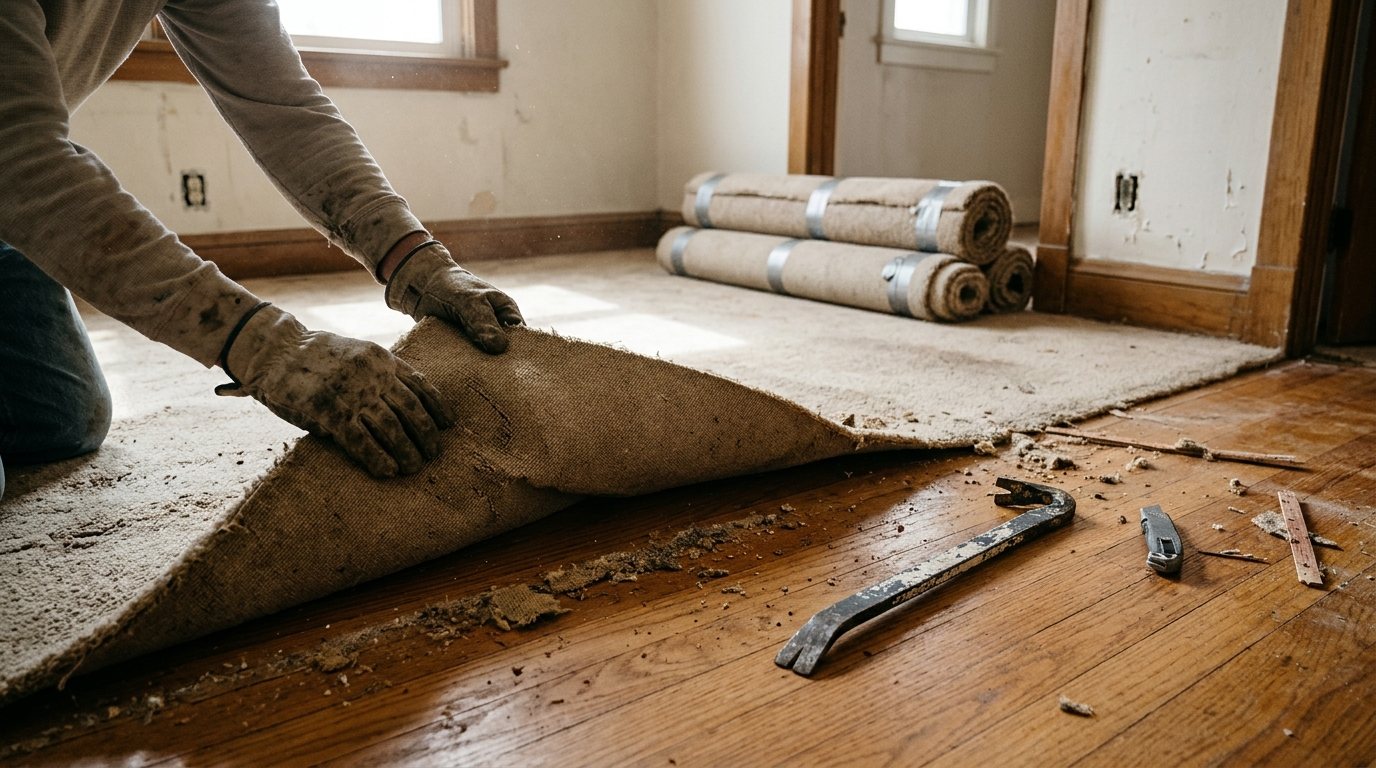
Grab the carpet in a corner with pliers and pull up firmly to release it from the tack strip. If you cannot get a grip, cut a small square about 6 inches across in the corner to make a handle. Then walk along the wall pulling the carpet free from the strip.
3. Cut the carpet into strips
Once you have pulled back about 3 feet, fold the carpet over and cut it from the back, which is easier and keeps the blade off the subfloor. Cut strips 3 to 4 feet wide, roll each one tightly and wrap it with duct tape. Rolls this size are easy to carry and easier to fit within curbside pickup limits.
4. Cut around transitions and closets
At doorways, cut the carpet along the metal transition strip or the edge of the next floor. Leave transitions in place until you know what your new flooring needs. Cut closet carpet at the doorway and remove it as a separate piece.
5. Remove the pad
On a wood subfloor, the pad is stapled down. Pull it up by hand in sections, roll it and bag it, leaving staples behind with small tufts of foam. On concrete, the pad is usually glued, so scrape it off with a long-handled floor scraper. Home Depot recommends always replacing the pad when you replace carpet, even if it looks fine.
6. Pull the staples
On plywood or OSB, push a long-handled scraper along the floor like a broom to pop staples loose, then pull any stubborn ones with pliers. On hardwood, slow down and lift each staple with a 5-in-1 tool or flat screwdriver, then pull it straight out with pliers so you do not gouge the boards. Vacuum often so you can see what is left.
7. Remove the tack strips
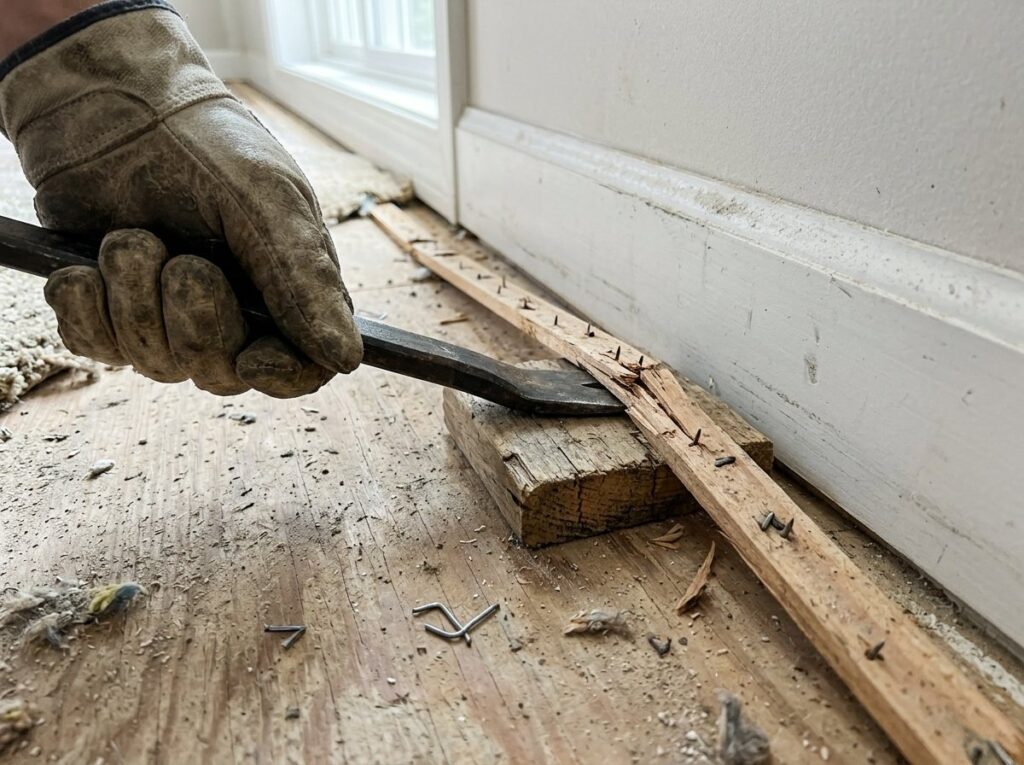
Tack strips are the thin wood strips with upward-angled nails around the room’s edge. If you are installing new carpet and the strips are solid, you can leave them. For any other flooring, remove them all: slide a flat pry bar under the strip near each nail, put a scrap of wood under the bar as a fulcrum, and lever up. On concrete, the nails can be brittle, so wear safety glasses and expect some to snap.
Removing carpet from stairs
Work from the top step down, one step at a time. Remove any metal nosing at the top, pull the carpet off each tread and riser with pliers, and cut it into short pieces as you go. Each step has its own tack strips and many staples, so take your time and keep the stairway clear of loose debris.
Asbestos caution: old tile and glue under carpet
In older homes, carpet was often laid over earlier floors such as vinyl tile, sheet vinyl or linoleum. Some older resilient flooring, its backing and the dark adhesive used to glue it down can contain asbestos. You cannot tell by looking, and disturbing it is what releases fibers.
If you uncover old tile, sheet flooring or dark mastic, stop and get a sample tested by an accredited lab, or hire a licensed asbestos inspector. Until you have results, the EPA advises not to sand, scrape, saw or drill suspect materials, and specifically warns against sanding or leveling asbestos flooring or its backing and against using a power stripper on it. Do not sweep or vacuum suspect debris with a regular vacuum.
If material tests positive and is in good condition, covering it with new flooring is often allowed and much cheaper than removal. The EPA states that removal must be done only by a trained and accredited asbestos professional, and rules vary by state and city, so check locally before any work.
How to prepare the subfloor
With the carpet, pad, staples and strips gone, give the floor a thorough cleaning and inspection before new flooring goes down.
| Subfloor | What you will usually find | How to prep it |
|---|---|---|
| Plywood or OSB | Staples, pad residue, paint drips, loose or squeaky panels | Remove all staples, scrape drips, drive loose nails or add screws into joists, vacuum, then check flatness |
| Concrete slab | Glued pad residue, carpet adhesive, cracks, possible moisture | Scrape residue, use adhesive remover on stubborn spots, patch cracks, test for moisture before installing |
| Hardwood | Staple holes, tack strip nail holes at edges, pad stains, worn finish | Pull every staple by hand, fill holes, then clean or refinish |
| Old vinyl or tile | Possible asbestos in tile, backing or adhesive | Test first; if positive, leave in place and cover, or hire an abatement pro |
Look for water damage and mold
Dark stains, soft spots or a musty smell under the pad point to past leaks, often near bathrooms, exterior doors and pet areas. Probe soft spots with a screwdriver. Small areas of stained but solid plywood can usually be sealed with a stain-blocking primer once dry, while soft, delaminated or moldy panels should be cut out and replaced.
Fix squeaks and check that the floor is flat
Now is the easiest time to stop squeaks, since the subfloor is fully exposed. Drive screws through the subfloor into joists wherever it moves or creaks; our guide on how to fix squeaky floors covers the details. Hard flooring is much less forgiving than carpet, so check for dips and humps with a long straightedge and follow our guide on how to level a floor if you find problems.
Clean it thoroughly
Sweep, then vacuum with a shop vac. On wood subfloors, avoid mopping with water and use a dry mop or tack cloth instead. On concrete, a damp mop can lift dust and residue, but let the slab dry fully before installing anything. If you found hardwood, our guide to refinishing hardwood floors explains how to bring it back.
How to dispose of old carpet
- Check for carpet recycling first. Some areas have carpet collection programs through recycling centers or flooring retailers, and recycling can be cheaper than the landfill.
- Ask your trash hauler. Many will take short, taped rolls at the curb, sometimes as a bulk pickup with a fee or a size limit.
- Haul it yourself. A transfer station or landfill will take carpet and pad by weight or by load.
- Keep suspect materials separate. Anything that may contain asbestos needs its own disposal rules and should never go out with regular trash.
Bob Vila’s cost guide lists recycling at about $0.05 to $0.25 per square foot and landfill disposal at about $0.40 to $0.50 per square foot, or a flat fee of roughly $75 to $150 to haul it away.
When to call a pro
Most homeowners can remove carpet themselves, but hand the job off if you see any of these:
- Old tile, sheet vinyl or dark adhesive under the carpet that has not been tested for asbestos.
- Large areas of mold, rot or soft subfloor, especially after a flood or long-term leak.
- Carpet glued directly to concrete over a large area, which can mean days of scraping.
- Long or winding staircases, or physical limits that make kneeling and lifting heavy rolls unsafe.
| Professional service | Typical cost | Source |
|---|---|---|
| Carpet and pad removal, including disposal | $1 to $1.50 per sq ft | Angi |
| Typical 12 x 12 room | $140 to $220 | Angi |
| Carpeted stairs | $2 to $3 per step | Angi |
| Glued-down carpet | $1.30 to $2.10 per sq ft (Angi); $3 to $5 per sq ft (Bob Vila) | Angi, Bob Vila |
| Subfloor replacement if damaged | $1.30 to $12 per sq ft | Angi |
Many flooring installers include removal of old carpet in their quote, so ask before paying for it separately.
Frequently asked questions
Is it hard to remove carpet yourself?
No special skills are needed, but it is physical work with a lot of kneeling, cutting and lifting. Most people can clear a bedroom in an afternoon. The slowest part is usually pulling staples and scraping glued pad, not lifting the carpet itself.
Should I remove the carpet tack strips?
Remove them if you are installing hardwood, laminate, vinyl plank or tile, since they sit right where the new floor needs to go. If you are putting down new carpet and the strips are solid and not rusted or rotted, you can leave them in place.
Can I reuse the old carpet pad?
It is not recommended. Old pad compresses and holds dirt and odors, and Home Depot advises always replacing it when you install new carpet.
How do I know if there is hardwood under my carpet?
Lift a corner in a closet or remove a floor vent cover and look at the edge of the floor. You can also check from the basement or crawlspace, or look at where carpet meets other flooring at a doorway. Many older homes had hardwood covered with carpet.
Can I install new flooring right over carpet tack strip holes and staple holes?
Yes, on a plywood or OSB subfloor small holes do not matter once the staples are out and the surface is flat. On hardwood you plan to keep, fill the holes with wood filler before refinishing.
The bottom line
To remove carpet, clear the room, pull it off the tack strips, cut it into rolls 3 to 4 feet wide, and then take out the pad, every staple and the tack strips. Protect yourself with gloves, knee pads and a mask, inspect the subfloor for damage before new flooring goes down, and stop to test any old tile or dark glue for asbestos before you scrape it.