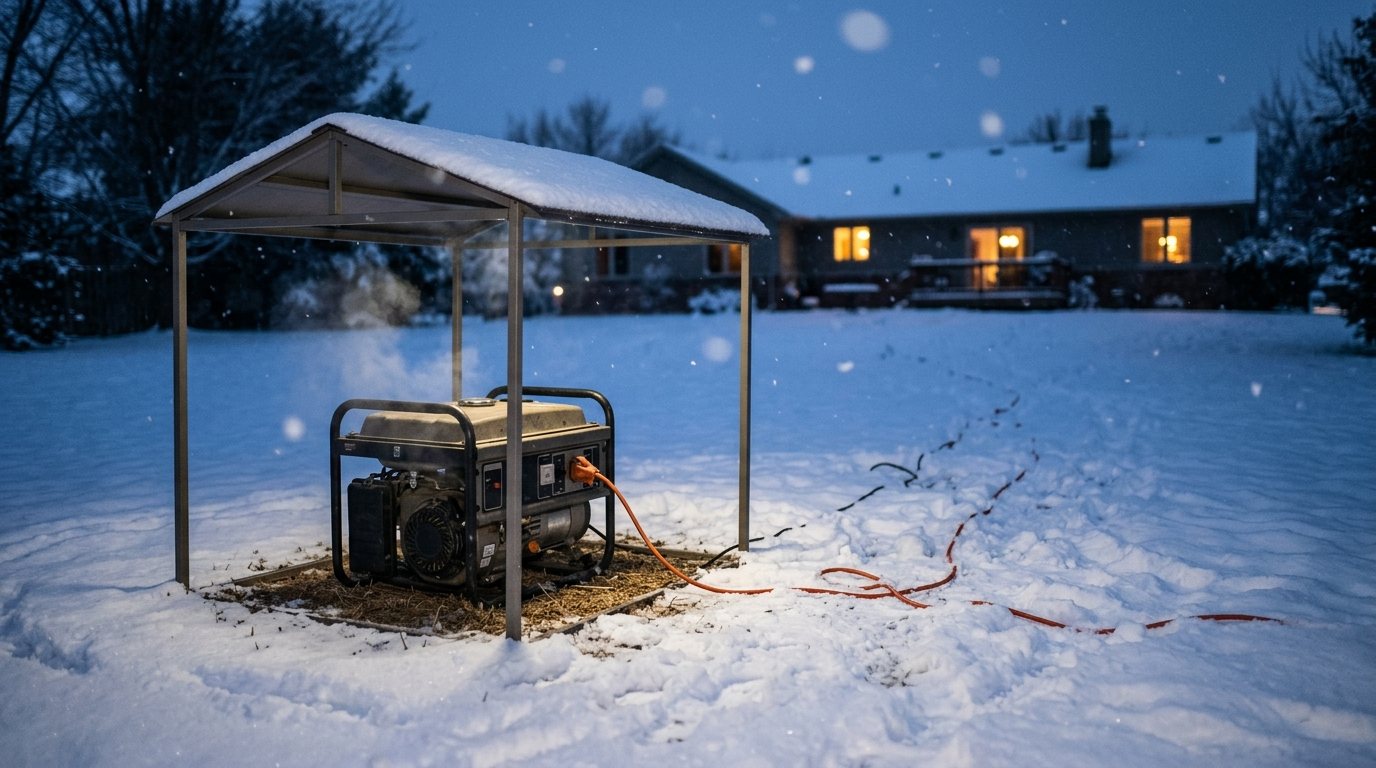
A winter storm knocks out the power, the house is getting colder by the hour and the generator is sitting in the garage. It’s tempting to run it right there with the door open, or to plug it into a wall outlet so the whole house comes back to life. Both choices can kill.
This guide covers how to run a portable generator safely: where to put it to avoid carbon monoxide poisoning, why backfeeding is so dangerous, how transfer switches and interlocks work, how to size a generator, and how to handle fuel, extension cords and CO alarms.
Quick answer: Run a portable generator outdoors only, at least 20 feet from doors, windows and vents, with the exhaust pointed away from the house. Never run it in a garage, basement or shed, even with doors open. Never plug it into a wall outlet; power appliances with outdoor-rated extension cords or have a licensed electrician install a transfer switch or interlock. Install battery-powered or battery-backup CO alarms inside before the storm.
Carbon monoxide: the danger you can’t see or smell
A portable generator’s engine produces carbon monoxide (CO), a colorless, odorless gas that can build up to deadly levels within minutes in an enclosed or partly enclosed space. According to the CDC’s carbon monoxide guidance, more than 400 Americans die each year from unintentional CO poisoning not linked to fires, and more than 100,000 visit an emergency department.
The CPSC’s portable generator safety alert is blunt: never use a generator inside homes, garages, crawlspaces, sheds or similar areas, and opening doors or windows does not make it safe. Keep it at least 20 feet from doors, windows and vents that could let CO indoors. The CDC gives the same 20-foot guidance.
Where to put the generator
- Outdoors, on a dry, level surface, at least 20 feet from any door, window or vent, including your neighbors’.
- With the exhaust pointed away from the house and any air intakes.
- Not in an attached garage, carport, breezeway, porch, basement, crawlspace or shed.
- Not under a window that someone might open, and not upwind of your home on a breezy day if you can avoid it.
Signs of CO poisoning and what to do
The CDC lists headache, dizziness, weakness, upset stomach, vomiting, chest pain and confusion as the most common symptoms, often described as flu-like. People who are asleep can die before they notice anything. If you or anyone in the house feels sick, dizzy or weak while a generator is running, or a CO alarm sounds, get everyone into fresh air right away and call 911. Our guide to a carbon monoxide detector going off explains what to do next.
Safety note: Some newer generators have a CO-sensing feature that shuts the engine off when CO builds up. Treat it as a backup, not permission to run the generator closer to the house. The 20-foot rule and working CO alarms still apply.
CO alarms: your second line of defense
Placement outside isn’t enough on its own, because exhaust can drift through gaps, vents and doors. The CPSC recommends battery-operated CO alarms or plug-in alarms with battery backup, tested monthly, and certified to UL 2034, IAS 6-96 or CSA 6.19.01. The CDC advises putting them near every sleeping area.
- Check that every CO alarm works and has fresh batteries before storm season, not during the outage.
- Remember that plug-in alarms without battery backup go dark when the power does.
- Consider adding an alarm on every level of the home, including the basement.
- Never silence or remove a sounding alarm and stay inside to investigate.
Backfeeding: never plug a generator into a wall outlet
Backfeeding means feeding generator power into your home’s wiring through an outlet, usually with a homemade cord that has a plug on both ends. The CPSC warns never to do it. That power doesn’t stay in your house: it can flow out through the service and onto utility lines, where a transformer steps it up to a dangerous voltage. Consumer Reports, in an article on why a portable generator needs a transfer switch, notes it can put utility crews at risk of electrocution and calls the practice dangerous and in many cases illegal.
Backfeeding can also overload your home’s wiring and damage electronics if utility power comes back while the generator is connected, and the exposed prongs on a double-male cord are live and deadly. There are only three safe ways to use a generator’s power.
Extension cords to individual appliances
The simplest option is to plug appliances directly into the generator with heavy-duty, outdoor-rated extension cords. It needs no electrical work, but it can’t power hardwired equipment like a furnace blower or well pump.
Manual transfer switch
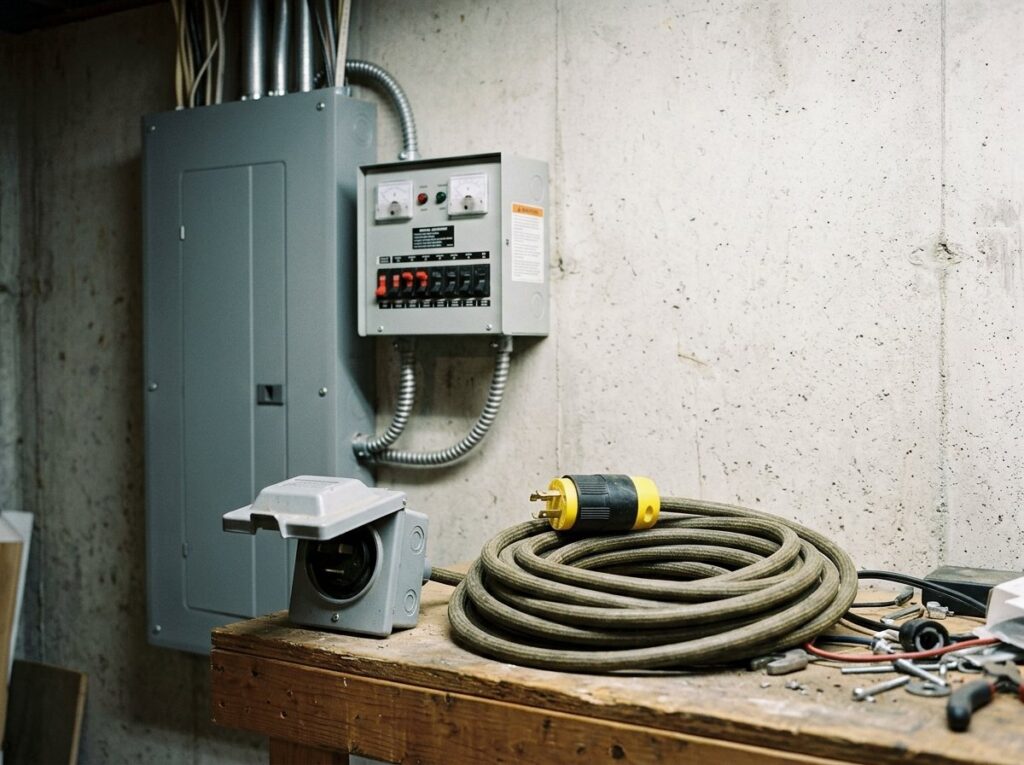
An electrician installs a transfer switch beside the main panel and a power inlet outside. You plug the generator into the inlet and use the switch to choose which circuits run on generator power. The switch physically prevents generator and utility power from connecting at the same time, and it lets you run hardwired equipment such as a furnace, well pump or water heater safely.
Panel interlock kit
An interlock is a metal bracket on the main panel that blocks the main breaker from being on while the generator breaker is on, so the house can’t draw from the grid and the generator at once. It’s usually cheaper than a transfer switch, but it must match your panel and be accepted by your local code. An electrician can confirm whether it’s allowed where you live.
| Option | What it powers | Typical installed cost | Who installs it |
|---|---|---|---|
| Outdoor extension cords | Plug-in appliances only | Cost of the cords | You |
| Manual transfer switch | Selected circuits, including hardwired equipment | About $500 to $1,500 (Consumer Reports); $400 to $1,300 for a manual switch (Angi) | Licensed electrician |
| Interlock kit | Selected circuits through the main panel | Kit about $50 to $150, plus $400 to $800 labor (Consumer Reports) | Licensed electrician |
| Automatic transfer switch | Usually paired with standby generators | About $600 to $2,500 (Angi) | Licensed electrician |
Sizing basics: how big a generator do you need?
An undersized generator gets overloaded, and an oversized one burns more fuel than you need. Size it to what you’ll actually run at the same time, using the wattage on each appliance’s data label or manual.
- List your essentials. Typically the refrigerator and freezer, a few lights, phone chargers, a sump pump and, with a transfer switch, the furnace blower.
- Add the running watts. Total the running (rated) watts of everything you’ll use at once.
- Add the biggest surge. Motors draw extra starting watts for a few seconds. Add the starting surge of the single largest motor, since they rarely all start at once.
- Leave headroom. Choose a generator whose running output comfortably exceeds your total, rather than one you’ll run at its limit.
- Stagger startups. Turn on large loads one at a time so surges don’t overlap.
Inverter generators produce steadier power that’s gentler on computers and other electronics, and they tend to run quieter. Whatever you choose, follow the manufacturer’s ratings rather than guesses.
Extension cords done right
The CPSC recommends heavy-duty extension cords made for outdoor use, with a wattage rating higher than the total of everything plugged into them and three-prong plugs.
- Inspect cords for cuts, crushed spots and damaged plugs before every use.
- Use the shortest cord that reaches while keeping the generator 20 feet from the house, and use heavier cords for longer runs.
- Don’t run cords under rugs or through doorways where they can be pinched, and don’t let them sit in puddles or snow.
- Avoid chaining several cords together; run separate cords to separate loads instead.
Fuel storage and refueling
Gasoline vapors are heavier than air and can travel to a pilot light or spark. The CPSC says never store generator fuel in the home; keep gasoline in labeled, non-glass safety containers outside living areas, such as a detached shed.
- Turn the generator off and let it cool before refueling; fuel spilled on a hot engine can ignite.
- Add fuel stabilizer to gasoline you plan to keep, and rotate your supply so it stays fresh.
- Never store fuel near a furnace, water heater or other fuel-burning appliance.
- Keep a fire extinguisher rated for flammable liquids nearby.
Running a generator in snow, rain and cold
Water and electricity don’t mix. The CPSC advises protecting the generator from moisture without moving it indoors or near openings, by running it on a dry surface under an open, canopy-like structure. Generator tents and covers designed for running use are one option.
Before the storm, start the generator and let it run under a light load so you know it works, and check the oil, since many engines shut down when oil is low. Clear snow away from the unit and its air intake during use, dry your hands before touching it, and keep pets and children well away. While the power is out, our guide on how to prevent frozen pipes covers what to do if heat goes off for long.
Tools and materials
- Portable generator sized to your essential loads
- Heavy-duty, outdoor-rated, three-prong extension cords
- Battery-powered or battery-backup CO alarms
- Labeled, approved fuel containers and fuel stabilizer
- Generator tent or open canopy, and a dry, level base
- Fire extinguisher rated for flammable liquids
- Flashlights, spare oil and the owner’s manual
When to call a pro
Running a generator with extension cords is something you can do yourself. Anything that connects the generator to your home’s wiring is a job for a licensed electrician. Call one if:
- You want to power hardwired equipment like a furnace, well pump or water heater.
- Someone suggests a double-male “generator cord” or plugging into a dryer outlet. Don’t do it.
- You’re considering a transfer switch, inlet box or interlock kit, which may need a permit.
- Your generator outlets spark, cords get hot or breakers trip repeatedly.
Consumer Reports estimates $500 to $1,500 for a transfer switch including installation, and $50 to $150 for an interlock kit plus $400 to $800 in labor. Angi puts the average transfer switch installation at about $1,450, with a typical range of $1,200 to $1,600 and permits of $50 to $350 where needed. Book the work before storm season, when electricians are busiest. Our winter home maintenance checklist helps you plan the rest.
Frequently asked questions
How far should a generator be from the house?
At least 20 feet from doors, windows and vents, according to both the CPSC and CDC, with the exhaust pointed away from the home. Farther is better, and remember your neighbors’ windows too.
Can I run a generator in the garage with the door open?
No. The CPSC and CDC both say never to run a generator in a garage, even with the door and windows open. CO can build up quickly and seep into the house.
Is it illegal to backfeed a generator into a house?
Backfeeding through an outlet is dangerous and, according to Consumer Reports, illegal in many places. It can electrocute utility workers and damage your home. Use extension cords or have an electrician install a transfer switch or approved interlock.
Can I run a generator in the rain or snow?
Only if it’s protected from moisture while staying outdoors and well away from the house. Use a dry, level surface and an open canopy or tent designed for running generators, never a garage or enclosed porch.
Do I need a CO alarm if my generator is outside?
Yes. Exhaust can drift inside through doors, windows and vents, and CO gives no warning. Use battery-powered or battery-backup CO alarms near sleeping areas and test them monthly.
The bottom line
A portable generator can keep your home safe and warm through a winter outage, but only if you respect its two biggest dangers. Keep it outdoors and 20 feet from openings, protect your family with working CO alarms, and never backfeed through an outlet. For anything connected to your home’s wiring, hire a licensed electrician to install a transfer switch or interlock.