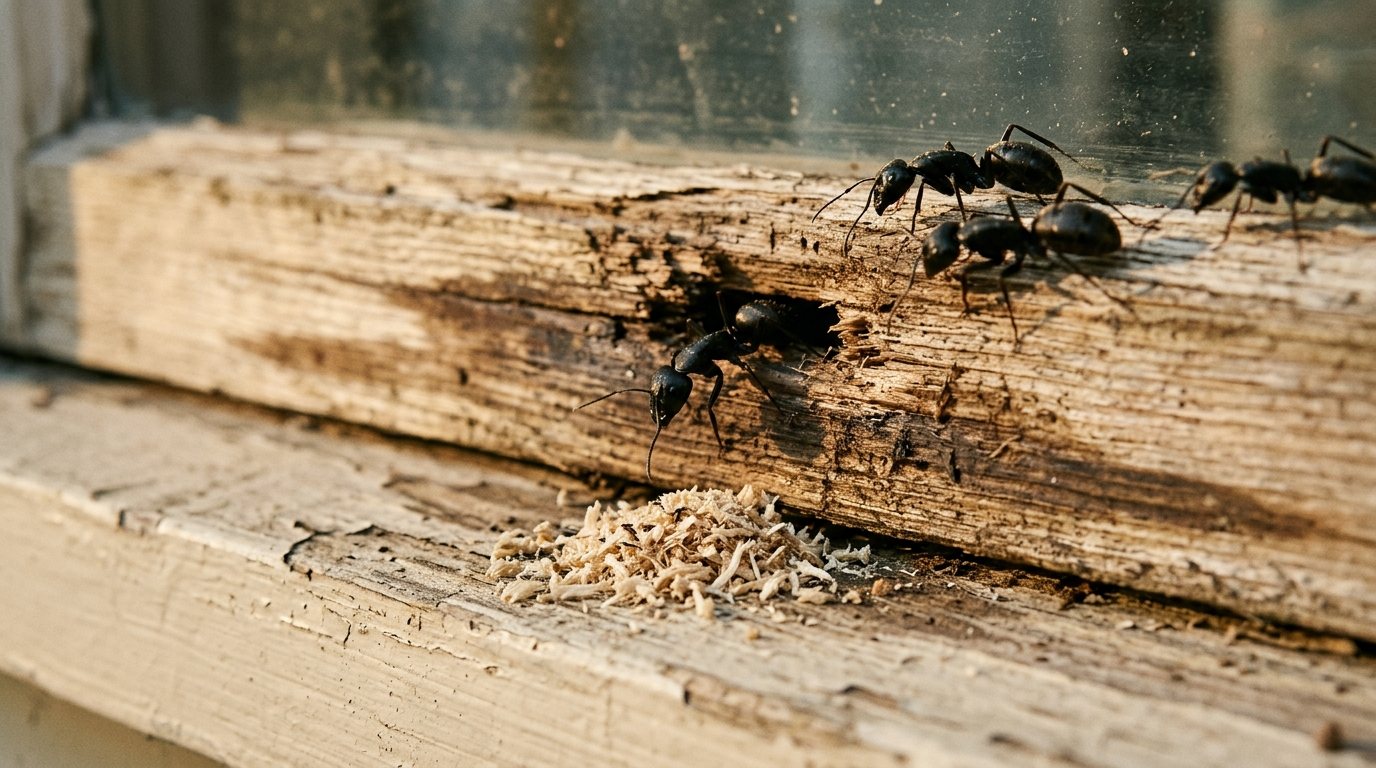
You keep finding big black ants on the kitchen floor at night, or a small pile of what looks like sawdust under a window sill. Carpenter ants don’t eat wood the way termites do, but they hollow it out to build nests, and a colony that goes unnoticed for years can weaken trim, sills and framing.
This guide shows you how to identify carpenter ants and tell them apart from termites, read the frass they leave behind, track down the nest and choose between baits and direct treatment. It also explains why damp wood is the root of most infestations and when damage calls for a professional.
Quick answer: Find the nest by following ants back from a bait at night and looking for sawdust-like frass near damp wood. If you can reach the nest, treat it directly with a labeled insecticide dust or spray; if you can’t, use slow-acting carpenter ant baits so workers carry the poison home. Then fix the leaks and rotten wood that attracted them, and call a pro if the nest is in structural framing or ants keep coming back.
How to identify carpenter ants
Carpenter ants are among the largest ants in North America. According to University of California IPM, workers of common species are about 1/4 to 1/2 inch long, though some species are smaller.
- Color: usually all black, or red and black. Some species are yellowish and black.
- Shape: a single node at the narrow waist and an evenly rounded back when you look from the side.
- Antennae: bent like an elbow.
- Behavior: most active after sunset, often trailing along foundations, siding, fences and utility lines.
- Swarmers: winged adults that appear in spring when colonies send out new queens.
If you’re seeing small ants marching to crumbs on the counter, you’re more likely dealing with a sugar ant problem. Our guide to getting rid of ants in the kitchen covers those species.
Carpenter ants vs termites
Winged carpenter ants and winged termites are easy to confuse, and the treatment for each is very different. Use these differences to tell them apart.
| Feature | Carpenter ant | Termite |
|---|---|---|
| Waist | Narrow, pinched | Broad, no visible waist |
| Antennae | Elbowed | Straight, bead-like |
| Wings (swarmers) | Front pair longer than back pair | Both pairs about equal length |
| What they do with wood | Tunnel to nest, don’t eat it | Eat the wood |
| Debris left behind | Fibrous sawdust-like frass, often with insect parts | Mud tubes (subterranean) or tiny six-sided pellets (drywood) |
| Galleries | Smooth and clean, almost sanded | Rough, often packed with soil or mud |
If what you’re finding points to termites instead, read our guide to the signs of termites and get a professional inspection.
Signs of a carpenter ant infestation
A few ants wandering in from outside isn’t always an infestation. These signs suggest a nest in or very close to the house:
- Frass: small piles of coarse, fibrous wood shavings, often mixed with dead ants and insect parts, below tiny slit-like openings in trim, sills or walls.
- Large ants indoors at night, especially in kitchens and bathrooms.
- Ants indoors in cold months, when outdoor ants are inactive. That’s a strong hint the nest is inside the house.
- Winged ants inside in spring, often around windows.
- Faint rustling inside walls, floors or woodwork when the house is quiet.
- Soft or hollow-sounding wood near a known leak.
Why moisture-damaged wood matters
Carpenter ants prefer to start nests in wood that’s damp or already softened by decay. UC IPM notes that indoor nests often begin where there’s water damage, and that ants also nest in wall voids, hollow doors and insulation. Common trouble spots include window and door frames, sills, porch and deck framing, roof edges around chimneys, bathroom floors, and areas under leaky dishwashers or sinks.
Indoor nests are usually satellites of a larger parent colony outdoors, often in a tree, stump, woodpile or landscape timbers. A single parent nest can feed several satellites, and colonies can hold several thousand ants. That’s why killing the ants you see rarely solves the problem: you need to treat the nests and remove the damp wood that invited them in.
Step 1: Find the nest
Finding the nest is the most important and most time-consuming part of the job. Plan to spend an evening or two on it.
- Set out a lure. Put a small dab of honey, sugar water or bits of cooked meat or dead insects where you’ve seen ants, then wait until after dark.
- Follow the trail. Use a flashlight to follow loaded workers as they carry food home. They often travel along baseboards, pipes, wires and the edges of carpet.
- Look for frass and openings. Check below the spot where the trail disappears into a wall, sill or door frame.
- Listen and tap. Tap along trim and walls with a screwdriver handle and listen for hollow sounds or rustling.
- Check damp areas. Inspect wood near past leaks, under bathrooms and kitchens, and around windows, chimneys and decks.
- Search outdoors. Follow trails from the house to trees, stumps, woodpiles and fence posts to find the parent nest.
Pro tip: Before you drill into a wall to reach a nest, check for wiring and plumbing with a stud finder that detects AC voltage, and shut off the circuit if you’re unsure. Small holes drilled into a void are easy to patch afterward.
Step 2: Choose baits or direct treatment
Spraying the ants you see rarely works. UC IPM notes that only about 10 percent of a colony is out foraging at any one time, so the queen and most of the workers stay safely inside the nest. Your choice depends on whether you can reach the nest.
| Method | When to use it | How it works | Tips |
|---|---|---|---|
| Carpenter ant bait | Nest can’t be found or reached | Workers carry slow-acting poison back to the colony | Make sure the label lists carpenter ants; don’t spray near baits |
| Insecticide dust into the nest | Nest located in a wall void or wood | Fine dust coats galleries and the ants inside | Use a bulb duster through small drilled holes |
| Labeled spray into the nest | Nest located and accessible | Contact kill of ants in the nest | Apply only as the label directs, often through drilled holes |
| Professional perimeter treatment | Recurring problem or hidden nests | Long-lasting barrier products applied outside | Some of the most effective products are licensed-applicator only |
Using carpenter ant baits
Baits work slowly, so give them a few weeks. Place them along active trails and near where ants enter, and keep them away from children and pets. Carpenter ants switch between sweets and protein, so UC IPM suggests offering more than one type of labeled bait and letting the ants choose. Replace bait as it’s eaten and don’t spray or clean the trail nearby, or you’ll kill the workers that would carry it home.
Treating the nest directly
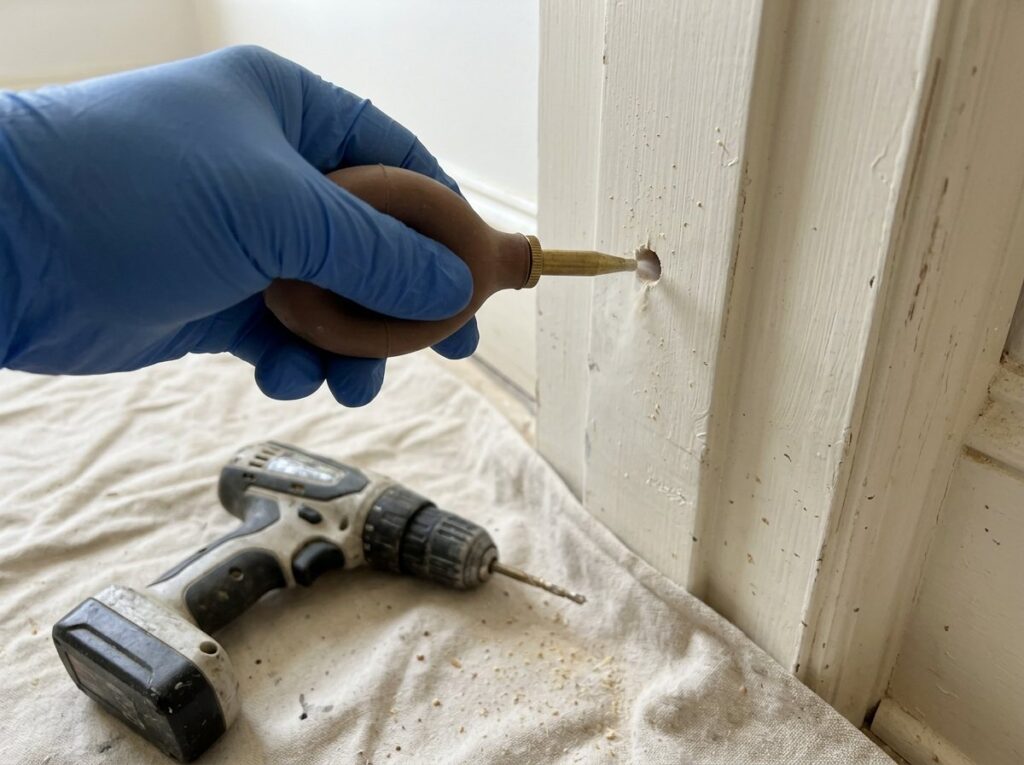
If you’ve found the nest, a direct treatment usually works faster. Drill a few small holes into the void or damaged wood, then puff a labeled dust inside with a bulb duster. UC IPM lists borate dusts and diatomaceous earth among the options for galleries. Desiccant dusts are low in toxicity but can seriously irritate the lungs if inhaled, so wear a dust mask and apply a light film rather than heavy piles. Seal the holes once activity stops.
Safety note: Always read and follow the pesticide label, and use only products that list carpenter ants and the site you’re treating. Never use outdoor-only products indoors, keep children and pets away during and after application, and wear gloves, eye protection and a mask when dusting. If someone is exposed, follow the label’s first aid steps and call Poison Control at 1-800-222-1222.
Step 3: Fix moisture and cut off ant highways
Treatment kills the colony, but these repairs keep the next one from moving in. UC IPM recommends most of these steps as the foundation of carpenter ant control.
- Fix leaking pipes, roof leaks and clogged gutters. Our guide to cleaning gutters safely walks you through the job.
- Replace rotten or water-damaged wood rather than just treating it.
- Improve ventilation in damp attics and crawl spaces.
- Trim tree branches and shrubs so they don’t touch the house.
- Seal gaps where utility lines and pipes enter.
- Keep mulch near the foundation 2 to 3 inches deep or less.
- Remove contact between soil and wood siding, trim or framing.
- Store firewood off the ground and several feet from the house.
Tools and materials
- Flashlight and honey or sugar water for tracking
- Carpenter ant bait stations or gel bait
- Labeled insecticide dust or diatomaceous earth and a bulb duster
- Drill with a small bit and a stud finder
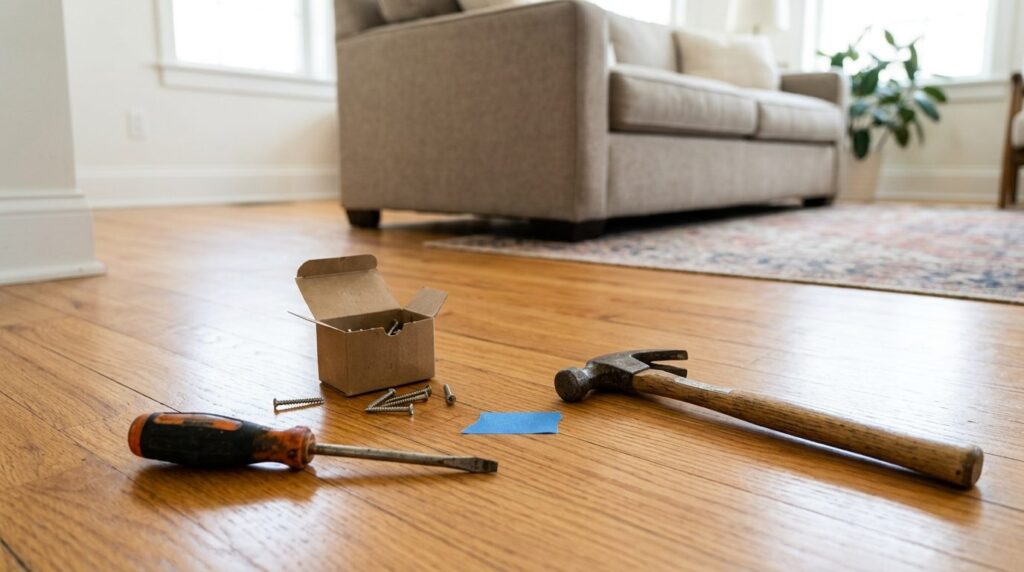
- Screwdriver for probing soft wood
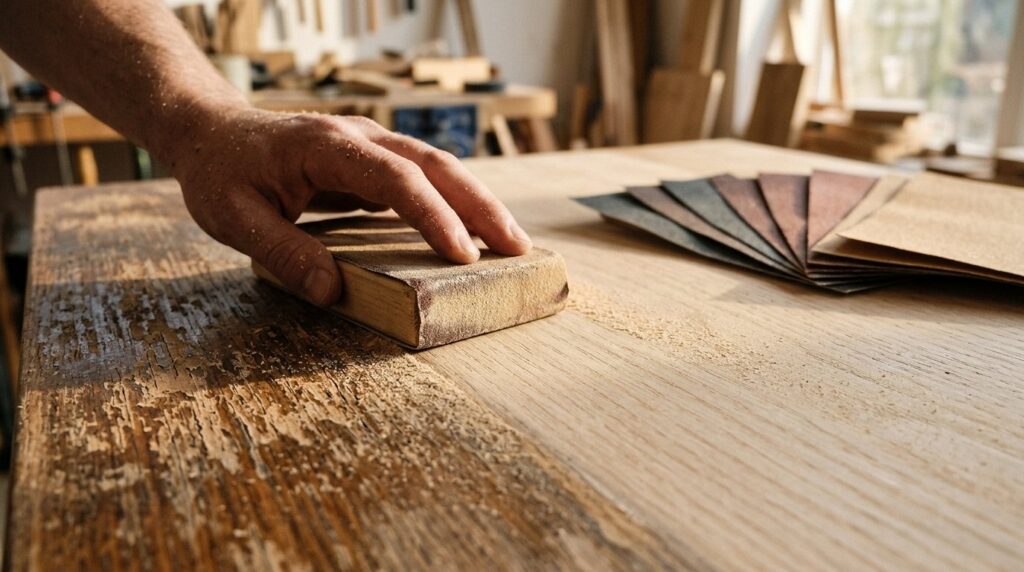
- Wood filler, caulk and replacement trim as needed
- Gloves, safety glasses and a dust mask
When structural damage needs a pro
Small nests in trim, a door frame or a window sill are often a DIY job. Call a licensed pest control company, and a carpenter or contractor for repairs, if you notice any of these red flags:
- You can’t find the nest after several evenings of tracking.
- Ants return every spring, which suggests satellite nests you haven’t found.
- The nest is in sill plates, joists, rafters or other structural framing.
- Floors feel soft or bouncy, or wood crumbles when you probe it.
- You’re not sure whether you’re dealing with ants or termites.
- The nest is high on the house, inside a chimney chase or somewhere you can’t reach safely.
According to This Old House, carpenter ant removal typically costs $250 to $500, making it the most expensive type of ant treatment. General ant extermination averages about $150. Repairing damaged framing is a separate cost, so ask the pest company to document the damage and get quotes from a contractor.
Frequently asked questions
Do carpenter ants eat wood?
No. They chew tunnels to make room for their nest and push the shavings out as frass. They feed on insects, honeydew from aphids, sweets and other foods.
How much damage can carpenter ants do?
Colonies grow slowly, so damage builds over several years rather than weeks. A large, long-established colony can excavate enough galleries to weaken structural wood, which is why you shouldn’t ignore repeated sightings.
Why am I seeing carpenter ants in fall or winter?
Outdoor ants slow down in cold weather. If you see workers inside during the colder months, the nest is probably in a warm part of your house, such as a wall near a heat source or a damp spot under a bathroom.
Does vinegar or dish soap kill carpenter ants?
Spraying vinegar or soapy water kills the ants it hits and can disrupt a trail, but it doesn’t reach the nest. Use it for cleanup, not as your treatment plan.
Will carpenter ants go away on their own?
Not usually. A colony with damp wood and steady food keeps growing and can produce satellite nests. Finding and treating the nest, then fixing the moisture, is what makes them leave for good.
The bottom line
To get rid of carpenter ants, find the nest first, then treat it directly or let slow-acting baits do the work. Fix the leaks and rotten wood that attracted them, trim back anything that touches the house, and follow every product label. If the nest is in framing or ants keep coming back, bring in a pro before small damage turns into a structural repair.