If your dishwasher smells sour when you open the door, leaves a gritty film on glasses or has a greasy ring around the bottom of the tub, it needs a proper cleaning. Food scraps, grease and hard water minerals collect in places the spray never fully reaches, even though the machine is full of hot water and detergent.
This guide walks you through a complete deep clean: the filter, spray arms, door gasket and tub, followed by a vinegar, baking soda or dishwasher cleaner cycle. You will also learn what causes odors, which cleaners to avoid and a simple monthly routine.
Quick answer: Remove the filter and scrub the mesh under hot running water with a soft brush. Clear the spray arm holes with a toothpick, wipe the door gasket and edges, then run an empty hot cycle with a dishwasher cleaner or about 2 cups of white vinegar in an upright cup. Follow with a short hot cycle using 1 cup of baking soda on the tub floor, and repeat monthly.
Why dishwashers get dirty and start to smell
Every load sends food particles, grease and detergent residue through the machine. Most of it goes down the drain, but some gets caught in the filter, sticks to the gasket or settles in the sump at the bottom of the tub. Whirlpool lists food scraps left in the bottom and buildup of detergent, minerals and dirt as the usual sources of odor.
| What you notice | Likely cause | What to do |
|---|---|---|
| Sour or rotten food smell | Food trapped in the filter or sump | Wash the filter, run a cleaning cycle |
| Musty or mildew smell | Door kept closed, mildew on the gasket | Scrub the gasket, leave the door ajar |
| White film or cloudy glasses | Hard water scale | Vinegar or citric acid cleaner, rinse aid |
| Upper rack dishes still dirty | Blocked or stuck spray arm | Clear the holes, check the arm spins |
| Standing water in the bottom | Clogged filter, drain hose or disposal | Clean the filter, then check the drain path |
If water still sits in the tub after you clean the filter, work through our dishwasher not draining guide before running a cleaning cycle.
Tools and materials
- White distilled vinegar (about 2 cups) and baking soda (about 1 cup)
- Dishwasher cleaner tablet or powder, as an alternative to vinegar
- Soft old toothbrush and toothpicks or a wooden skewer
- Dish soap, microfiber cloths and an old towel for drips
- Rubber gloves and a flashlight
- A dishwasher-safe cup that stands upright
How to clean a dishwasher, step by step
The hands-on part takes about 30 to 45 minutes, and the cleaning cycles do the rest. Keep your owner’s manual handy, since filter and spray arm designs vary between brands.
Step 1: Empty the machine and check the tub floor
Unload everything and slide out the bottom rack. Put on gloves and use a flashlight to check the drain area and under the lower spray arm. Remove anything that does not belong, such as broken glass, fruit pits, bones or labels, because these can jam the filter or damage the drain pump.
Step 2: Clean the dishwasher filter
Many newer dishwashers use a manual filter instead of a built-in food grinder. That makes them quieter, but the filter only stays clean if you clean it, and a clogged filter is the most common cause of smells, gritty dishes and slow draining.
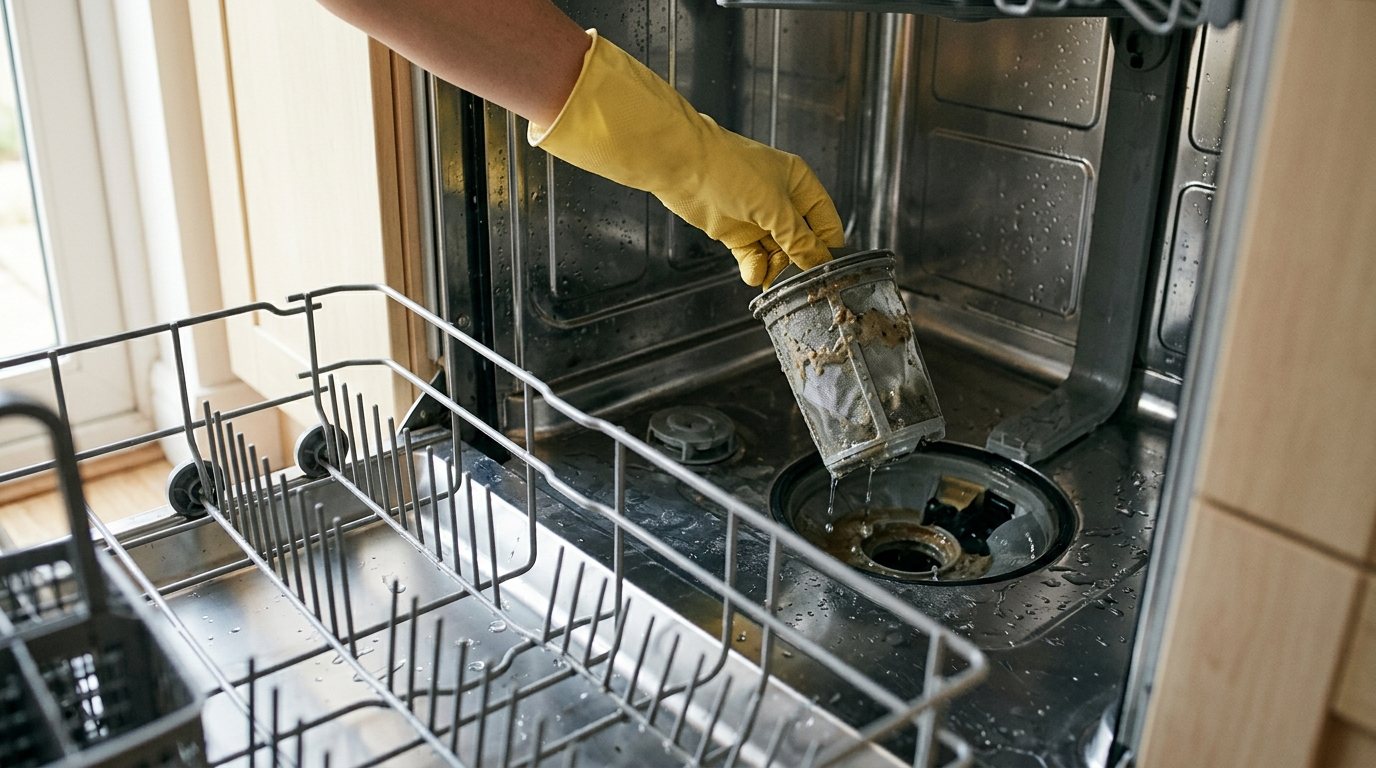
- Find the filter, usually a round cylinder in the back corner or center of the tub floor.
- Twist it counterclockwise about a quarter turn and lift it out. If there is a flat mesh screen underneath, lift that out too.
- Rinse both parts under hot running water and scrub the mesh gently with a soft toothbrush and a drop of dish soap.
- For greasy buildup, soak the filter in hot soapy water for 10 to 15 minutes. Never use a wire brush or scouring pad, which can tear the mesh.
- Wipe the filter housing and sump with a damp cloth.
- Reinstall the parts and twist the cylinder until it locks. An unlocked filter can let debris reach the pump.
Whirlpool recommends clearing food debris from the filter area after each load and removing removable filters to clear clogs. Some filters are not designed to come out, so check your manual first.
Step 3: Clear the spray arms
Seeds, rice, labels and hard water scale can plug the small holes in the spray arms, which leaves parts of the load dirty even when the machine sounds normal.
- Spin each arm by hand. It should turn freely without hitting the racks or filter.
- Remove the arms if your model allows it. Lower arms usually lift straight off; upper arms often unclip or unscrew from under the upper rack.
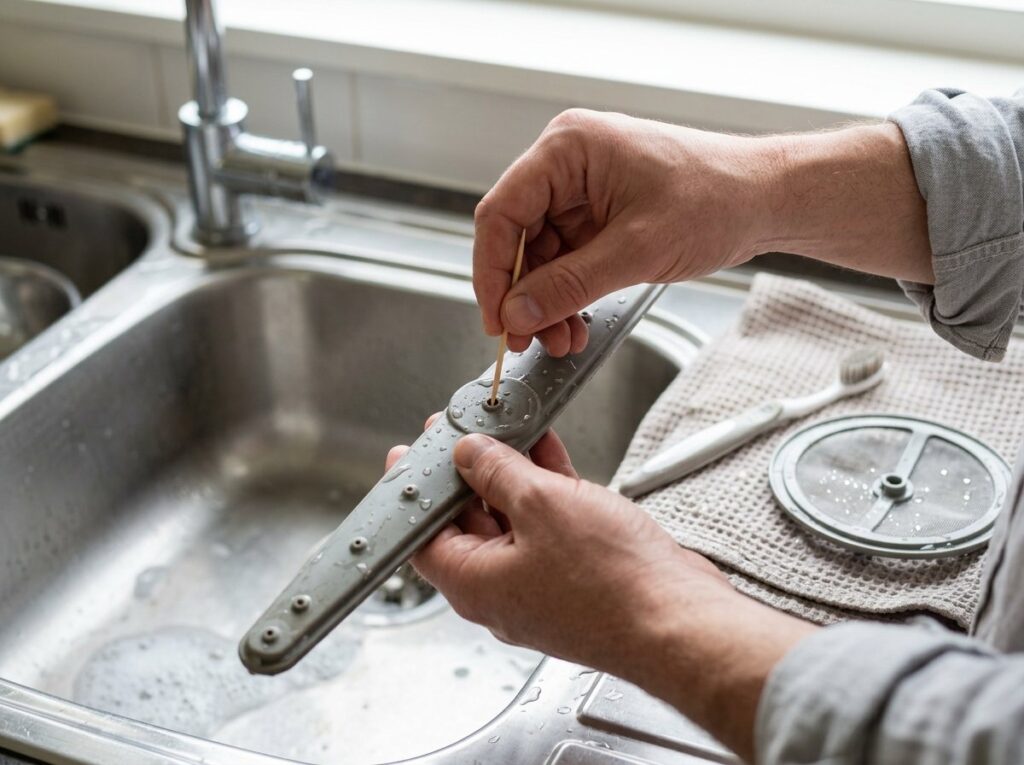
- Look through the holes against the light and push out debris with a toothpick, which is gentler on the plastic than a metal pin.
- Rinse and shake the arm to free loose bits inside. For white scale, soak it in warm water with a couple of cups of vinegar for about 20 minutes.
- Reinstall the arms and spin them again.
Step 4: Scrub the door, gasket and edges
The rubber gasket, the bottom edge of the door and the strip of tub just below the door opening collect the most grime because the spray does not hit them directly. This is also where black mildew spots usually appear.
- Mix warm water with a little dish soap, or about 3 cups of hot water with half a cup of white vinegar. Some manufacturers recommend plain warm water on the gasket, so follow your manual.
- Scrub along the gasket with a soft toothbrush, gently lifting any folds.
- Wipe the bottom edge of the door and the area below it where drips collect.
- Clean the detergent dispenser and rinse aid cap. Wipe the controls with a barely damp cloth, never a dripping one.
- Dry everything with a microfiber cloth.
Pro tip: If the gasket is cracked, flattened or has mildew that will not scrub off, replacing it usually beats fighting the smell. Many gaskets press into a channel by hand, and the part number is in your manual.
Step 5: Wash the racks and utensil basket
Wipe the racks with a soapy cloth and soak the utensil basket in warm water with a couple of cups of vinegar for about 20 minutes. Look for chipped coating or rust on the tines while you are there, since exposed metal can leave rust spots on dishes.
Deep-clean cycle: vinegar, baking soda or dishwasher cleaner
With the filter, arms and gasket clean, run a cycle to dissolve grease and mineral film on the tub walls, pump and hoses. Always run it with the dishwasher empty and no detergent.
Option 1: White vinegar, then baking soda
- Pour about 2 cups of white distilled vinegar into a dishwasher-safe cup and stand it upright on the lower rack, as Whirlpool’s instructions describe.
- Run a normal or hot cycle with heated dry turned off.
- When it finishes, sprinkle about 1 cup of baking soda across the tub floor.
- Run a short hot cycle to freshen the tub and lift light stains.
- Prop the door open for an hour or two so the tub dries completely.
Whirlpool notes that diluted apple cider vinegar may stain, so stick with distilled white. Run vinegar and baking soda in separate cycles, because mixed together they neutralize each other. Vinegar is acidic, and Whirlpool warns that using it too often could damage the dishwasher, so keep it for the monthly deep clean.
Option 2: A dishwasher cleaner
Dishwasher cleaner tablets and powders, many based on citric acid, are made to break down grease and limescale. Place the product where the package directs and run an empty hot cycle. It is the better choice for hard water, heavy buildup or an odor that vinegar did not fix.
What about bleach?
Skip chlorine bleach unless your manual specifically allows it. Home Depot warns that it damages stainless steel tubs and parts, and it does nothing for grease or scale. For mildew, scrubbing the gasket and drying the tub properly usually solves the problem.
Safety note: Never mix chlorine bleach with vinegar, ammonia or any acidic cleaner, and do not run them in back-to-back cycles without a plain rinse in between. The combination releases toxic chlorine gas. Wear gloves when reaching into the filter area, because broken glass often ends up there.
What causes dishwasher odors (and how to stop them)
Food trapped in the filter and sump
This is the most common cause. Rotting food in a warm, damp tub smells quickly, especially if the door stays shut for a few days. Scraping plates into the trash and checking the filter every week or two prevents most of it.
Mildew from trapped moisture
A dishwasher that stays closed between loads never fully dries, so mildew grows on the gasket and door bottom. Leave the door cracked for an hour after each cycle and wipe the gasket weekly.
A dirty garbage disposal or drain hose
Most dishwashers drain through the disposal, so a dirty disposal can push its smell back into the tub. Run the disposal before starting the dishwasher, and see our guide to garbage disposal smells if the sink smells too. The drain hose should also rise in a high loop under the sink to help stop dirty water flowing back.
Hard water buildup
Mineral scale gives grease a rough surface to cling to. If you see white crust or cloudy glasses, use rinse aid every load and choose a cleaner made for limescale. Our guide on removing hard water stains covers the same buildup on faucets and glass.
A simple monthly dishwasher cleaning routine
Whirlpool recommends a monthly deep clean, and more often with hard water. Home Depot suggests starting monthly and never going longer than six months between cleanings.
- Every load: Scrape plates, remove large scraps near the filter and run the kitchen tap until the water is hot before starting.
- Weekly: Wipe the gasket and door edges, and rinse the filter if you run the machine daily.
- Monthly: Wash the filter, clear the spray arms, scrub the gasket and run a vinegar and baking soda pair or a cleaner cycle.
- Every six months: Check the drain hose loop, inspect the gasket for cracks and look for rust on the racks.
If dishes still come out spotty or dirty after a full clean, the cause may be loading, detergent or water temperature. Our guide to a dishwasher not cleaning dishes walks through those fixes.
When to call a pro
Cleaning fixes most odor and film problems. Call an appliance technician if you notice any of these red flags:
- Water leaking onto the floor from the door or the base of the unit
- Standing water that remains after cleaning the filter and running the disposal
- A burning or electrical smell, or a cycle that trips the breaker
- Water that never heats, spray arms that will not spin or error codes that keep returning
According to HomeAdvisor’s dishwasher repair cost guide, most repairs run about $160 to $300, with an average around $200. A service call is typically $35 to $100 and is usually applied to the repair. Typical ranges include $75 to $100 for a spray arm, $50 to $100 for a door gasket or filter kit and $150 to $350 for a pump.
Frequently asked questions
How often should you clean your dishwasher?
Do a full deep clean once a month, covering the filter, spray arms, gasket and a cleaning cycle. Check the filter more often if you run the dishwasher daily. Homes with hard water may need the cleaning cycle more often.
Can you put vinegar and baking soda in a dishwasher at the same time?
No. Vinegar is an acid and baking soda is a base, so together they neutralize each other. Run the vinegar cycle first, then sprinkle baking soda on the tub floor and run a second short hot cycle.
Can vinegar damage a dishwasher?
A monthly vinegar cycle is what manufacturers like Whirlpool describe, but they warn that frequent use could damage the machine. Avoid adding vinegar to every load or using it in place of rinse aid. If your manual advises against it, use a dishwasher cleaner instead.
Why does my dishwasher smell like rotten eggs or sewage?
That smell usually comes from food rotting in the filter or sump, or from a dirty disposal sending odors back up the drain hose. Clean the filter, run the disposal with plenty of cold water and check the high loop in the drain hose. If the smell persists, have the drain connection checked.
Do I need to clean a self-cleaning dishwasher filter?
Machines with a built-in grinder need much less filter care, but the sump can still collect bones, glass and seeds. Check the bottom of the tub monthly and wipe out any debris. Your manual will tell you which type you have.
The bottom line
Most dishwasher smells and cloudy dishes come from a dirty filter, plugged spray arms and grime on the gasket. Clean those three areas, run an empty vinegar or dishwasher cleaner cycle followed by baking soda, and leave the door ajar to dry. Repeat it monthly and your dishwasher will smell fresh, clean better and last longer.