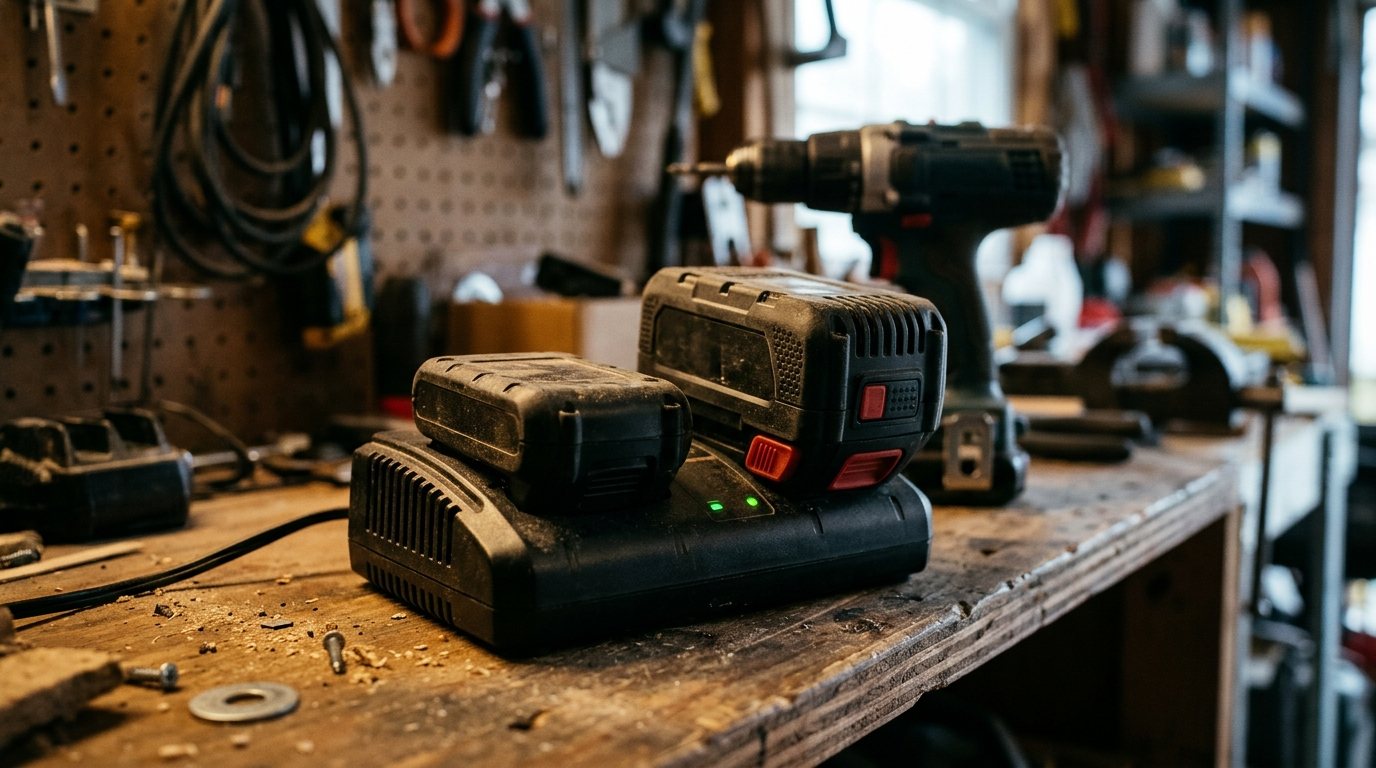
One cordless drill says 20V MAX, the one next to it says 18V, and the price tags are almost the same. It’s natural to assume the 20-volt tool is more powerful, or that the two batteries might be interchangeable. Neither is true, and the labels cause a lot of confusion when you’re choosing your first cordless tool or buying one as a gift.
This guide explains what 18V and 20V MAX really mean, how amp-hours and watt-hours affect runtime, why brushless motors matter, and how to choose a battery platform you’ll be happy with for years. You’ll also find storage, charging and disposal tips that help lithium-ion packs last longer and stay safe.
Quick answer: 18V and 20V MAX batteries are the same thing measured two ways. Both use five lithium-ion cells; 20V is the peak voltage of a fully charged pack with no load, while 18V is the nominal voltage under normal use. Compare tools by torque, motor type and amp-hours, not by the 18 or 20 on the label, and remember that batteries only fit tools from the same brand platform.
18V vs 20V MAX: the same pack, labeled differently
Cordless tool batteries are built from lithium-ion cells connected in series. Each cell is rated at about 3.6 volts nominal and reaches roughly 4 volts when fully charged. Five cells in series give you 18 volts nominal, but about 20 volts right off the charger with nothing connected.
Some brands label their packs by that peak figure and others by the nominal figure. One major manufacturer spells it out in the fine print on its 20V MAX battery listing: the maximum initial voltage, measured without a workload, is 20 volts, and the nominal voltage is 18. That’s why tool reviewers treat 18V and 20V MAX tools as direct competitors.
The same logic applies across the range. A 12V MAX pack is 10.8 volts nominal, a 40V MAX pack is 36 volts nominal and a 60V MAX pack is 54 volts nominal. Outside the US, the same packs are often sold under the nominal number, so an 18V tool in the UK or Australia may be identical to a 20V MAX tool in the US.
| Label you’ll see | Nominal voltage | Cells in series | Typical tools |
|---|---|---|---|
| 12V or 12V MAX | 10.8V | 3 | Compact drills, drivers, small saws |
| 18V or 20V MAX | 18V | 5 | Drills, impact drivers, circular saws, most household tools |
| 36V or 40V MAX | 36V | 10 | Mowers, blowers, string trimmers |
| 54V or 60V MAX | 54V | 15 | High-demand saws, grinders, outdoor tools |
What actually affects power and runtime
Amp-hours (Ah)
Amp-hours measure capacity, or how long a pack can deliver current. A 5.0Ah battery holds about two and a half times the energy of a 2.0Ah battery at the same voltage, so it runs longer, but it’s also bigger and heavier. Higher-capacity packs can also help demanding tools like circular saws hold their speed under load.
Watt-hours (Wh)
Watt-hours combine voltage and capacity, which makes them the fairest way to compare total energy. Multiply nominal voltage by amp-hours: an 18V 2.0Ah pack holds about 36Wh, and an 18V 5.0Ah pack holds about 90Wh. A 12V 2.0Ah pack holds about 21.6Wh.
Motor type
Brushless motors waste less energy on friction and heat than older brushed motors, so they deliver more runtime and power from the same battery and need no brush replacement. They cost more, but for tools you’ll use often, the difference is usually worth it.
The tool itself
Two 18V drills can perform very differently. Gearing, electronics and motor design matter as much as the battery. Compare torque ratings, speed, and reviews rather than the voltage number. Our guide to impact driver vs drill explains how torque figures translate to real jobs.
Choosing the right amp-hour size
| Battery size | Feel | Best for |
|---|---|---|
| 1.5Ah to 2.0Ah (compact) | Light and slim | Drills and impact drivers, overhead work, furniture assembly |
| 3.0Ah to 5.0Ah (standard) | Balanced | All-day household projects, jigsaws, reciprocating saws |
| 6.0Ah and up (high capacity) | Heavy and bulky | Circular saws, grinders, mowers, blowers |
Many homeowners do best with one compact pack for drills and drivers and one larger pack for saws and outdoor tools. Small packs in power-hungry tools drain quickly and run hot.
How to choose a battery platform
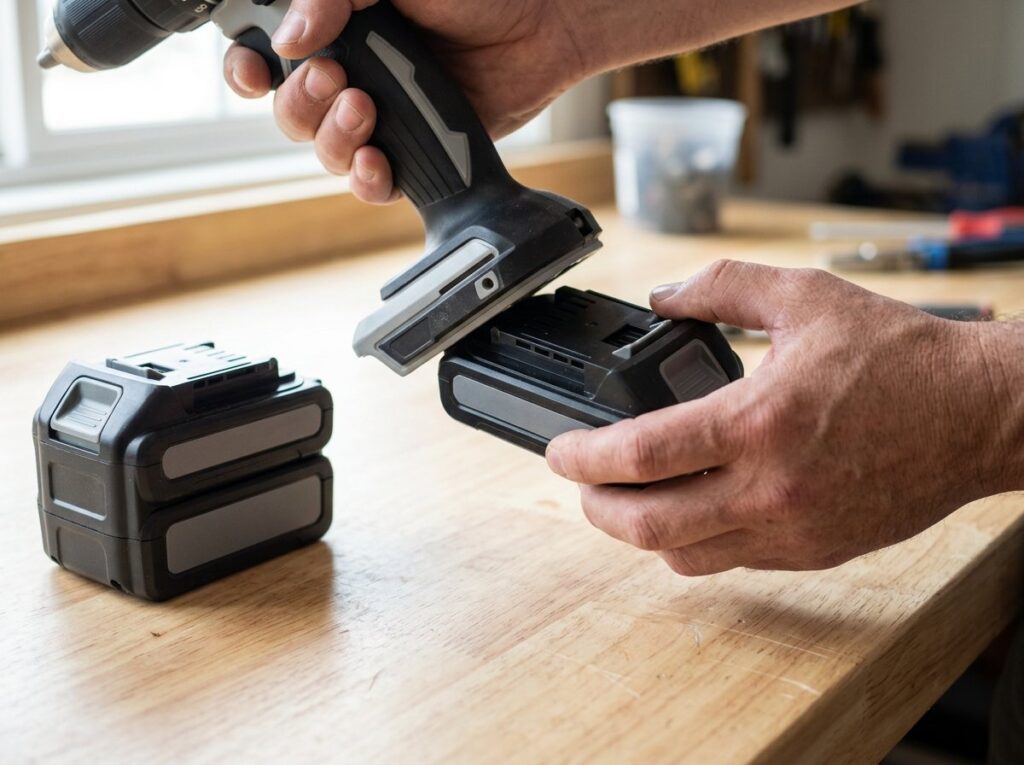
A battery platform is a brand’s family of tools that share one battery type. Batteries generally don’t fit across brands, so your first cordless purchase usually decides your next ten. Take a few minutes before you buy.
- List the tools you’ll realistically want in the next few years: drill, impact driver, circular saw, leaf blower, string trimmer or work light.
- Check that the platform offers all of them at a price you’re comfortable with, including outdoor tools if you need them.
- Decide between 12V and 18V/20V. A 12V system is lighter and cheaper for light household tasks, while 18V/20V covers almost everything, including saws and yard tools.
- Look at the cost of extra batteries, since packs can cost as much as a bare tool.
- Prefer brushless tools and kits with two batteries and a charger.
- Check where you can buy tools and get warranty service locally.
Pro tip: Once you have a couple of batteries, buy additional tools as bare tools (tool only, no battery) to save money. Tool retailers often run bundle and free-battery promotions, including around the holidays. If you’re buying a cordless tool as a gift, find out which platform the person already owns so their batteries fit.
Can you mix batteries and adapters?
An 18V pack and a 20V MAX pack from different brands may be electrically similar, but the connectors, latches and communication electronics are different. Third-party adapters that let one brand’s battery run another brand’s tool exist, but they bypass the protections the manufacturers designed and can void your warranty. For safety, stick with genuine or properly certified batteries and the charger made for them.
Within a single brand, compatibility is usually broad. Most brands’ compact, standard and high-capacity packs fit all tools in the same platform, and some brands offer packs that work across two voltage lines. Check the manufacturer’s compatibility chart before you buy.
Charging, storage and battery life
Lithium-ion packs typically last a few hundred charge cycles, and heat is what shortens their life most. According to this guide to common tool battery mistakes, packs usually last roughly 300 to 500 recharges, and long-term heat above about 80 degrees Fahrenheit begins to damage them.
- Store batteries indoors at around half charge if you won’t use them for a while, not fully charged or completely flat.
- Keep them out of hot cars, attics and sun-baked garages, and bring them inside during freezing weather.
- Let a hot battery cool before charging it.
- Use the charger designed for your battery, and don’t leave packs on old chargers that lack smart charging.
- Avoid running packs until the tool stops completely when you can help it.
Cold-weather use
Lithium-ion packs deliver less runtime when they’re cold, which you’ll notice with cordless snow blowers, leaf blowers and outdoor work lights in winter. Keep spare packs indoors and bring them out just before use. Many chargers won’t start charging a very cold pack until it warms up, so let a battery reach room temperature before you put it on the charger.
Signs a battery is wearing out
An aging pack runs noticeably shorter than it used to, drops from full to empty quickly, gets hot during light use or triggers fault lights on the charger. Once a pack shows these signs, retire it to light-duty tools or recycle it rather than pushing it in a saw or grinder.
Safety note: Stop using any battery that’s swollen, cracked, leaking, unusually hot or smells burned, and keep it away from flammable materials. Never throw lithium-ion batteries in household trash or recycling bins. The EPA advises taking them to a battery drop-off or household hazardous waste site, with the terminals covered in electrical tape.
When to call a pro (or the manufacturer)
Battery problems rarely need a contractor, but they do sometimes need the manufacturer or an authorized service center:
- A battery or charger gets hot, smokes, sparks or smells burned
- A pack is swollen, cracked or was dropped hard and now behaves oddly
- The charger flashes a fault code with several known-good batteries
- A tool is still under warranty and stops working with fresh batteries
Because replacement packs can cost as much as the tool itself, contact the manufacturer about warranty coverage before you buy a new one. If you want to check a pack yourself first, our guide on how to use a multimeter shows how to read DC voltage safely, but never open a lithium-ion pack.
Frequently asked questions
Is 20V more powerful than 18V?
No. A 20V MAX battery and an 18V battery both use five lithium-ion cells and have the same nominal voltage. Differences in power come from the motor, electronics and battery capacity, not the label.
Can I use an 18V battery in a 20V tool?
Only if both come from the same brand platform. Different brands use different connectors and electronics, so a battery from one brand won’t fit another brand’s tool without an adapter, which isn’t recommended.
Does a higher amp-hour battery give more power?
It mainly gives longer runtime. Larger packs can help power-hungry tools like circular saws hold their speed, but they add weight, so compact packs are often better for drills and drivers.
Is 12V enough for a homeowner?
For light jobs like furniture assembly, hanging pictures and small repairs, yes. If you want saws, yard tools or plan to build decks and fences, an 18V or 20V MAX platform is the better long-term choice.
Should I leave batteries on the charger?
Most modern chargers stop charging when a pack is full, but it’s still best to remove batteries once they’re charged. For long-term storage, keep them off the charger at around half charge in a cool, dry room.
How long do cordless tool batteries last?
Typically a few hundred charge cycles, or several years of normal homeowner use. Storing them cool and partly charged, and avoiding heat, helps them last longer.
The bottom line
When you compare 18V vs 20V batteries, you’re comparing the same five-cell pack described two ways. Choose a platform based on the tools you’ll need, prefer brushless motors, pick amp-hours to match the job, and store packs cool and partly charged. If you’re still building your collection, our basic home tool kit guide shows which cordless tools to buy first.