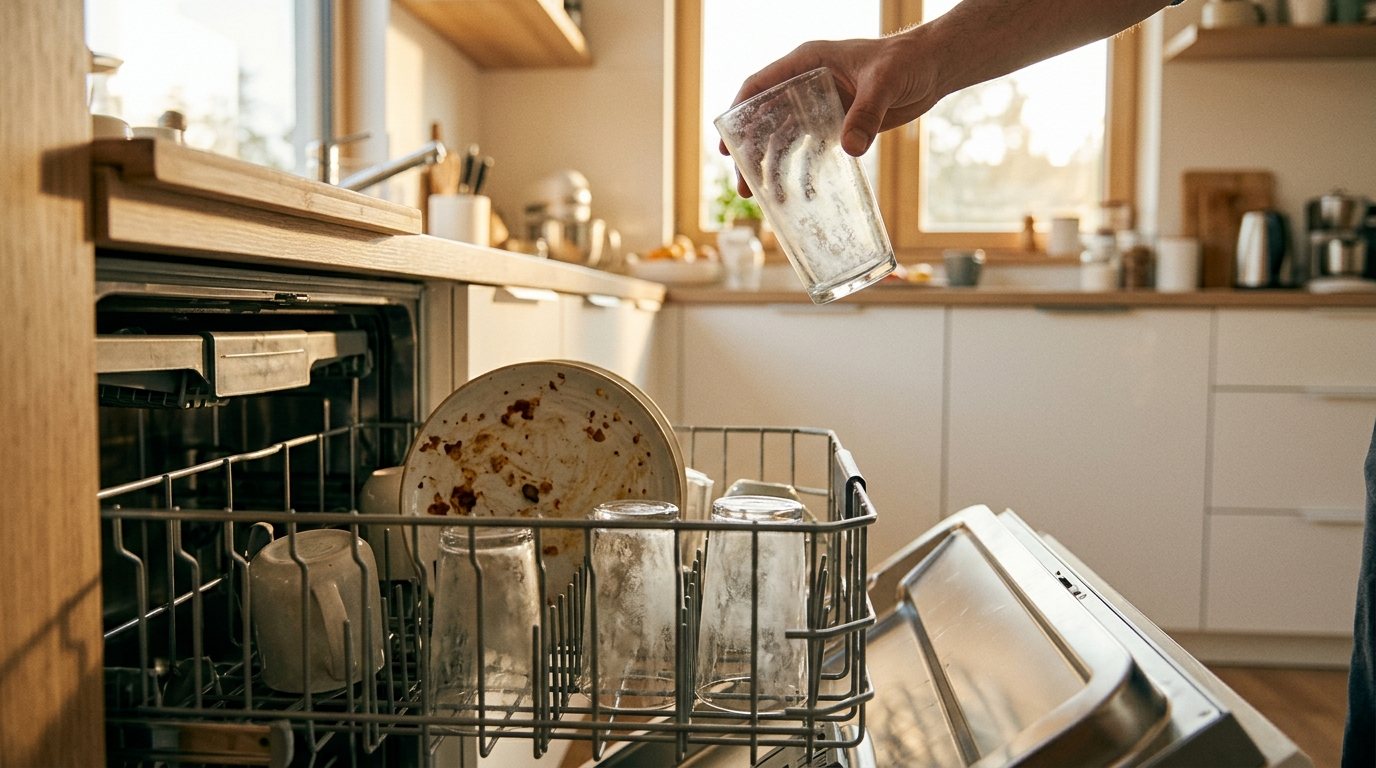
You open the dishwasher expecting clean plates and find dried egg on the forks, gritty specks on the glasses, or a cloudy film on everything. Running the load again rarely helps, and it is tempting to blame the detergent or assume the machine is dying.
In most cases the cause is something you can fix in under an hour with no special tools. This guide covers every common reason a dishwasher stops cleaning, in the order a technician would check them, plus a troubleshooting table, repair costs and signs it is time to call a pro.
Quick answer: Clean the filter at the bottom of the tub and clear the holes in the spray arms first, since those two cause most poor results. Then run the kitchen tap until it is hot before starting a cycle, use fresh dishwasher detergent plus rinse aid, and load so nothing blocks the arms. If dishes are still dirty, check whether the tub fills with enough water, which points to the inlet valve.
First, figure out what kind of “dirty” you have
The type of residue tells you where to look, so inspect a few items before you take anything apart.
- Food stuck to dishes: usually a clogged filter, blocked spray arms, loading problems or too little water.
- Gritty specks: food particles recirculating because the filter is full.
- White film that wipes off with vinegar: hard water minerals, too little detergent or no rinse aid.
- Cloudy film that will not wipe off: etching, permanent damage linked to overly soft water, too much detergent or very hot water.
- Detergent left in the cup: the dispenser is blocked, the water is too cool or the detergent is old.
- One rack dirty, the other clean: a blocked spray arm on that level, or a “top rack only” cycle.
To separate hard water film from etching, try the vinegar test from Samsung’s dishwasher support page: wipe a cloudy glass with white vinegar or lemon juice. If the film comes off, it is mineral buildup you can fix. If it stays, the glass is etched.
Common causes and how to fix them
Work through these in order. The first four are free and solve most cases.
1. Dirty or clogged filter
Many newer dishwashers use a manual filter you must clean yourself. When it fills with food, grease and labels, dirty water gets sprayed back onto your dishes. Clean it every month or two, or more often if you do not scrape plates.
- Pull out the bottom rack and find the round filter cylinder in the floor of the tub, near the back or around the lower spray arm.
- Twist it counterclockwise, usually about a quarter turn, and lift it out along with any flat mesh screen beneath it.
- Rinse both parts under warm water and scrub grease with a soft brush. Never use a wire brush or scouring pad, which can tear the mesh.
- Wipe out the sump below, then reinstall the screen and lock the cylinder back in.
If more than about an inch of water sits in the tub after a cycle, you may also have a drain problem. See our guide to a dishwasher not draining.
2. Clogged or stuck spray arms
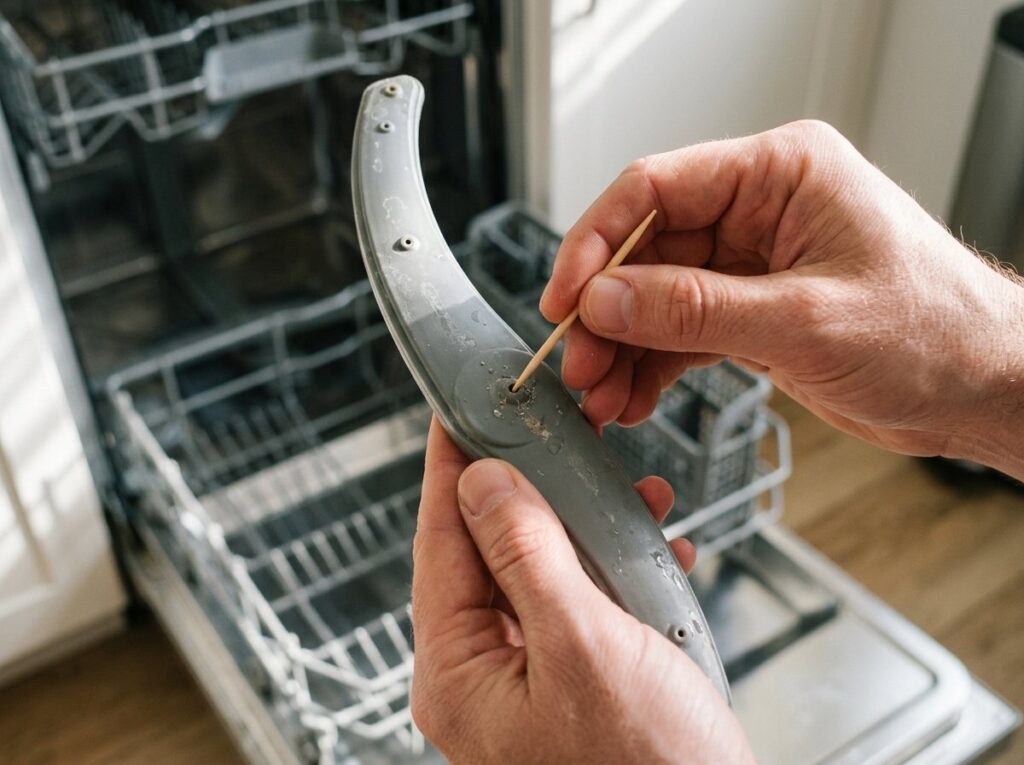
Spray arms spin on the pressure coming out of their small holes. Seeds, glass chips and mineral scale plug those holes, so the arm sprays weakly or stops turning.
- Spin each arm by hand. It should turn freely without rubbing on anything.
- Remove the arms as your manual describes. Lower arms usually lift off, while upper arms unscrew or unclip.
- Hold each arm to the light, clear blocked holes with a toothpick, and shake out debris from inside.
- Soak heavily scaled arms in white vinegar for about 30 minutes, rinse and refit.
Replace a cracked arm rather than gluing it, because heat and water quickly break down most adhesives.
3. Loading mistakes
Water has to reach every soiled surface, so anything that blocks the spray or the arms leaves dirty spots.
- Face dirty sides of plates and bowls toward the center, where the spray is strongest.
- Do not nest bowls or let spoons cup together. Mix utensil handles up and down.
- Keep tall platters and cutting boards at the sides or back so they do not block the dispenser.
- Turn each spray arm by hand after loading. If it hits anything, rearrange.
Check your cycle too. Quick and light cycles struggle with baked-on food, so use the heavy cycle for pots and casseroles, and remember that “top rack only” turns the lower arm off.
4. Water is not hot enough
Detergent and grease removal both depend on heat. Most manufacturers want water entering the dishwasher at about 120°F (49°C), and LG’s support guidance says not to exceed 140°F (60°C), because hotter water can etch glass while cooler water leaves food behind.
Before you start a load, run the hot tap at the kitchen sink until it runs hot, then start the dishwasher so the first fill is not lukewarm. If the tap never gets much above 110°F on a kitchen thermometer, check your water heater setting, and consider our guide on how to flush a water heater if sediment is limiting hot water. Avoid running the dishwasher during showers or laundry.
Safety note: Do not raise your water heater above 120°F just to help the dishwasher, especially if young children or older adults live in the home, because hotter tap water increases the risk of scalds. Use the dishwasher’s heated wash or sanitize option instead.
5. Detergent problems
Never use liquid hand dish soap in a dishwasher. It foams heavily, weakens the spray and can push suds out of the door.
- Old detergent: opened powder and pods absorb moisture and stop dissolving. Store them sealed in a cool, dry cupboard.
- Wrong amount: too little leaves food and film, while too much can leave residue and, with soft water, cause etching. Follow your dispenser fill lines.
- Blocked dispenser: if detergent is still in the cup after the cycle, make sure no tall item or rack stops the door opening.
- Pre-rinsing: scrape scraps into the trash but skip rinsing. Enzyme detergents work best with some food soil to act on.
6. No rinse aid
Rinse aid helps water sheet off dishes instead of drying as droplets, which reduces spots and film and improves drying. Refill it when the indicator comes on or about every three to four weeks. If spots persist, many models let you raise the rinse aid setting.
7. Hard water film
Hard water carries calcium and magnesium that leave a chalky coating on glasses and the tub, and the same scale builds up in spray arm holes and valves over time.
- Confirm it with the vinegar test, a home test strip or your water utility’s annual quality report.
- Use quality detergent and rinse aid every load.
- Descale monthly by running an empty hot cycle with a cup of white vinegar upright on the top rack, or use a dishwasher cleaner.
- For very hard water, consider a water softener. Samsung notes water should not be softened below about 7 grains per gallon, since overly soft water can etch glass.
Our guides on how to remove hard water stains and how to clean a dishwasher cover descaling in more detail.
8. Low water fill or a failing inlet valve
If dishes are still dirty, the machine may not be getting enough water. The inlet valve behind the lower kickplate lets water in, and when its screen clogs or the valve weakens, the tub underfills and the spray loses force.
Start a normal cycle, wait until the fill stops and the wash motor runs, then open the door. Water should cover the bottom of the tub around the filter. If you see only a puddle, or hear hammering or buzzing during the fill, suspect the valve. Also make sure the supply valve under the sink is fully open. Many manufacturers specify roughly 20 to 120 psi at the dishwasher.
9. Wash pump, diverter or dispenser failure
Less often, a part fails. A worn wash pump may hum or squeal without moving much water. A failing diverter, which switches water between the upper and lower arms, often leaves one rack dirtier than the other. A faulty dispenser latch leaves the cup closed. These repairs need testing with a multimeter and are good jobs for a pro.
Dishwasher troubleshooting table
| What you see | Likely cause | What to do |
|---|---|---|
| Gritty specks on glasses | Clogged filter | Remove, rinse and brush the filter |
| Food stuck on one rack | Blocked spray arm, diverter or half-load cycle | Clear arm holes, use a full cycle |
| Food stuck in random spots | Loading, nested items, light cycle | Reload facing the arms, use heavy cycle |
| Greasy film on plastics | Water too cool | Run the hot tap first, use heated wash |
| White film that wipes off | Hard water, no rinse aid | Add rinse aid, descale monthly |
| Cloudy film that stays | Etching | Use less detergent, avoid over-softened water |
| Detergent left in cup | Blocked or faulty dispenser | Move tall items, test the dispenser |
| Only a puddle during wash | Inlet valve or low pressure | Open supply valve, have the valve tested |
| Humming, weak spray | Wash pump failure | Call a technician |
Tools and materials
- Soft brush or old toothbrush
- Toothpicks
- White vinegar or dishwasher cleaner
- Fresh detergent and rinse aid
- Kitchen thermometer
- Towels for spills
- Screwdriver and multimeter (optional, for valve checks)
When to call a pro
Call an appliance technician if you have cleaned the filter and arms, fixed loading and water temperature, and dishes are still dirty. Other red flags:
- The tub fills with only a puddle, or not at all.
- Loud humming, grinding or squealing during the wash.
- Water leaking from the door or base.
- A burning smell, a tripped breaker or recurring error codes.
According to HomeAdvisor’s dishwasher repair cost guide, most repairs run about $160 to $300, plus a service call fee of roughly $35 to $100 that is often credited toward the work. Typical ranges include $80 to $125 for an inlet valve, $75 to $100 for a spray arm and $150 to $350 for a pump. With average replacement around $1,200 and most machines lasting 8 to 10 years, replacing an older unit makes sense when a repair nears half the cost of a new one.
Frequently asked questions
Why is my dishwasher leaving food on dishes?
The usual causes are a clogged filter, blocked spray arm holes and dishes loaded so they shield each other. Clean the filter and arms first, then reload with dirty surfaces facing the center. If it continues, check water temperature and fill level.
Why are my dishes gritty after the dishwasher?
Grit is usually food particles sprayed back because the filter is full. It can also be undissolved powder from old detergent or cool water. Clean the filter, use fresh detergent and run the hot tap first.
Should I run vinegar through my dishwasher?
An occasional empty hot cycle with a cup of vinegar upright on the top rack helps remove scale and grease. Do not pour it into the detergent dispenser or use it every load. If your manual warns against vinegar, use a dishwasher cleaner instead.
Is it worth fixing a dishwasher that does not clean?
Usually yes, because most causes are free fixes. An inlet valve or spray arm is often worth replacing too. If the machine is near 10 years old and needs a pump or control board, replacement is often better value.
Why are my glasses cloudy after the dishwasher?
Film that comes off with vinegar is hard water, which rinse aid and descaling fix. Film that stays is etching and is permanent. Use less detergent and avoid very hot or over-softened water to stop it spreading.
The bottom line
A dishwasher that leaves dishes dirty is rarely broken. Clean the filter and spray arms, load so water reaches every surface, run the hot tap first and use fresh detergent with rinse aid. If the tub still underfills or the pump hums without spraying, that is the point to book a technician.