The boiler is running, but one radiator is warm at the bottom and cold at the top, or you hear gurgling every time the heat comes on. Trapped air is the usual culprit in a hot water system, and letting it out is one of the quickest, cheapest heating fixes you can do yourself.
Before you grab a radiator key, though, you need to know which kind of system you have. Hot water radiators are bled by hand, while steam radiators vent air automatically and should never be opened the same way. This guide shows you how to tell them apart, how to bleed hot water radiators safely, how to check boiler pressure afterward and what to do with a cold steam radiator.
Quick answer: For hot water radiators, turn the heat off and let them cool, then open each bleed valve about a quarter to half turn with a radiator key until air stops hissing and a steady stream of water appears. Work from the lowest floor up, then check that the boiler pressure gauge is back in its normal range, often around 12 to 15 psi for a one- or two-story home. Never open or remove the air vent on a steam radiator.
Signs your radiators need bleeding
- The radiator is cold at the top and warm at the bottom.
- You hear gurgling, trickling or bubbling in the radiator or pipes.
- Some radiators heat up well while others, often upstairs, stay lukewarm.
- Rooms take longer to warm up and the boiler runs longer than usual.
A radiator that is cold at the bottom but warm at the top is a different problem, usually sludge settling inside, which bleeding will not fix.
Hot water or steam? Check before you touch anything
Many older homes in the US have steam heat, and the radiators look similar to hot water ones. The clues below will tell you which system you have.
| Clue | Hot water system | Steam system |
|---|---|---|
| Valve near the top of the radiator | Small bleed valve with a square stem or a screwdriver slot | Larger chrome or brass air vent, often bullet shaped, on the side |
| Pipes to each radiator | Two pipes, one in and one out | Often a single pipe with one valve at the bottom |
| Boiler gauge | Pressure and temperature gauge, usually reading in psi | Glass sight tube showing the water level, plus a low-pressure gauge |
| Sounds | Mostly quiet, some gurgling if air is trapped | Hissing vents and occasional clanking as steam arrives |
| Can you bleed it? | Yes, by hand | No; vents release air automatically |
Why you should never bleed a steam radiator
A steam radiator has no water in it to bleed. As the boiler heats, steam pushes air out through the vent on the side of the radiator, and the vent closes when hot steam reaches it. As HeatingHelp.com explains, every steam system is an open system that breathes air in and out through its vents.
Opening, unscrewing or prying at that vent while the system is running can release steam hot enough to cause serious burns, and it lets air and water escape where they should not. If a steam radiator stays cold, check these instead:
- The supply valve. On a one-pipe system, the valve at the bottom should be fully open or fully closed, never partway.
- The air vent. Rust and debris carried by the steam clog vents over time. A vent that never lets air out, or that spits water, usually needs replacing.
- The pitch. A one-pipe radiator should tilt slightly back toward the supply valve so condensed water can drain. Trapped water causes banging and cold spots.
Steam pipes that bang loudly are a related problem; our guide to banging pipes and water hammer explains the causes.
Safety note: Radiators, pipes and the water inside a hot water system can be hot enough to scald. Turn the heat off and let the radiators cool before bleeding, wear gloves, and keep your face away from the valve. Never remove a steam vent while the boiler is firing.
Tools and materials
- Radiator bleed key (or a flathead screwdriver for slotted valves)
- Old towel or rag to wrap around the valve
- Small cup, bowl or container to catch water
- Work gloves
- Flashlight for reading the boiler gauge
How to bleed a hot water radiator step by step
- Turn the heat off. Set the thermostat to OFF and wait until the radiators are cool enough to touch comfortably. Bob Vila also notes that running the system while bleeding can draw more air in.
- Plan your route. Start with the radiators on the lowest floor and work upward, finishing with the top floor, because air rises and collects in the highest radiators.
- Find the bleed valve. It is usually a small fitting at the top corner of the radiator, on the opposite end from the supply pipe.
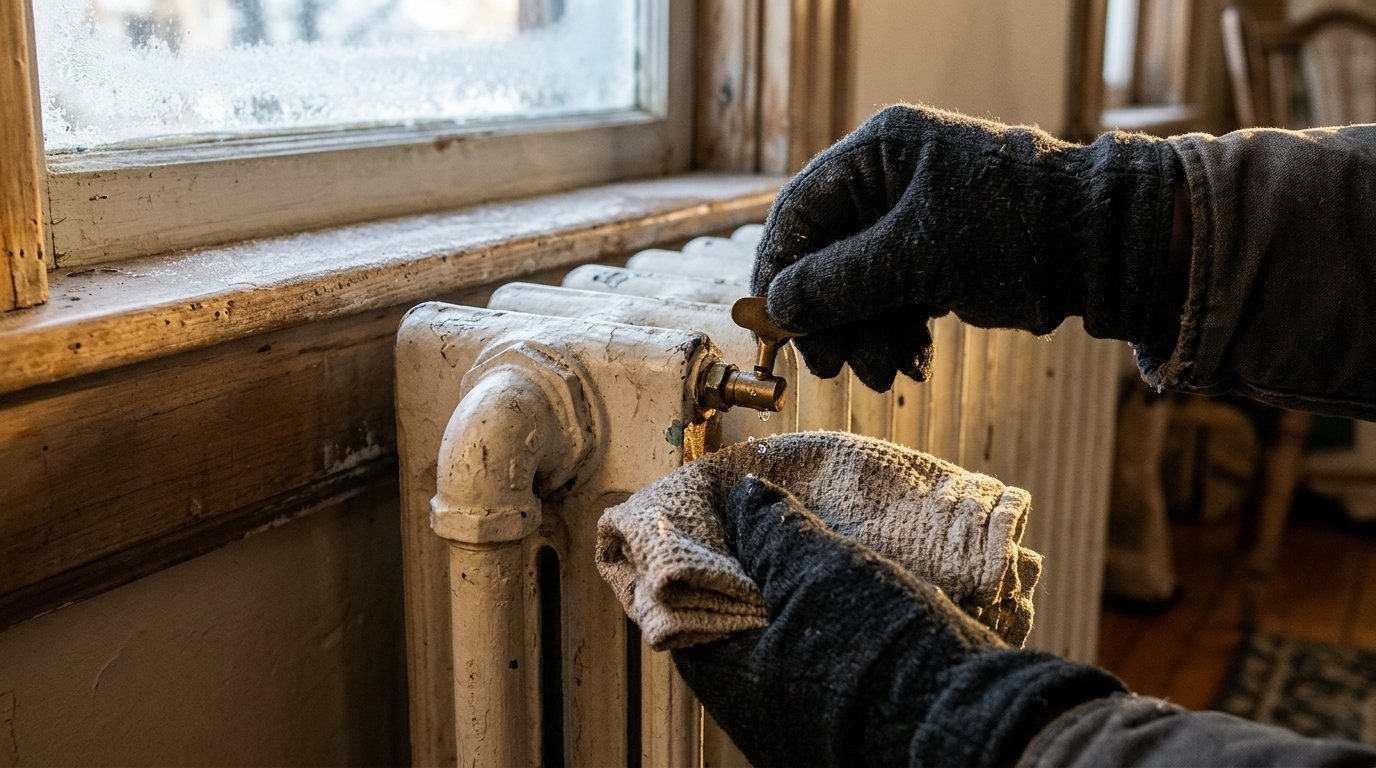
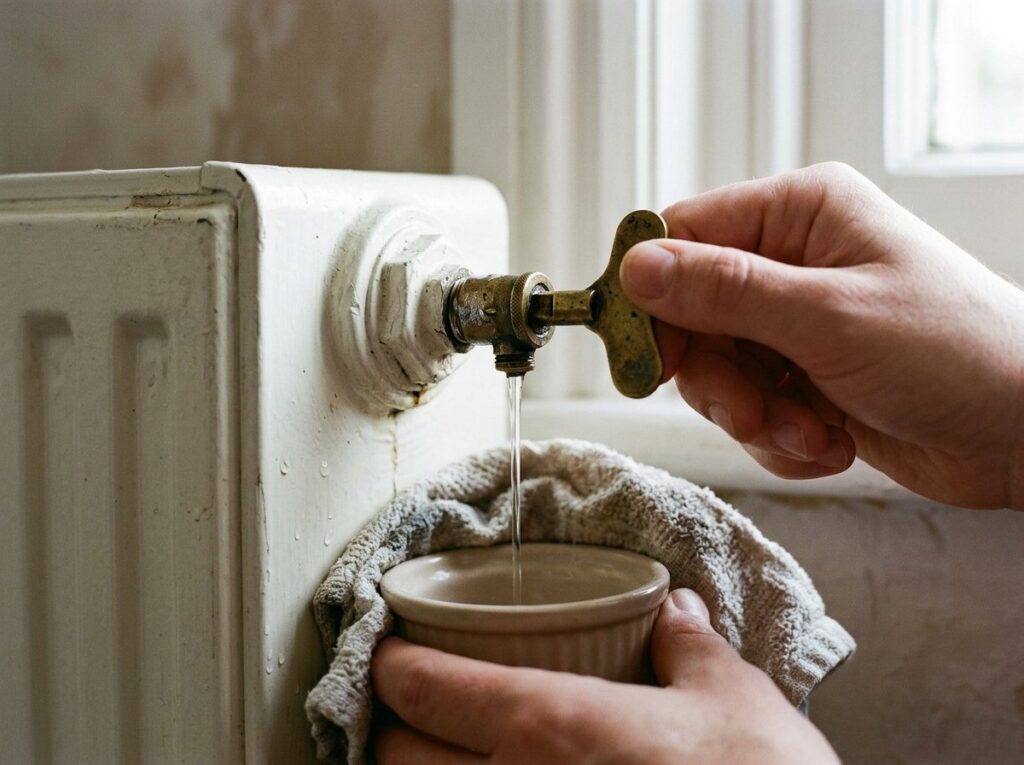
- Protect the floor. Hold a rag around the valve and put a cup or bowl underneath.
- Open the valve slowly. Fit the key and turn it counterclockwise about a quarter to half turn. You should hear air hissing out. Do not unscrew it all the way.
- Close it when water flows. When the hissing stops and water comes out in a steady stream instead of sputtering, turn the key clockwise to close it snugly. Do not overtighten.
- Repeat on every radiator. Bleed them all, including those that seem fine, since small air pockets add up.
- Check the boiler pressure. Look at the gauge on the boiler and compare it with the normal range in the next section.
- Turn the heat back on. After an hour or so, feel each radiator from top to bottom. It should be evenly warm.
Pro tip: Radiator keys are cheap and easy to lose. Buy two, then tape one to the boiler or a nearby pipe so it is always there at the start of the heating season.
What if there is no bleed valve?
Not every hot water system has a manual bleed valve on each radiator. Fin-tube baseboard heaters often hide a small vent under the end cover, sometimes a coin-slot valve you can open with a flat screwdriver or a coin. Some radiators and high points in the piping have automatic air vents with a small cap on top instead, which release air on their own and only need attention if they leak or stop working.
If you cannot find any vent at all, air is usually removed at the boiler through purge valves or an air separator. Purging a system that way involves the fill valve and pump, so it is best left to a heating technician.
Check your boiler pressure after bleeding
Letting air and a little water out lowers the pressure in a hot water system. Most US systems have an automatic fill valve that tops the system back up, but you should still confirm the gauge returns to its normal reading. Bob Vila gives a rule of thumb of about 1 psi for every 2 feet of height, which works out to roughly 12 to 15 psi for a standard two-story house.
The heating pros at HeatingHelp.com give similar figures:
| Home or reading | Typical pressure |
|---|---|
| One-story house with basement | About 12 psi |
| Two-story house | About 12 to 15 psi, up to 25 psi in some systems |
| Three-story house | About 18 to 25 psi |
| Typical residential relief valve setting | 30 psi |
Your boiler’s data plate and manual give the exact range for your system. Gauges in the UK and Australia usually read in bar, so follow the manufacturer’s range there. If the pressure stays low, keeps dropping or climbs toward the relief valve setting, call a heating technician rather than adjusting valves you do not recognize.
Common mistakes to avoid
- Trying to bleed a steam radiator. It has an automatic vent, not a bleed valve, and opening it can release scalding steam.
- Bleeding with the heat on. Hot water can spray out, and a running pump can pull air in.
- Opening the valve too far. A quarter to half turn is enough. Fully unscrewing the pin can let water gush out.
- Using pliers on a square stem. Pliers round off the corners, making the valve hard to open next time.
- Skipping the pressure check. Bleeding several radiators can drop pressure low enough to affect heating.
- Ignoring repeated air. If radiators need bleeding every week, air is getting in somewhere, often through a leak or a failing vent at the boiler.
When to call a pro
Call a heating technician or plumber if:
- The boiler pressure stays low, keeps dropping or the relief valve drips.
- Radiators need bleeding again within days.
- A radiator is cold at the bottom, which suggests sludge, or stays cold after bleeding.
- A steam radiator vent spits water or hisses constantly, or steam pipes bang loudly.
- You see water leaking from a valve, a pipe joint or the radiator itself.
Prices vary by region. Bob Vila’s radiator repair cost guide lists these typical ranges:
| Service | Typical cost range |
|---|---|
| Minimum service or callout fee | $75 to $100 |
| Professional radiator bleeding | $100 to $200 |
| Steam vent replacement | $150 to $250 |
| Radiator valve replacement | $150 to $350 |
| Boiler repair | $150 to $400 |
| Radiator leak repair | $150 to $600 |
Bleeding is a good time to look over the rest of your heating system too. Our winter home maintenance checklist and our tips on how to lower your heating bill cover the next steps.
Frequently asked questions
Should the heating be on or off when bleeding radiators?
Off. Turn the heat off and let the radiators cool so you do not get sprayed with hot water and the pump does not pull more air in. Turn it back on once every radiator is bled and the pressure is normal.
Which radiator should I bleed first?
Start on the lowest floor and finish with the radiators on the top floor. Air rises through the system, so the highest radiators usually hold the most and should be bled last.
How do I know when a radiator is fully bled?
The hissing stops and water comes out in a steady, bubble-free stream rather than sputtering. Close the valve at that point and wipe up any drips.
Can you bleed a steam radiator?
No. Steam radiators release air automatically through a vent on the side. If one stays cold, check that the supply valve is fully open, that the vent is not clogged and that the radiator tilts slightly toward the supply pipe.
Why is my radiator still cold after bleeding?
If it is cold at the bottom, sludge has likely built up inside and the system may need flushing. If the whole radiator is cold, check that its valves are open and that the boiler pressure is normal, then call a technician.
How often should I bleed radiators?
Bleed them at the start of each heating season and whenever you notice cold spots at the top or gurgling. Needing to bleed them often is a sign of a leak or another fault that a technician should find.
The bottom line
Bleeding hot water radiators takes a key, a rag and about ten minutes per floor: heat off, lowest floor first, open until the water runs steadily, then check the boiler pressure. Steam radiators are different and should never be opened; a cold one points to a closed valve, a clogged vent or poor pitch. If air or pressure problems keep coming back, have a heating pro find the cause.