The heating season is starting, the furnace is kicking on more often, and you cannot remember the last time anyone touched the filter. Maybe you have opened the cabinet, stared at a dusty slot, and wondered which size to buy, which way the arrow goes, or whether that expensive MERV 13 filter is worth it.
This guide shows you exactly how to change a furnace filter in about five minutes. You will learn where to find it, how to read the size correctly, what MERV ratings mean in plain terms, how often to replace it, and the common mistakes that cost homeowners comfort and money.
Quick answer: Turn the thermostat off, slide the old filter out of its slot near the furnace or behind the return grille, and note the size printed on the frame. Slide in a new filter of the same size with the airflow arrow pointing toward the furnace, close the cover, and write the date on the frame. Check it monthly and replace it when you can no longer see light through it.
Why your furnace filter matters
The filter is there mainly to protect your heating and cooling equipment. It keeps dust and debris off the blower and the indoor AC coil, and it catches some airborne particles as a bonus. When it clogs, the blower has to pull air through a wall of dust, and airflow drops.
Low airflow causes real problems: in winter, the heat exchanger can overheat until a safety switch shuts the burners off, which is a common reason for a furnace blowing cold air. In summer, the AC coil can get cold enough to ice over, the classic AC unit freezing up problem. ENERGY STAR notes that airflow problems can reduce a heating and cooling system’s efficiency by up to 15 percent.
Where to find your furnace filter
Most homes have one filter, but some have two or more. Look in these places, starting at the furnace or air handler.
A slot beside the furnace
On many furnaces, a thin slot with a removable cover sits where the large return duct meets the cabinet, usually on the side or bottom. The cover may be a simple flap, a metal panel or a strip of foil tape left by the installer.
Inside the blower compartment
Some furnaces hold the filter inside the lower door, resting on rails beside or under the blower. Turn the power off before you open that door.
Behind a return air grille
Large grilles on a wall or ceiling, often in a hallway, can be filter grilles. They usually open with two latches or thumbscrews, and the filter sits right behind the louvers. If you find one, check the furnace for a second filter too.
In a media cabinet
A deep box between the return duct and the furnace usually holds a 4- or 5-inch media filter. These are thicker and last longer, and they often come with a gasket on the access door.
How to find the right filter size
The size is printed on the edge of the cardboard frame as length by width by depth, such as 16x25x1. That number is the nominal size, rounded for the store shelf. The actual filter is a little smaller; a 16x25x1 filter typically measures about 15.5 x 24.5 x 0.75 inches so it slides into a 16×25 slot.
Always buy by the nominal size on the old frame. If the label has worn off, measure the old filter and round each dimension up to the nearest whole inch, or measure the slot opening itself. Pay close attention to depth: a 1-inch filter in a 4-inch cabinet leaves a large gap, and air will flow around the filter instead of through it.
Pro tip: Take a photo of the frame label and save it on your phone, or write the size on the furnace cabinet with a marker. Buying a multipack in the right size makes the next change take two minutes.
MERV ratings explained
MERV stands for Minimum Efficiency Reporting Value. It runs from 1 to 16, and a higher number means the filter traps more small particles. The EPA’s MERV guide breaks the scale down like this:
| MERV range | What it captures | Good for |
|---|---|---|
| 1 to 4 | Under 20% of larger particles (3 to 10 microns), such as lint and coarse dust | Basic equipment protection only |
| 5 to 7 | 20% to 50% of larger particles | Budget pleated filters |
| 8 to 10 | 70% to 80% or more of larger particles, plus some 1 to 3 micron particles | Most homes; dust, pollen, some pet dander |
| 11 to 13 | MERV 13 traps at least 50% of fine particles (0.3 to 1 micron) and 85% to 90% of larger ones | Allergies, pets, wildfire smoke |
| 14 to 16 | 75% to 95% or more across all sizes | Usually commercial and hospital systems |
The EPA suggests using at least MERV 13, or the highest rating your system fan and filter slot can handle, and checking with an HVAC technician if you are unsure. Carrier, a major equipment maker, calls MERV 8 to 13 ideal for most homes and warns that denser filters can restrict airflow in systems not designed for them. A thicker 4-inch filter usually offers the same rating with much less resistance than a 1-inch one, because it has far more pleated media.
How to change a furnace filter step by step
- Turn the system off. Set the thermostat to OFF so the blower does not pull dust into the system while the slot is open. If you need to open the blower door, also switch off the furnace service switch, which looks like a light switch on or near the unit.
- Open the filter cover. Remove the slot cover, open the blower door or unlatch the return grille.
- Check the arrow and size. Before you pull the old filter, note which way its arrow points and read the size on the frame.
- Remove the old filter. Slide it out slowly and keep it level so dust does not fall into the duct. Put it straight into a trash bag.
- Clean the slot. Vacuum dust from the slot, the rails and the return grille.
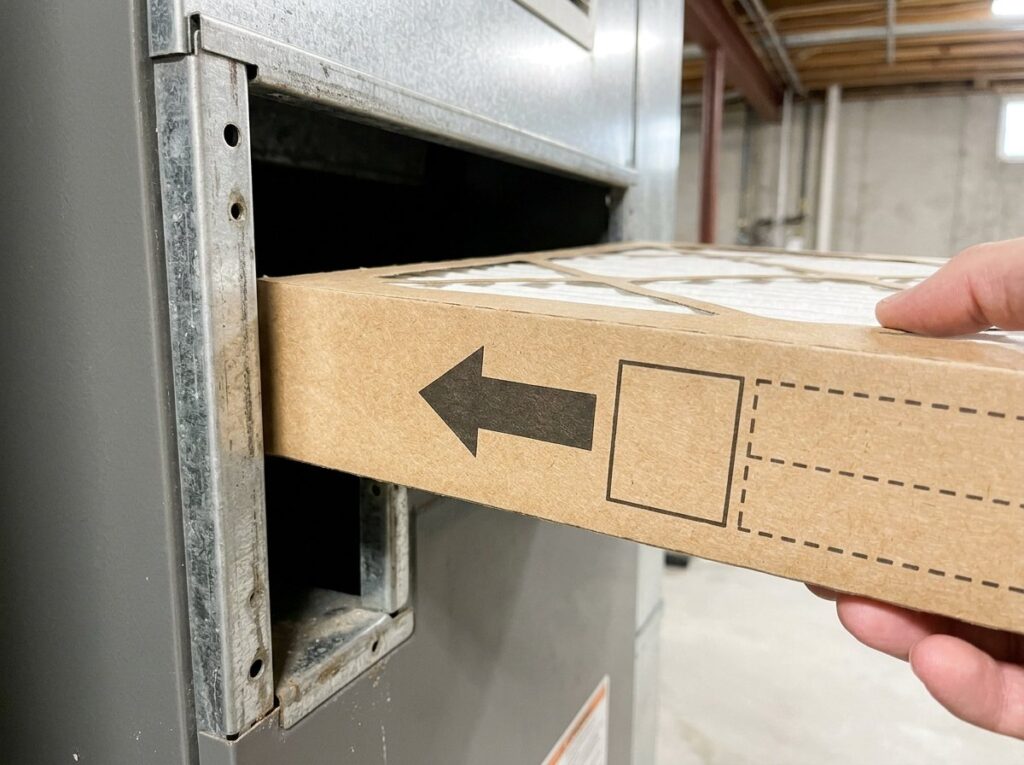
- Insert the new filter. Point the airflow arrow toward the furnace and away from the return duct. On a ceiling grille, the arrow points up into the duct; on a wall grille, it points into the wall.
- Check the fit. The filter should sit flat with no gaps around the edges. Close the cover so it seals.
- Restore power and date it. Turn the service switch and thermostat back on, then write today’s date on the frame where you can see it.
Safety note: Many furnaces have a door safety switch that cuts power when the blower door is removed, but do not rely on it alone. Switch off the service switch before reaching inside, keep hands away from the blower and burner area, and never run the furnace with the blower door off.
Tools and materials
- Replacement filter in the exact nominal size
- Flashlight
- Tape measure (if the size label is missing)
- Screwdriver for grilles with screws
- Vacuum with a brush attachment
- Trash bag and a permanent marker
- Dust mask if you have allergies
How often to change a furnace filter
There is no single schedule for every home. ENERGY STAR recommends checking the filter every month, especially during the heavy-use months of winter and summer, and changing it at least every three months. Carrier gives these typical intervals by thickness:
| Filter or situation | Typical replacement interval |
|---|---|
| 1-inch pleated filter | Every 1 to 3 months |
| 4-inch media filter | Every 6 to 9 months |
| Pets, smoking, dusty home or renovation work | Check monthly, replace when gray |
| Peak heating or cooling season | Check monthly, replace at least every 3 months |
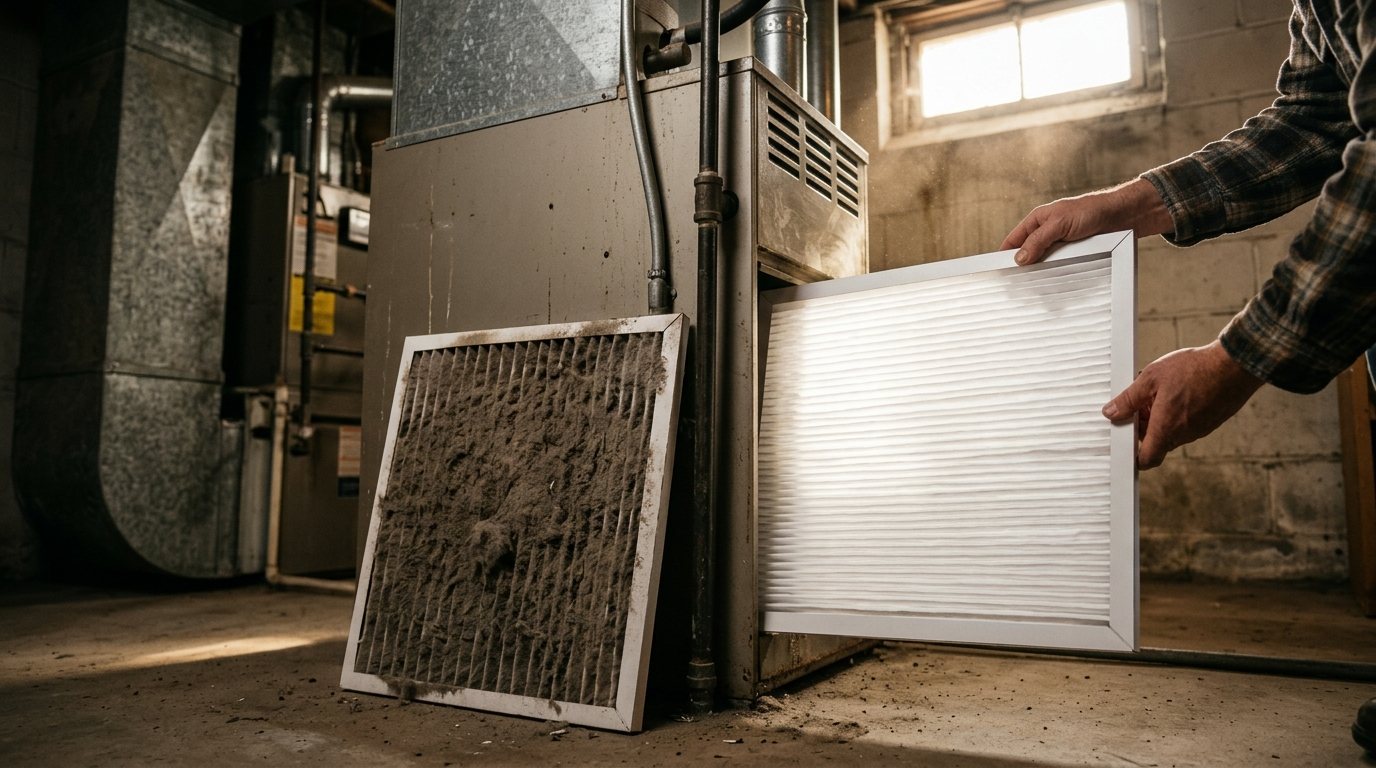
The simplest test is the light check. Hold the filter up to a bright window or lamp. If you cannot see light through the media, replace it, whatever the calendar says.
Common mistakes to avoid
- Installing it backward. The arrow shows the direction of airflow, so it must point toward the furnace. A backward filter loads unevenly and can collapse.
- Buying by actual size. If you measure a filter at 15.5 x 24.5 and buy that size, it will not exist on the shelf. Shop by the nominal size.
- Leaving gaps. A filter that is too small, or a missing slot cover, lets dirty air bypass the filter and coat the coil and blower.
- Jumping to the highest MERV in a 1-inch slot. A dense filter in an older system can cut airflow, especially once it starts to load with dust.
- Forgetting the second filter. Homes with filter grilles in several rooms need every one changed.
- Running without a filter. Even a day or two lets dust stick to the damp AC coil and blower wheel.
- Washing a disposable filter. Only filters marked washable should be rinsed, and they must dry completely before going back in.
When to call a pro
Changing the filter is a homeowner job, but call an HVAC technician if:
- A new filter turns dark within a couple of weeks, which can point to leaky return ducts pulling in attic or crawlspace dust.
- The filter is bowed, sucked into the slot or whistling loudly.
- The furnace still overheats, shuts off or blows cold air with a clean filter.
- You want to add a 4-inch media cabinet or move to a higher MERV filter and are not sure your blower can handle it.
- You cannot find a filter anywhere in the system.
Costs vary by region. According to Fixr’s HVAC repair cost data, these are typical ranges for the repairs a neglected filter can lead to:
| Service | Typical cost range |
|---|---|
| Blower motor repair | $200 to $900 |
| Blower motor replacement | $300 to $2,000 |
| Evaporator coil replacement | $400 to $2,700 |
A filter costs a small fraction of any of these, which is why a monthly check is one of the best-value habits in home maintenance. It also pairs well with the other tips in our guide on how to lower your heating bill.
Frequently asked questions
Which way does the arrow go on a furnace filter?
The arrow points in the direction the air flows, which is toward the furnace and away from the return duct. If the filter sits in a ceiling return grille, the arrow points up into the ceiling.
Can I run my furnace without a filter?
Avoid it. Without a filter, dust coats the blower wheel and the AC coil, which reduces airflow and can lead to costly cleaning. If you have no spare, leave the old filter in place until you can buy a new one.
Is a MERV 13 filter too restrictive for my furnace?
It depends on your system. The EPA recommends MERV 13 where the system can handle it, but a dense 1-inch filter can reduce airflow in some older furnaces. A 4-inch MERV 13 filter is usually easier on the blower, and a technician can measure whether your system copes.
Are furnace filters and AC filters the same?
In most homes with central air, yes. The furnace and air conditioner share the same blower and ductwork, so one filter serves both all year.
Do I need to turn off the furnace to change the filter?
Set the thermostat to OFF so the blower is not running while the slot is open. If the filter is inside the blower compartment, also switch off the furnace service switch before opening the door.
The bottom line
Changing a furnace filter is one of the easiest and most valuable jobs in your home. Buy the nominal size printed on the old frame, point the arrow toward the furnace, check it every month and replace it when light no longer shows through. A clean filter protects your blower and coil, keeps air moving and helps prevent the overheating and freezing problems that lead to repair calls.