
It always seems to start at 3 a.m.: a single, high-pitched chirp, then silence, then another chirp just as you drift off. You climb a step stool, stare at the ceiling and still cannot tell which alarm it is. A chirping smoke detector is not an emergency, but it is your alarm telling you it may not work when you need it.
This guide explains what the chirp means, how to find the right alarm, how to replace the battery and reset it so the chirp actually stops, and what to do with hardwired and interconnected alarms. It also covers the 10-year replacement rule and the official guidance on testing and placement, so you fix the noise and end up with a safer home.
Quick answer: A single chirp every so often almost always means a low battery. Replace the battery with the exact type listed on the alarm, then reset it by holding the test button. If it still chirps, check the manufacture date on the back: alarms more than 10 years old, and sealed 10-year alarms that chirp, must be replaced. Hardwired alarms also have a backup battery that needs replacing, and their circuit breaker should be checked.
Why smoke detectors chirp
A chirp is different from an alarm. A full alarm is a loud, continuous pattern that means smoke has been detected. A chirp is a short single beep repeating at intervals, and it is how the alarm reports a problem with itself.
1. Low battery (the most common cause)
Battery-powered alarms chirp when the battery gets weak, and hardwired alarms chirp when their backup battery gets weak. The chirp often starts at night because batteries lose a little voltage as the house cools down, which pushes a weak battery below the alarm’s warning level. The chirp may even stop when the house warms up in the morning, but the battery still needs replacing.
2. The alarm has reached the end of its life
Smoke alarm sensors wear out. The U.S. Fire Administration says smoke alarms need to be replaced 10 years from the date of manufacture, which is printed on the back of the alarm. Many newer alarms give a distinct end-of-life chirp pattern, sometimes with a flashing light, that a new battery will not stop. Your manual or the label on the alarm explains the pattern.
3. A battery problem, not a dead battery
A new battery that is the wrong type, is not seated firmly, or has a battery door that is not fully closed can keep the alarm chirping. Some alarms need a specific battery, such as a 9-volt or a particular lithium type, and a few have a pull tab that must be removed fully.
4. Leftover charge after a battery change
Alarms can store a small amount of charge and remember the low-battery error. If you change the battery but do not reset the alarm, it may keep chirping for a while. A reset, covered below, usually clears it.
5. Dust, insects or humidity
Dust and small insects inside the sensing chamber can cause chirps or false alarms. Steam from a shower or cooking can trigger false alarms in nearby units. Gently vacuum the vents with a soft brush attachment, and avoid placing alarms right next to bathrooms or stoves.
6. A hardwired alarm has lost power
Hardwired alarms run on household power and use their battery only as a backup. If the alarm circuit’s breaker has tripped or a connection has come loose, the alarm runs on its backup battery until it is drained and starts chirping. Check that the green power light is on.
Smoke detector chirping: quick troubleshooting table
| What you notice | Most likely cause | What to do |
|---|---|---|
| Single chirp at regular intervals | Low battery | Replace the battery and reset the alarm |
| Still chirps after a new battery | Battery not seated, wrong type, or error memory | Reseat, check the type, hold the test button to reset |
| Chirps with a different pattern or flashing light | End of life or a fault | Check the date and manual; replace the alarm |
| Alarm is more than 10 years old | Worn-out sensor | Replace the whole alarm |
| Sealed 10-year alarm chirps | Battery or unit at end of life | Replace the whole alarm |
| Hardwired alarm chirps, no green light | Lost power; backup battery draining | Check the breaker, replace the backup battery |
| Every alarm sounds at once | Interconnected system; one unit detected smoke or steam | Find the initiating alarm and address the cause |
How to find which alarm is chirping
Chirps are short and high-pitched, which makes them hard to locate, especially in hallways. Stand in one spot and wait for the next chirp, then move toward it. Many alarms flash an LED in time with the chirp, which helps.
If you have interconnected alarms, the low-battery chirp usually comes only from the unit with the weak battery, while a full alarm sounds on all of them. Some interconnected models flash a different light on the unit that started the alarm. Check every alarm, including ones in basements, hallways and bedrooms, and do not forget carbon monoxide alarms and combination units, which chirp too.
How to replace the battery and reset a chirping smoke detector
Tools and materials
- Sturdy step stool or stepladder
- Replacement battery of the exact type printed on the alarm
- Soft brush or vacuum with a brush attachment
- A marker to write the date on the new battery
Steps for battery-powered alarms
- Set up a stable step stool or ladder on a level floor, and have someone hold it if you can.
- Twist the alarm counterclockwise off its mounting plate.
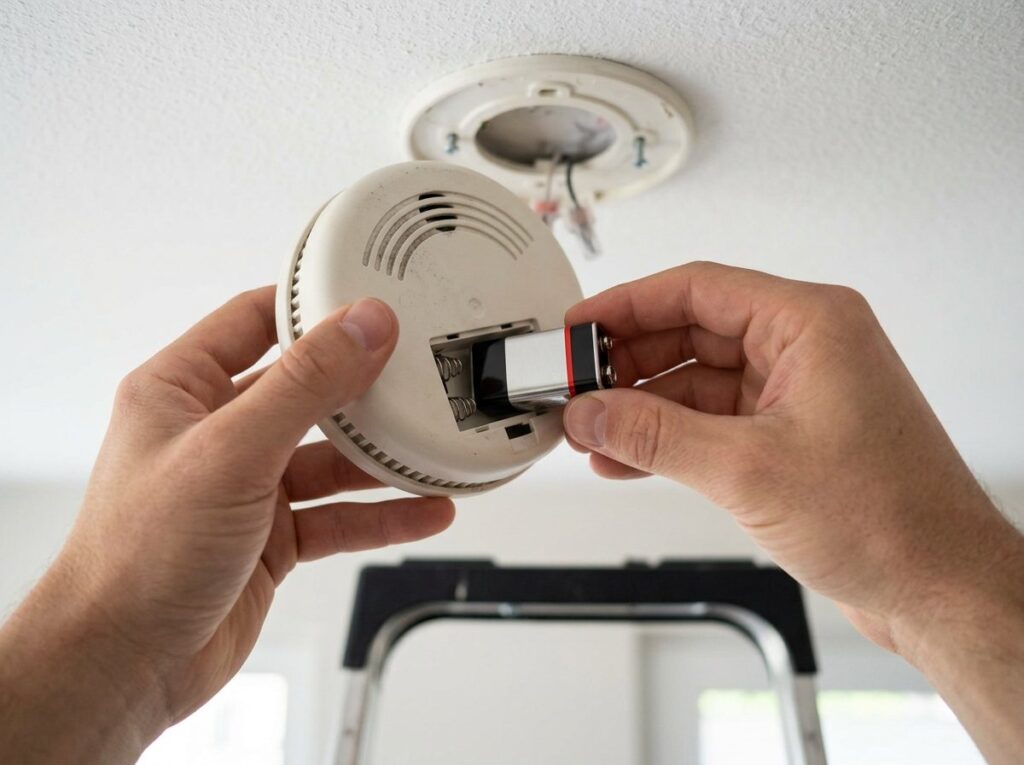
- Remove the old battery and check the label for the battery type and the manufacture date. If the alarm is more than 10 years old, replace the whole alarm instead.
- Gently vacuum or brush dust from the vents.
- Install the new battery, making sure it is firmly seated and the battery door closes completely.
- Press and hold the test button for several seconds until the alarm sounds, then release. This tests the alarm and helps clear the low-battery memory.
- Reattach the alarm to its mounting plate and wait to confirm the chirping has stopped.
If it still chirps: do a full reset
- Remove the alarm and take out the battery.
- Press and hold the test button for several seconds to drain any remaining charge. Your manual gives the exact time for your model.
- Reinstall the battery, reattach the alarm and press the test button once.
If the chirp continues after a new battery and a full reset, the alarm has likely reached the end of its life or has a fault. Replace it.
Hardwired smoke detectors with backup batteries
Hardwired alarms connect to a house circuit, usually with a small plug-in wiring harness behind the alarm, and many are interconnected so that all of them sound together. They still have a backup battery, and the USFA recommends replacing it at least once a year.
- Turn off the breaker for the smoke alarm circuit. Many alarm circuits are labeled, but some share a circuit with lights or outlets.
- Twist the alarm off its base and unplug the wiring harness by squeezing the clip. Do not pull on the wires.
- Replace the backup battery, plug the harness back in and reattach the alarm.
- Turn the breaker back on, confirm the green power light is on, then press the test button. On an interconnected system, all alarms should sound.
When a hardwired alarm reaches 10 years, replace it with a compatible model. Same-brand replacements often plug straight into the existing harness. If the new alarm needs a different harness, you will be working with house wiring: turn off the breaker and confirm the wires are dead with a non-contact voltage tester, or hire a licensed electrician. The USFA notes that hardwired alarms should be installed by a qualified electrician, and local codes may require a permit for new hardwired or interconnected alarms.
Safety note: Never remove a battery to silence a chirp without replacing it, and never leave an alarm off its base. If the alarm sounds a full alarm rather than a chirp, treat it as a real fire until you know otherwise: get everyone out and call 911 from outside. Turn off the breaker before touching any hardwired alarm wiring, and use a stable ladder rather than a chair.
Smoke alarm guidance worth following
According to the National Fire Protection Association (NFPA), smoke alarms cut the risk of dying in a home fire in half, but only if they are installed correctly and kept in working order. The USFA recommends:
- Testing every alarm once a month by pressing the test button.
- Replacing batteries in battery-powered alarms, and backup batteries in hardwired alarms, at least once a year.
- Replacing every smoke alarm 10 years from its manufacture date.
- Installing alarms inside each bedroom, outside each sleeping area and on every level of the home, including the basement.
- Choosing interconnected alarms so that when one sounds, they all sound.
A good habit is to pair alarm checks with a seasonal routine. Our fall home maintenance checklist and winter home maintenance checklist both include smoke and carbon monoxide alarm checks.
When to call a pro
Most chirping is a battery or age problem you can solve yourself. Call a licensed electrician if:
- A hardwired alarm has no power even though its breaker is on.
- The alarm breaker trips repeatedly. Our guide on why a circuit breaker keeps tripping explains why that matters.
- You want to add hardwired or interconnected alarms where there is no wiring.
- The new alarm needs a different wiring harness and you are not comfortable working with house wiring.
- You see scorching, melted plastic or loose wires at an alarm base.
Costs depend on how many alarms you have and how accessible the wiring is. HomeAdvisor’s electrician cost guide lists typical hourly rates of about $50 to $130 and a service call fee of roughly $100 to $200 for the first hour, so replacing several hardwired alarms in one visit is the most cost-effective approach. Battery-only alarms do not need an electrician.
Frequently asked questions
Why does my smoke detector chirp at night?
Batteries lose a little voltage as the house cools overnight, which can push a weak battery below the alarm’s low-battery threshold. The chirp may stop in the morning as the house warms up, but the battery still needs replacing.
Why is my smoke detector still chirping after I changed the battery?
The battery may be the wrong type, not fully seated, or the alarm may be remembering the earlier low-battery error. Reseat the battery, confirm the type, and do a full reset by holding the test button with the battery out. If it still chirps, the alarm is probably at the end of its life.
How do I know how old my smoke detector is?
Take it off the ceiling and look at the label on the back for the date of manufacture. If it is 10 years old or more, or there is no date, replace the alarm.
Can I just take the battery out of a hardwired smoke detector?
No. The backup battery keeps the alarm working during a power outage, and many hardwired alarms will keep chirping without it. Replace it with the correct type instead.
Do carbon monoxide alarms chirp too?
Yes. CO alarms and combination smoke and CO alarms chirp for low batteries and at end of life, and they have their own replacement dates printed on the back. Check the label and manual for the pattern.
The bottom line
A chirping smoke detector is almost always asking for a new battery, or telling you it is too old to trust. Replace the battery with the correct type, reset the alarm, and replace any alarm that is 10 years old or keeps chirping. Test every alarm monthly, replace batteries yearly, and call a licensed electrician for hardwired wiring problems or new interconnected alarms.