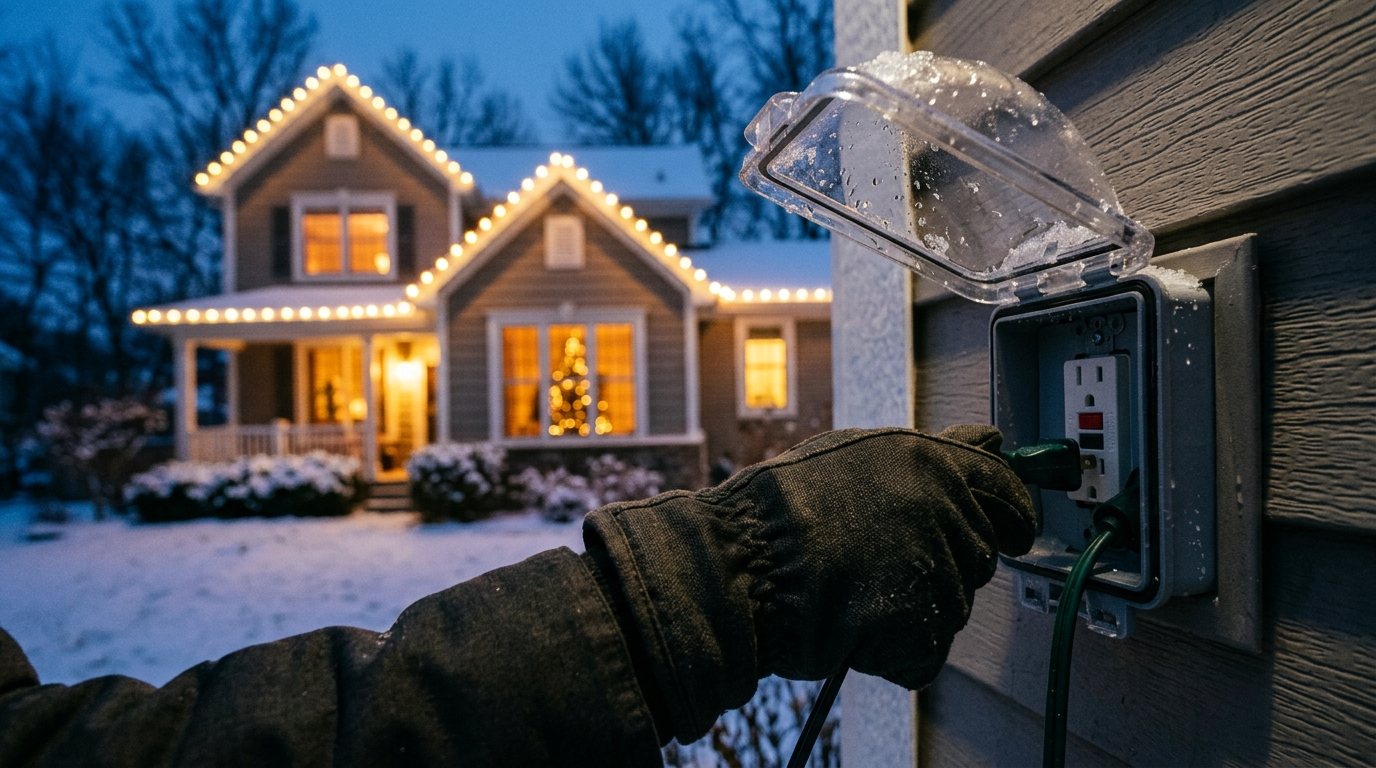
The boxes come down from the attic, the tangled strands come out, and before long you are running extension cords across the lawn and wondering how many sets you can plug into one outlet. Holiday lights make the season, but they also put a lot of extra load on outlets and cords that spend the rest of the year doing very little, often outdoors in rain, snow and wind.
This guide brings together guidance from the U.S. Consumer Product Safety Commission (CPSC) and the Electrical Safety Foundation International (ESFI) with practical steps you can follow this weekend. You will learn how to read certification marks, choose indoor or outdoor rated lights and cords, use GFCI protection, avoid overloading circuits, and set up timers so your display stays bright and safe.
Quick answer: Use lights and cords that carry a certification mark from an independent testing laboratory and are rated for where you use them, indoors or outdoors. Inspect every strand and throw out damaged ones. Plug outdoor decorations into GFCI-protected outlets, keep connections off wet ground, do not connect more strands than the package allows, and spread the load across circuits. Turn displays off, or use a timer, when you go to bed or leave the house.
Start with certified, correctly rated lights
Look for a certification mark
The CPSC’s holiday decorating safety tips advise using only lights that carry a label from an independent testing laboratory. In the US, common marks include UL, ETL and CSA. A mark means the product was tested to a safety standard, which matters for cheap lights sold online that may never have been tested.
The mark also tells you where the lights belong. UL-listed sets, for example, use a green holographic label for indoor-only lights and a red one for lights rated for both indoor and outdoor use. Other labs print the rating on the tag or package. If a set has no mark and no rating, do not use it outdoors, and think twice about using it at all.
Inspect every strand before you hang it
The CPSC recommends checking every set, new or old, for broken or cracked sockets, frayed or bare wires and loose connections. Plug each strand in on a non-flammable surface for a few minutes before hanging it, and feel the plug and wires for warmth. Throw away any set with damaged insulation rather than taping it up, and replace missing or broken bulbs with the type specified by the manufacturer.
LED vs incandescent holiday lights
If you are still using old incandescent mini lights, switching to LEDs is one of the simplest safety upgrades you can make. LEDs use far less power and run much cooler, so you can light more of your house on a single circuit with less risk of overheating.
| Feature | LED lights | Incandescent lights |
|---|---|---|
| Power use | Very low per strand | Much higher per strand |
| Heat | Cool to the touch | Bulbs get warm to hot |
| Strands you can connect | Often many; follow the limit on the package | CPSC advises no more than three sets strung together |
| Breakage | Usually plastic lenses, more durable | Glass bulbs that break easily |
| Fire risk near trees and fabrics | Lower because of lower heat | Higher, especially on dry trees |
| Upfront cost | Higher | Lower |
Never mix LED and incandescent strands in the same connected run. The connection limits printed on each are different, and the higher-wattage sets can overload the lighter wiring of the others.
Avoid overloading outlets and circuits
Overloading is the most common electrical mistake during the holidays. The CPSC’s holiday safety center warns never to string together more than three sets of incandescent lights and never to overload electrical outlets. For LED strands, follow the maximum number of connected sets printed on the tag or box.
To check a circuit, add up the wattage of everything plugged into it, including inflatables, projectors and anything else already on that circuit, such as a space heater or TV. A 15-amp, 120-volt circuit can carry 1,800 watts in theory, and electricians generally recommend keeping long-running loads to about 80 percent of that, or roughly 1,440 watts. A 20-amp circuit works out to about 1,920 watts by the same rule.
- Spread large displays across outlets on different circuits instead of one outdoor outlet.
- Do not plug power strips into other power strips or extension cords into other extension cords.
- Avoid cheap multi-outlet adapters that let you plug many cords into one outlet.
- Watch for warning signs: warm plugs or outlets, dimming lights indoors when the display turns on, or a breaker that trips.
If a breaker trips when the display comes on, you are over the limit. Our guide on why a circuit breaker keeps tripping explains how to find and spread out the load.
Outdoor setups: GFCIs, cords and weather
Plug into GFCI-protected outlets
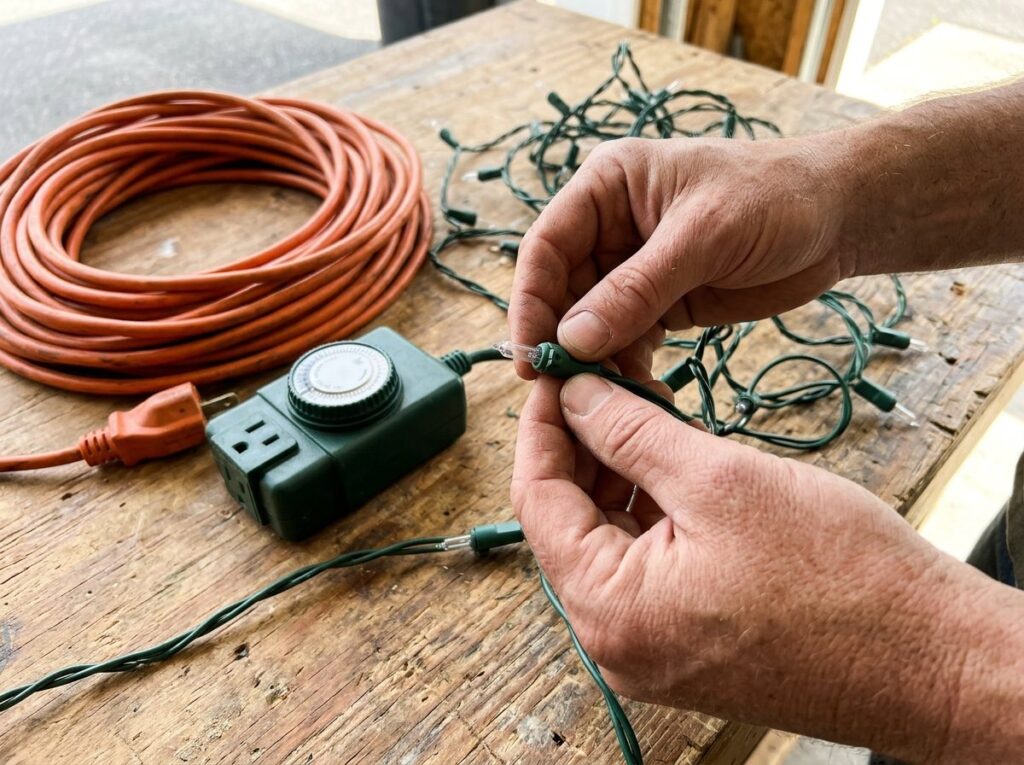
Outdoor decorations should always be plugged into an outlet with GFCI protection, which cuts power within a fraction of a second if current leaks through water or a damaged cord. Most outdoor outlets in newer homes already have it, either built in or from a GFCI elsewhere on the circuit. Press TEST and RESET before you plug in your display to confirm it works. If you have no protected outdoor outlet, use a portable, outdoor-rated GFCI device.
A GFCI that trips during rain or heavy dew is doing its job, usually because water has reached a plug connection. Dry and protect the connection rather than moving the display to an unprotected outlet. Our guide on why a GFCI outlet keeps tripping walks through the fixes.
Choose the right extension cords
Use only extension cords marked for outdoor use (look for a “W” in the cord’s rating or “suitable for use with outdoor appliances”). Choose a cord heavy enough for the load and the distance: a lower gauge number means a thicker wire, and long runs need heavier cords. Check the cord’s amp or watt rating against the total of everything plugged into it.
The ESFI home electrical safety checklist also warns against cords that are damaged, pinched in doors or windows, attached with nails or staples, run under rugs, or used as permanent wiring. Those rules apply just as much to holiday cords, so plan your layout to avoid them.
Keep connections dry and secure
- Lift plug connections off the ground and away from puddles, gutters and snowbanks, or use a covered, weather-resistant connection box.
- Use an in-use (bubble) cover on outdoor outlets so the outlet stays covered while cords are plugged in.
- Let cords hang in a small downward loop before they reach the outlet, so water drips off instead of running into the plug.
- Fasten lights and cords firmly to the house, trees or other solid supports, as the CPSC recommends, so wind does not pull connections apart.
Hang lights without damaging cords
Use plastic light clips or insulated hooks, never nails, staples or tacks that can pierce insulation. Keep lights away from power lines and the service drop to your house. If you are working from a ladder along the roofline, follow the setup and positioning tips in our guide on how to clean gutters safely, and never lean or overreach from the top rungs.
Timers and turning lights off
The CPSC advises turning off all light displays when you go to bed or leave the house, because a short circuit can start a fire. A timer makes this automatic and saves electricity. For outdoor displays, use a timer or smart plug rated for outdoor use and for the load you are connecting, and keep it inside a weather-protected box or under an in-use cover.
Indoors, a simple plug-in timer for the tree is one of the easiest safety habits you can build. Set it to turn off at bedtime so you never have to remember.
Indoor decorating safety
- Trees: Keep live trees well watered, since dry needles ignite easily, and look for a “fire resistant” label on artificial trees, as the CPSC recommends.
- Metal trees: Never put electric lights on a metal tree, which could become energized by a damaged strand.
- Clearance: Keep lights and trees away from fireplaces, space heaters, candles and curtains.
- Cords: Do not run cords under rugs or through doorways where they can be pinched or stepped on.
- Candles: Never leave candles unattended, and consider flameless candles near decorations.
Tools and materials
- Certified lights rated for indoor or outdoor use as needed
- Outdoor-rated extension cords of adequate gauge and length
- Portable outdoor GFCI, if your outdoor outlet is not protected
- Outdoor-rated timer or smart plug
- Plastic light clips and weather-resistant connection covers
- Sturdy ladder and a helper
Safety note: Unplug a strand before replacing bulbs or fuses, never remove the grounding pin from a three-prong plug, and never use indoor lights or cords outside. If an outlet, plug or cord feels hot, smells like burning plastic or shows scorch marks, unplug it, turn off the breaker and have a licensed electrician check the outlet before using it again.
When to call a pro
Call a licensed electrician if:
- You have no outdoor outlet, or your outdoor outlet has no GFCI protection.
- A GFCI will not reset, or trips even in dry weather with the display unplugged.
- Breakers trip repeatedly even after you spread the load across circuits.
- An outlet or cover plate gets warm, buzzes or shows discoloration.
- You want permanent outdoor lighting or a dedicated circuit for a large display.
Adding GFCI protection is not expensive compared with the risk it removes. HomeServe’s GFCI cost guide puts a GFCI outlet installed by an electrician at typically $150 to $350 including parts and labor. New outdoor circuits and permanent lighting cost more and may need a permit, so get a written quote.
Frequently asked questions
How many strands of Christmas lights can I connect together?
For incandescent sets, the CPSC advises no more than three strung together. LED sets often allow more, but always follow the maximum printed on the tag or package, and never mix LED and incandescent sets in one run.
Can I use indoor lights outside?
No. Indoor-only lights are not built to handle moisture and temperature swings, which can damage insulation and create shock or fire hazards. Check the label for an outdoor rating before you hang anything outside.
Is it safe to leave Christmas lights on overnight?
The CPSC recommends turning off light displays when you go to bed or leave the house. A timer is the easiest way to make sure that happens every night.
Why do my outdoor lights keep tripping the GFCI?
Usually water has reached a plug connection, a strand has damaged insulation, or too many sets are connected to one GFCI. Lift connections off the ground, cover them, and test strands one at a time to find the faulty one.
Can I use an indoor extension cord outdoors?
No. Use cords marked for outdoor use, sized for the total load and length. Indoor cords have thinner insulation that can crack in the cold and let moisture in.
The bottom line
Safe holiday lighting comes down to a few habits: use certified lights and cords rated for where you put them, inspect every strand, plug outdoor displays into GFCI-protected outlets, and do not overload outlets or circuits. Keep connections dry, use timers, and call a licensed electrician if outlets get warm, breakers keep tripping or you need a new outdoor outlet.