You press the reset button, the outlet clicks back to life, and an hour later the bathroom, garage or patio outlet is dead again. Sometimes it trips every time it rains, or with nothing plugged in at all. A GFCI that keeps tripping is annoying, but it is usually pointing to something real.
This guide explains how a GFCI works, how to test and reset one, the seven most common reasons for repeat trips, and a simple way to find the culprit. You will also learn how to tell when the GFCI itself has worn out, how to replace one safely, and which warning signs mean it is time for a licensed electrician.
Quick answer: Unplug everything from the GFCI and every outlet it protects, then press reset. If it holds, plug devices back in one at a time until it trips: that device has a fault and should be repaired or replaced. If it trips with nothing plugged in, look for moisture in an outlet box or a worn-out GFCI. If it still trips once everything is dry, or you see scorch marks or smell burning, turn off the breaker and call a licensed electrician.
How a GFCI outlet works (and why tripping is a good thing)
A ground fault circuit interrupter constantly compares the current flowing out on the hot wire with the current returning on the neutral wire. Those should match. If some current leaks through another path, such as water, a damaged cord or a person, the GFCI cuts power almost instantly.
The U.S. Consumer Product Safety Commission’s GFCI fact sheet notes that a GFCI reacts to a difference as small as 0.006 amps (6 milliamps), far below what would trip a normal breaker. That is why it can prevent a serious shock while the breaker does nothing. A trip means the device did its job, so your goal is to find what it reacted to.
One GFCI can protect several outlets
A GFCI receptacle has LINE terminals that receive power from the panel and LOAD terminals that can feed ordinary-looking outlets further along the circuit. Those downstream outlets are protected too, so a wet outdoor outlet can trip a GFCI in the garage or a bathroom. It is also why a dead outlet may just need a GFCI reset somewhere else, as explained in our guide to an outlet that is not working.
GFCI breakers and self-testing GFCIs
Some homes use GFCI breakers in the panel instead, which have their own TEST button and protect the whole circuit. GFCIs made since June 2015 must also include a self-test feature under the UL 943 standard. As the IAEI’s UL Question Corner explains, a newer GFCI that fails its self-test will usually cut power and refuse to reset, which can look like constant tripping.
How to test and reset a GFCI outlet
The CPSC recommends testing GFCIs once a month and after a power outage. It takes less than a minute.
- Plug a lamp or night light into the GFCI and turn it on.
- Press TEST firmly. You should hear a click, and the light should go out.
- Press RESET until it clicks and stays in. The light should come back on.
- If the light stays on when you press TEST, the GFCI is not protecting you. Stop using the outlet and replace it.
- If RESET will not stay in, unplug everything, wait a minute and try again, then use the troubleshooting steps below.
If a dead outlet has no buttons, check every GFCI in the bathrooms, kitchen, garage, basement and outside, plus any panel breaker with a TEST button.
Why your GFCI keeps tripping: 7 common causes
1. Moisture in the outlet box
Water is the most common trigger. Shower steam, a splash at the sink, condensation in a cold garage or wind-driven rain in an exterior box can all create a tiny leakage path. If trips happen mostly after showers or wet weather, moisture is the likely cause.
Turn off the breaker and let the outlet dry, ideally overnight, and run the bathroom exhaust fan during and after showers. Water getting in again and again points to a failed cover gasket, a missing seal around the box or a leak in the wall.
2. A faulty appliance or damaged cord
Appliances with heating elements or motors, such as hair dryers, space heaters, kettles, older power tools and pressure washers, can develop small internal leaks as they age. A cracked cord or crushed plug can do the same. If the GFCI trips only when one device runs, the device is the problem, so repair or replace it rather than moving it to an unprotected outlet.
3. Outdoor outlets exposed to the weather
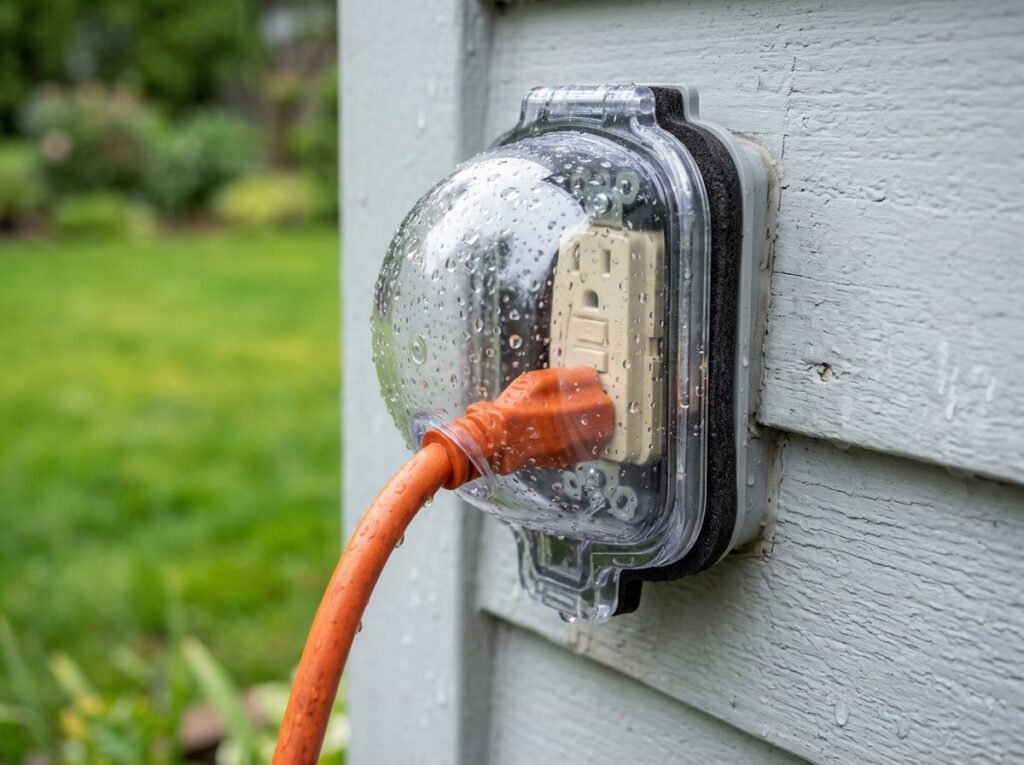
A flat flip-up cover only keeps rain out while nothing is plugged in. Codes now call for bubble-style “in-use” covers that stay closed over a plugged-in cord, plus weather-resistant receptacles in wet locations. Holiday light strands, landscape lighting and cord connections lying in wet grass are frequent culprits this time of year, so raise connections off the ground and read our holiday lights electrical safety guide before you decorate.
4. Too many outlets and devices downstream
Every appliance and cord leaks a tiny, harmless amount of current. When one GFCI protects a long string of outlets, perhaps a whole garage plus several outdoor receptacles, those small leaks can add up until it trips with no single device at fault. An electrician can split the circuit or add a second GFCI so each one protects fewer outlets.
5. Refrigerators, freezers and sump pumps
Large motors can cause occasional nuisance trips, especially older units in damp garages and basements. The danger is that a trip goes unnoticed and you lose a freezer of food or a sump pump during a storm. Rather than swapping the GFCI for a standard outlet, ask an electrician about a dedicated circuit and add a temperature or water alarm.
6. A worn-out or defective GFCI
GFCIs are electronic devices and they wear out. Lifespans of roughly 15 to 25 years are commonly quoted, but outdoor units, units that trip often and units hit by surges can fail sooner. A worn GFCI may trip randomly, refuse to reset or fail the TEST check.
7. Wiring problems
Loose connections, nicked insulation touching a metal box, rodent-chewed cable, a nail through a wire or a neutral shared with another circuit can all cause repeat trips. Most modern GFCIs will not reset at all if LINE and LOAD were wired backward. Faults inside walls are a job for a licensed electrician.
What about overloads? A standard GFCI receptacle does not trip because you plugged in too much. Excess current trips the breaker in the panel instead. If the breaker is what keeps shutting off, see our guide on why a circuit breaker keeps tripping.
How to find what is tripping your GFCI
A methodical approach finds the problem faster than resetting and hoping. You need about 20 minutes and a lamp to test with.
- Press TEST, then check nearby outlets with the lamp. Any that went dead are downstream of the GFCI. Write them down.
- Unplug everything from the GFCI and its downstream outlets, including easy-to-forget items like a garage freezer or outdoor timer.
- Press RESET. If it trips immediately with nothing plugged in, the cause is moisture, wiring or the GFCI itself, so skip to step 5.
- If it holds, plug devices back in one at a time and run each for a few minutes. The one that trips the GFCI is the likely culprit. Confirm by trying it on another GFCI-protected outlet.
- If it trips with nothing connected, turn off the breaker, verify the power is off, and inspect the outdoor and bathroom boxes on the circuit for water or corrosion. Let wet boxes dry before restoring power.
- Note when trips happen: during rain, at night, when the fridge starts or when a switch is used. Patterns help you, or an electrician, narrow it down.
GFCI troubleshooting at a glance
| What you notice | Most likely cause | What to do |
|---|---|---|
| Trips only when one appliance runs | Fault in that appliance or its cord | Stop using it; repair or replace it |
| Trips after showers or rain | Moisture in a box on the circuit | Dry it out, improve covers and seals |
| Trips with nothing plugged in | Moisture, wiring fault or worn GFCI | Inspect boxes; replace GFCI or call an electrician |
| Will not reset at all | Active fault, end-of-life lockout or reversed wiring | Unplug everything and retry; then replace or call a pro |
| TEST button does not cut power | Failed GFCI | Replace it now; it is not protecting you |
| Breaker trips, not the GFCI | Overload or short circuit | Spread out loads; call a pro for shorts |
| Outlet warm, scorched or smells burnt | Loose connection or failing device | Turn off the breaker and call an electrician |
When and how to replace a GFCI outlet
Replace a GFCI if it will not trip on TEST, will not reset after you have ruled out moisture and appliances, trips randomly with nothing connected, shows a red end-of-life light, or has any discoloration. It is a manageable DIY job if you have replaced an outlet before and the wiring is copper. If the box holds more than two cables, the wires are aluminum or you are unsure which cable brings power in, hire an electrician, and check whether your area requires a permit.
Tools and materials
- New GFCI with the same amp rating as the circuit (15 or 20 amps), weather-resistant if outdoors
- Non-contact voltage tester
- Insulated screwdrivers and a wire stripper
- Painter’s tape and a marker for labeling wires
- Plug-in outlet tester or a lamp
Replacement steps
- Turn off the breaker. Check your non-contact tester on a known live outlet, then confirm the GFCI and all its wires are dead.
- Remove the cover plate and mounting screws, and pull the GFCI out gently.
- Before disconnecting anything, label the wires on the LINE terminals and those on the LOAD terminals. This is the step people most often skip.
- Connect the LINE wires to the new GFCI’s LINE terminals, black (hot) to brass and white (neutral) to silver, then the LOAD wires the same way if there are any. Bare or green ground goes to the green screw.
- Fold the wires into the box, mount the GFCI and install the cover plate.
- Restore power, press RESET, then confirm with TEST and a plug-in tester that it trips, resets and cuts power to downstream outlets.
For more on wire connections and outlet types, see our guide on how to replace an outlet.
Safety note: Always turn off the breaker and confirm the power is off with a non-contact tester before touching outlet wiring. Never tape down a reset button, replace a GFCI with a standard outlet to stop nuisance trips, or keep resetting one that trips the instant you press it. Each of those removes protection that exists to prevent electrocution.
When to call a pro
Call a licensed electrician if:
- The GFCI trips instantly with nothing plugged in, even after the boxes have dried.
- You see scorch marks or melted plastic, or smell burning near an outlet.
- The outlet, cover plate or wall around it feels warm.
- A new GFCI behaves the same way as the old one.
- The breaker also trips, or lights flicker on the same circuit.
- You find aluminum or cloth-covered wiring, or water entering a box from inside the wall.
Costs vary by region and by how hard the fault is to find. HomeServe’s GFCI cost guide puts a GFCI installed by an electrician at typically $150 to $350 including parts and labor, with hourly rates of about $40 to $100 and a first-visit fee of roughly $75 to $125 at many companies. Tracing a hidden wiring fault takes longer and costs more.
Frequently asked questions
Why does my GFCI outlet trip when it rains?
Water is getting into an outdoor box or connection on the circuit, often through a worn gasket, a flat cover with a cord plugged in, or a cord connection on wet ground. Check every exterior outlet the GFCI protects, let them dry and upgrade to in-use covers. If trips continue in dry weather, call an electrician.
Why does my GFCI trip with nothing plugged in?
The usual causes are moisture in a box, a wiring fault on the protected circuit, or a GFCI at the end of its life. Check downstream outlets for water first. If they are dry, replace the GFCI, and if a new one trips too, have an electrician trace the wiring.
Can a refrigerator be plugged into a GFCI outlet?
Yes. In many kitchens, garages and basements, code requires GFCI protection for that outlet, and most modern appliances run fine on one. If yours trips repeatedly, have the appliance checked and ask an electrician about a dedicated circuit rather than removing the GFCI.
Why won’t my GFCI reset?
A GFCI will not reset if a fault is still present, if a tripped breaker means no power is reaching it, if LINE and LOAD are reversed, or if a self-testing model has detected its own failure. Unplug everything, check the breaker and try again. If it still will not reset, replace it or call a pro.
The bottom line
A GFCI that keeps tripping is almost always reacting to something real: water in a box, a leaky appliance, too many outlets on one device or a GFCI that has worn out. Unplug everything, reset, and add devices back one at a time to find the cause. If it trips with nothing connected after the boxes are dry, or you notice heat, scorching or a burning smell, switch off the breaker and call a licensed electrician.