You have decided on wood floors, and now the samples are lined up: solid planks that look and feel like the real thing, and engineered planks that also look like the real thing but cost a little less and claim to handle basements. The salesperson says either is fine, which does not help you decide.
This guide explains how each type is built, compares them side by side on stability, moisture, refinishing, installation and cost per square foot, and then shows which one makes the most sense for each room and climate. You will also learn what to check on an engineered plank so you do not end up with one that cannot be refinished.
Quick answer: Choose solid hardwood for above-grade living areas and bedrooms where you want a floor that can be sanded and refinished many times over decades. Choose engineered hardwood for basements, floors over concrete slabs, radiant heat, and homes with big humidity swings, since its layered core resists shrinking and swelling. Both are real wood on top and both cost roughly the same installed, so the deciding factors are where the floor goes and how long you plan to keep it.
How solid and engineered hardwood are made
Solid hardwood
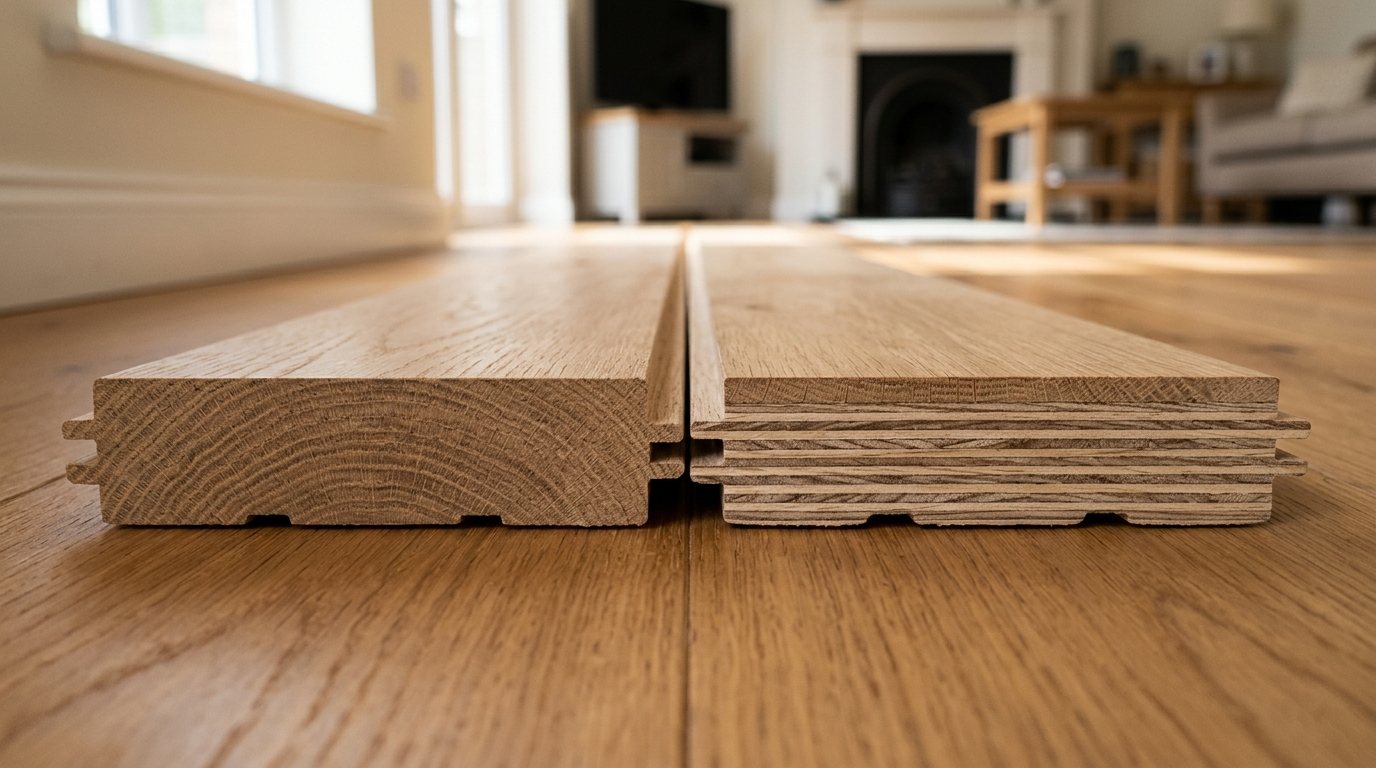
Solid hardwood is exactly what it sounds like: each board is milled from a single piece of wood, with the same species running from top to bottom. Most boards are 3/4 inch thick, with thinner 5/8- and 1/2-inch options available. Because the wood is solid all the way through, it can be sanded down and refinished repeatedly over its life.
Engineered hardwood
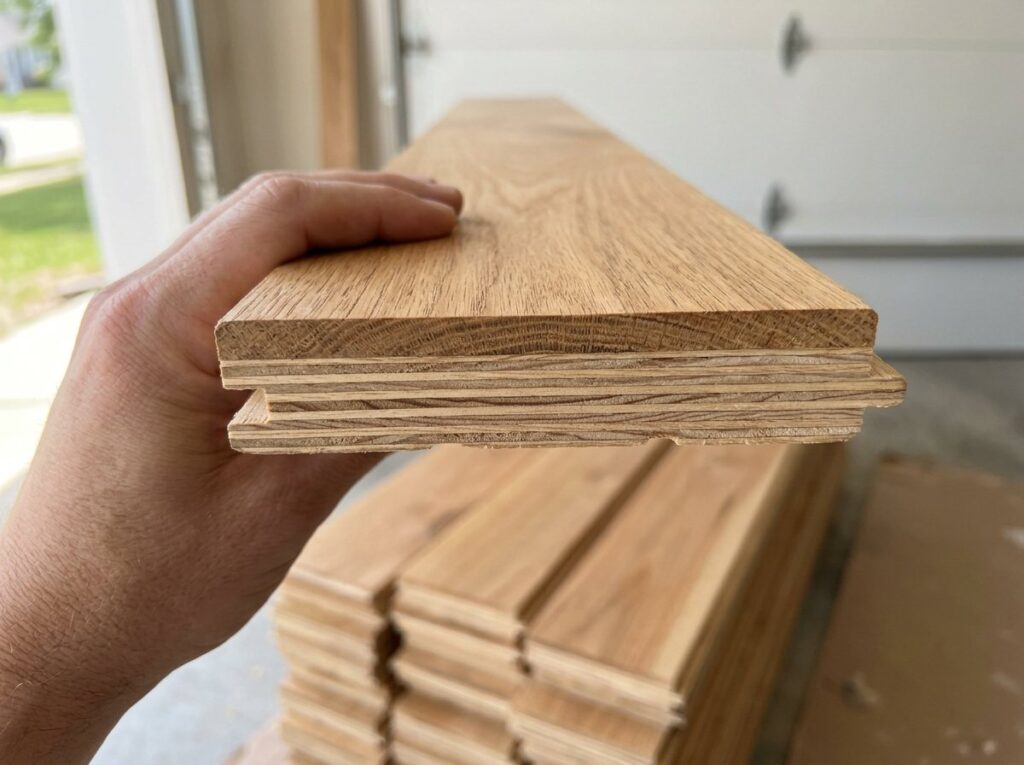
Engineered hardwood has a top layer of real hardwood, called the wear layer or veneer, bonded to a core of plywood or high-density fiberboard. In plywood-core products, the core is typically several thin layers glued with the grain running in alternating directions, which keeps the plank from moving much as humidity changes. The veneer can range from about 1/32 inch to 1/4 inch thick, and total plank thickness runs from about 1/4 to 3/4 inch.
From the surface, a good engineered floor is hard to tell apart from solid. The difference shows up in how it reacts to moisture, how it is installed, and how many times it can be refinished.
Engineered vs solid hardwood: side-by-side comparison
| Feature | Solid hardwood | Engineered hardwood |
|---|---|---|
| Construction | One piece of wood, usually 3/4 inch thick | Hardwood veneer over a plywood or fiberboard core |
| Stability | Expands and shrinks noticeably with humidity | Cross-layered core resists expansion and shrinking |
| Basements and below grade | Not recommended | Suitable with proper moisture control |
| Over concrete slabs | Risky; needs a wood subfloor or special prep | Common; glue-down or floating |
| Radiant floor heat | Generally not recommended | Many products are approved; check the spec |
| Refinishing | Can be sanded and refinished many times | About one to three times, depending on veneer thickness |
| Install methods | Nail-down or staple-down; glue-down in some cases | Nail, staple, glue-down or floating (often click-lock) |
| DIY friendliness | Low; nailing usually needs a pro | Higher; floating floors are DIY-friendly |
| Typical lifespan | 50 to 100 years or more with care (Angi) | 20 to 30 years on average (Angi) |
| Installed cost per sq ft | $5 to $28 (This Old House) | $6 to $23 (This Old House) |
| Resale appeal | Strong buyer preference | Good, especially with a thick wear layer |
The key differences explained
Stability and seasonal movement
All wood swells when it absorbs moisture and shrinks when it dries out. A solid board moves mostly across its width, so solid floors are prone to gaps in dry winters and cupping in humid summers. Engineered planks move far less because each layer of the core pushes against the next. If your solid floors already open up every winter, our guide to gaps in hardwood floors in winter explains why.
Moisture, basements and concrete
Neither type is waterproof, and both can be ruined by standing water or a leak. Engineered hardwood tolerates the higher humidity and cool slabs of basements far better, and it can be glued directly to concrete or floated over it. Solid hardwood is generally kept above grade, and gluing it straight to concrete is risky because of how much it moves.
Refinishing and lifespan
Solid hardwood’s big advantage is longevity. You can sand away scratches, stains and old finish and start fresh many times, which is why century-old solid floors are still in use. Engineered floors can only be sanded as deep as the veneer allows, typically one to three times depending on its thickness, and some thin-veneer products cannot be sanded at all. Both can be screened and recoated to refresh the finish without full sanding. Our guide to refinishing hardwood floors explains the difference.
Installation methods
Solid hardwood is traditionally blind-nailed through the tongue into a wood subfloor, which needs a flooring nailer and some skill. Engineered hardwood can be nailed or stapled like solid, glued down, or floated over an underlayment, often with click-lock edges. Floating installation is the most DIY-friendly option of all, though it can sound a little more hollow underfoot.
Prefinished vs unfinished
Engineered hardwood almost always comes prefinished from the factory, so the floor is ready to use as soon as it is installed. Solid hardwood is sold both prefinished and unfinished. Unfinished boards are sanded and finished on site, which lets you choose any stain and seals the seams into one continuous surface, but it adds several days of dust and drying time and, according to Hunker, about $1.50 to $5 per square foot.
Cost
Prices overlap heavily because species, grade, width and finish matter more than construction. This Old House lists installed solid hardwood at about $5 to $28 per square foot and engineered at about $6 to $23, with labor alone typically $3 to $8 per square foot. Angi puts engineered at about $4.50 to $16 per square foot and solid at about $6 to $25. Engineered can save money on installation when it floats or glues over concrete without a new wood subfloor.
Look, feel and resale
Solid floors have a dense, quiet feel, and buyers often prefer them. Premium engineered floors with thicker planks feel very similar, while thin floating products can sound hollow. Engineered planks are also more often available in wide boards, which are prone to cupping when made from solid wood.
Which to choose by room
- Living rooms, dining rooms and bedrooms (above grade): Either works. Solid is the classic long-term choice; engineered is fine if you want wide planks or a DIY install.
- Kitchens: Either can work with prompt cleanup of spills. Engineered handles humidity swings better, and solid can be refinished more often after years of wear.
- Basements: Engineered, installed over a moisture barrier as the manufacturer specifies. Skip solid below grade.
- Homes on concrete slabs: Engineered, glued down or floating, unless you add a wood subfloor.
- Rooms with radiant floor heat: Engineered products approved for radiant heat.
- Full bathrooms and laundry rooms: Neither is ideal. See our guide to the best waterproof flooring for kitchens and bathrooms instead.
- Condos and upper floors: Engineered is often easier to install over sound-control underlayment, but check your building’s rules first.
Matching or extending an existing floor
If you are adding wood to a room next to an existing solid floor, the new floor should usually be the same thickness so the two meet without a ridge or a bulky transition strip. Some engineered products are made 3/4 inch thick, which makes matching easier. If the existing floor is unfinished solid oak, extending it with unfinished solid oak and refinishing both areas together gives the most seamless result, since a fresh stain and finish blend old and new boards.
When you are replacing damaged boards, match the construction as well as the species. Engineered planks usually cannot be woven into a solid floor, or solid boards into an engineered one, because the profiles and thicknesses differ.
Which to choose by climate
Humid climates and coastal homes
High summer humidity makes solid boards swell and cup, especially wide planks. Engineered is the safer bet, particularly on slabs, which are common in warm regions. Whichever you choose, run air conditioning or a dehumidifier to keep humidity steady.
Cold, dry winters
Heated indoor air in winter dries wood out, opening gaps between solid boards. Engineered floors stay tighter. With solid, a whole-house humidifier and narrower boards reduce seasonal gaps.
Big seasonal swings
Homes that are humid in summer and very dry in winter put the most stress on solid wood. Engineered handles these swings better. With either type, let flooring acclimate as the manufacturer directs and install it only when the home is at normal living conditions.
Pro tip: Before buying engineered hardwood, ask for the exact wear layer thickness and core type, not just the total plank thickness. A thicker veneer on a plywood core can usually be sanded at least once, while a very thin veneer may only ever be screened and recoated.
How to judge engineered hardwood quality
- Wear layer: Thicker veneers allow sanding and refinishing; very thin ones do not.
- Core: Multi-ply plywood cores are generally the most stable; fiberboard cores are harder but more sensitive to water at the edges.
- Construction: Look for tight milling, consistent plank thickness and a smooth, even finish.
- Finish: Very hard factory finishes resist wear well but can be harder to recoat, so ask the manufacturer how the floor should be maintained and refreshed.
- Approved uses: Check that the product is approved for your subfloor, grade level and any radiant heat.
- Warranty and care: Read the moisture and cleaning requirements; our guide on how to clean hardwood floors covers safe routines for both types.
When to call a pro
Floating engineered floors are a reasonable DIY project, but call a flooring pro in these situations:
- You are installing solid hardwood, which usually requires a pneumatic flooring nailer and careful layout.
- You plan to glue down over concrete, where the slab needs moisture testing and proper adhesive or barrier.
- The subfloor is uneven, bouncy or damaged.
- You want to sand an engineered floor and are not sure how thick the veneer is, since sanding through it cannot be undone.
This Old House puts installation labor at about $3 to $8 per square foot and professional sanding and refinishing at about $3 to $8 per square foot.
Frequently asked questions
Is engineered hardwood real wood?
Yes. The top layer you walk on is real hardwood, and plywood cores are made of wood too. It is different from laminate and vinyl plank, which use a printed photo layer rather than real wood.
Which is more scratch resistant, engineered or solid hardwood?
Neither is inherently tougher, since scratch resistance depends on the species and the finish. A factory finish on either type usually resists wear better than a finish applied on site.
Can you refinish engineered hardwood?
Often, yes, but only as many times as the veneer allows, typically one to three full sandings depending on its thickness. Very thin veneers should only be screened and recoated.
Can you put solid hardwood in a basement?
It is generally not recommended. Basements are below grade, often on concrete and prone to humidity, all of which cause solid boards to swell and cup. Engineered hardwood is the better choice there.
Which is better if you have dogs?
Both will scratch under claws, so choose a hard species, a matte or low-sheen finish and a textured or wire-brushed surface that hides marks. Solid lets you sand out deep scratches more times, while engineered is less likely to cup if water bowls get splashed.
Does engineered hardwood increase home value like solid?
Both add appeal over carpet or vinyl, though many buyers still prefer solid. A good engineered floor with a thick wear layer holds up well in listings and inspections.
The bottom line
Engineered vs solid hardwood comes down to location and time horizon. Solid is the long-term choice for above-grade rooms where it can be refinished for generations, while engineered is the practical choice for basements, slabs, radiant heat and humid or dry climates. Costs are similar, so pick the construction that suits the room, then buy the best wear layer and finish your budget allows.