A dishwasher leaked overnight, a pipe burst while you were away, or a houseplant has been quietly overflowing for months. Now the boards are lifting at the edges, there is a dark stain spreading along the seams, or the whole floor feels uneven underfoot, and you are wondering whether it can be saved or has to come out.
This guide walks you through the signs of water damage and what each one means, the drying steps that matter most in the first day or two, how to read a moisture meter, how to tell whether boards can be saved or need replacing, the insurance basics, and how to keep mold from becoming a second problem.
Quick answer: Stop the water, remove standing water and wet rugs, and start drying immediately with fans, a dehumidifier and airflow from below if you have a basement or crawlspace. Track moisture meter readings against an unaffected area and do not sand, nail or replace anything until readings are back within the normal range, which can take weeks. Mild cupping often flattens as the wood dries, while buckled boards, black stains, contaminated water and mold usually mean replacement.
Signs of water damage in hardwood floors
Cupping
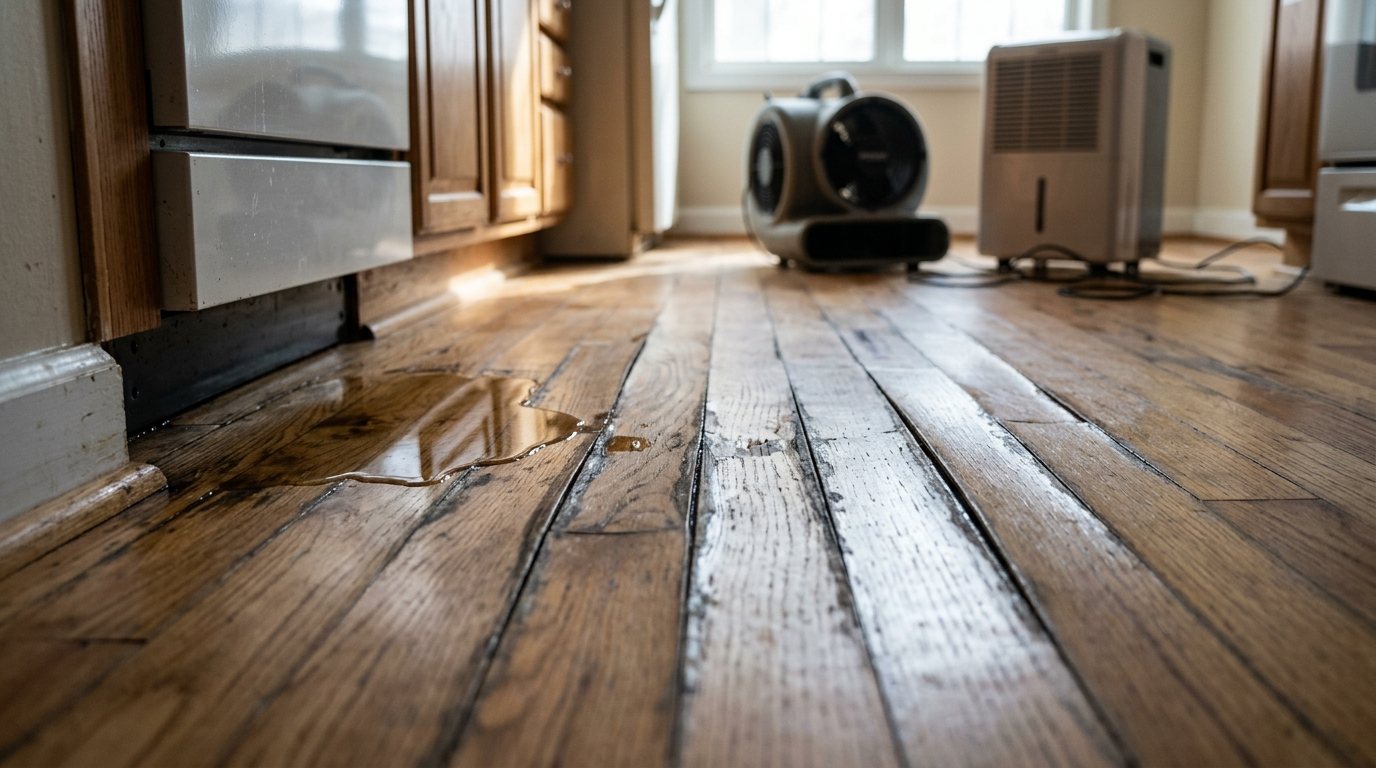
The edges of each board rise higher than the center, creating a washboard look. Cupping happens when the bottom of the board has more moisture than the top, so the underside swells. It is the most common sign of water coming from below, such as a damp crawlspace, a slab or a slow leak.
Crowning
The center of each board sits higher than the edges. Crowning can occur when water sits on top of the floor, but it is very often caused by sanding a cupped floor before it dried, which removes the raised edges and leaves the board humped once it flattens.
Buckling
Boards pull completely away from the subfloor and tent upward, sometimes by several inches. This is the most severe reaction and means the wood swelled so much that the nails or adhesive gave way.
Staining and other clues
White or cloudy marks usually sit in the finish and can often be buffed out or recoated. Gray, dark or black stains mean water reached the wood itself and reacted with it, and those rarely sand out completely. Also watch for soft or spongy spots, new squeaks, a musty smell and wide gaps that appear after the floor dries.
| Sign | What it looks like | What it usually means | Often savable? |
|---|---|---|---|
| Mild cupping | Edges slightly raised, boards still tight to subfloor | Moisture from below; short exposure | Yes, often flattens after drying |
| Severe cupping | Pronounced ridges, gaps at seams | Prolonged moisture or ongoing source | Sometimes, with drying then sanding |
| Crowning | Center of boards raised | Water on the surface or sanding too early | Sometimes, with refinishing |
| Buckling | Boards lifted off the subfloor | Fasteners or glue have failed | Rarely; replace the buckled area |
| White marks | Cloudy haze in the finish | Moisture trapped in finish or wax | Usually, with buffing or recoating |
| Black or dark stains | Gray to black discoloration in the wood | Long-term water or pet urine in the fibers | Rarely; replace the stained boards |
What to do in the first 24 to 48 hours
Speed matters more than anything else. The EPA says water-damaged areas should be dried within 24 to 48 hours to prevent mold growth, and wood that dries quickly has a much better chance of flattening.
- Stop the water. Shut off the fixture or appliance, or close the main valve. Our guide on how to shut off water to your house shows where to look.
- Photograph everything. Take wide shots and close-ups of the floor, the source and any damaged items before you move them, for your insurer.
- Remove standing water. Use a wet/dry vacuum, then towels. Pull up wet rugs and move furniture off the floor so air can reach the surface.
- Get air moving. Set fans across the surface and run a dehumidifier with the room closed. Keep the heating or cooling running to hold normal indoor conditions.
- Dry from below. If there is a basement or crawlspace, open it up, run fans and a dehumidifier there, and pull down wet insulation under the floor so the subfloor can dry.
- Find the cause. If the leak came from under a sink, behind an appliance or from the roof, fix it before drying starts in earnest. Our guide to a leak under the kitchen sink can help.
- Do not rush repairs. Avoid sanding, nailing down lifted boards or applying finish until moisture readings say the wood is ready.
Safety note: If water reached outlets, cords or appliances, turn off power to the area at the breaker before you step in, and leave it off until an electrician checks it. Treat water from toilets, sewers, floods or dishwashers as contaminated: wear waterproof gloves and boots, keep children and pets away, and expect porous materials it touched to be discarded.
Tools and materials
- Wet/dry vacuum and plenty of towels
- Box fans or air movers
- Dehumidifier sized for the room (a second one for the basement or crawlspace helps)
- Pin-type moisture meter, ideally with insulated pins for readings at depth, plus a pinless meter for scanning if available
- Thermo-hygrometer to track room humidity
- Phone camera and a notebook for photos and daily readings
- Waterproof gloves, boots and an N95 mask
How to read a moisture meter on a wet floor
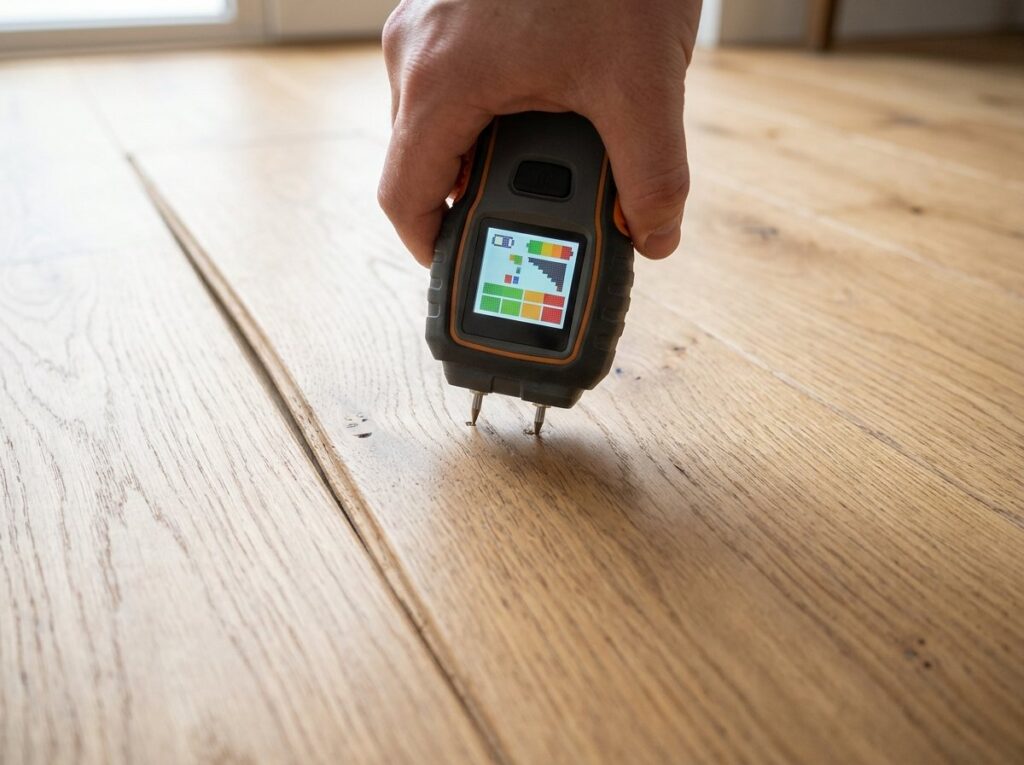
A moisture meter tells you what your eyes cannot: whether the wood is still drying and whether it is safe to repair. Readings are only useful when you compare them with each other, so take them the same way at the same spots every time.
Take a baseline from an unaffected area
Measure boards of the same species in a dry room or a part of the floor the water never reached. That number is roughly the normal moisture content for your home and season, and it becomes your target.
Map the wet area and measure at depth
Scan the floor with a pinless meter, or take pin readings in a grid, to see how far the moisture spread. With insulated pins, take readings near the surface and deeper in the board, and check the subfloor from below if you can reach it. A board that reads dry on top but wet underneath is still drying.
Know when the floor is ready
Hardwood Floors magazine advises that readings should be within 2% of the expected in-use moisture content before work continues, and the subfloor must also meet the flooring manufacturer’s limits. Even a small difference between the top and bottom of a board can cause cupping, which is why waiting for balanced readings matters. A General Services Administration preservation procedure goes further, advising that readings stay balanced for at least 30 days before cupped boards are repaired.
Log your readings daily or every few days. Steadily falling numbers mean drying is working; flat or rising numbers mean there is still a moisture source or not enough airflow.
Can the floor be saved or does it need replacing?
Signs boards can usually be saved
- The water was clean, such as a supply line or rain, and was found quickly.
- Boards are cupped but still firmly attached to the subfloor.
- Stains are white or in the finish, not dark in the wood.
- Moisture readings fall steadily once drying starts.
Many mildly cupped floors flatten on their own as they dry, which can take several weeks or months. If boards are still cupped once readings are normal and stable, a full sanding and refinish usually flattens the surface. Our guide to refinishing hardwood floors covers the process.
Signs replacement is likely
- Boards have buckled off the subfloor. Hardwood Floors magazine notes that buckled areas need replacing because their fasteners or adhesive no longer hold.
- Dark or black stains go deep into the wood.
- The water was contaminated, such as sewage, toilet overflow or floodwater.
- Mold is growing on or under the boards.
- The subfloor is swollen, delaminated or soft.
- Boards are severely warped or split and cannot be flattened.
Engineered hardwood is less forgiving
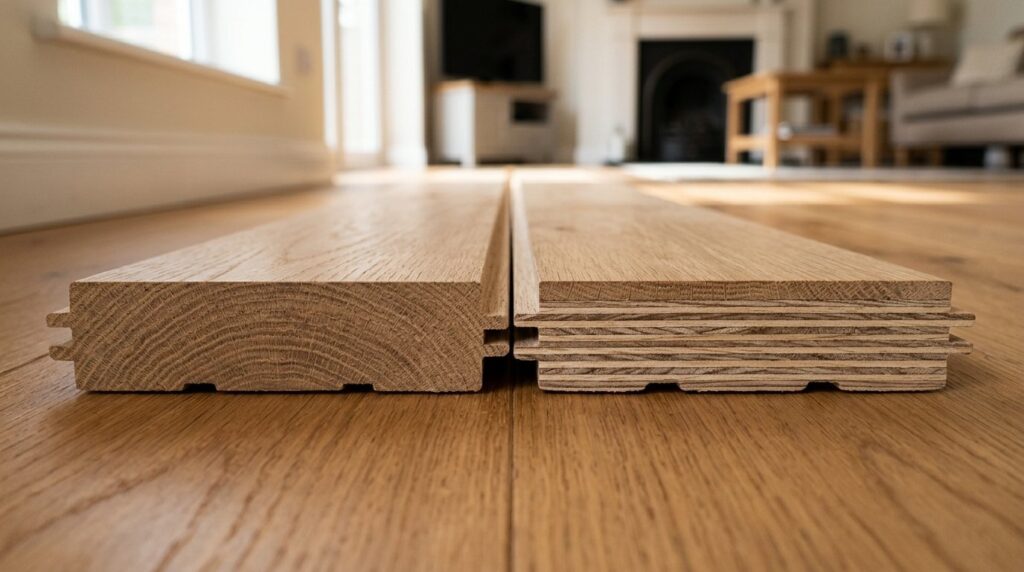
Engineered floors usually resist cupping better than solid, but the thin top veneer can delaminate from the core when soaked, and there may not be enough wear layer to sand out cupping. Click-together floating floors are often removed so the subfloor can dry. Our guide to engineered vs solid hardwood explains the construction differences.
Why you should never sand a wet, cupped floor
A cupped floor looks like it needs sanding, and it is tempting to fix it right away. But if you sand while the bottom of the boards is still wet, you remove the raised edges.
As the wood finishes drying and the underside shrinks back, the boards end up crowned, with the center higher than the edges and a thin finish in the middle. Wait for stable readings, then reassess. Some floors no longer need sanding at all.
Mold risk under wet floors
Mold needs moisture and a food source, and the wood, paper backing and dust under a floor provide both. Watch for a musty smell, dark spots along seams or at the edges of boards, and staining on the underside of the subfloor from the basement or crawlspace.
The EPA suggests that most people can clean up a moldy area smaller than about 10 square feet themselves, but recommends more expert help when there has been a lot of water damage or mold covers more than 10 square feet. Mold hidden under flooring often means pulling boards to reach it, which is a job for a remediation pro.
Insurance basics
- Sudden and accidental leaks are usually covered. According to the Insurance Information Institute, a standard HO-3 policy covers accidental discharge or overflow of water from plumbing, heating, air conditioning or household appliances.
- Floods are not. Standard homeowners policies do not cover flooding; that needs separate flood insurance.
- Poor maintenance is excluded. Damage from a slow leak you could have fixed may be denied, which is why early repairs matter.
- Document and mitigate. Report the damage promptly, photograph everything, start drying, and keep receipts for fans, dehumidifiers and emergency services. Ask your adjuster before tearing out flooring.
When to call a pro
- The water was contaminated, or the damage covers a large area or several rooms.
- Boards are buckling, or readings are not dropping after several days of drying.
- Water reached electrical wiring, ductwork or a finished ceiling below.
- You see or smell mold, or the subfloor is soft.
- You are filing an insurance claim and need professional moisture documentation.
| Professional service | Typical cost | Source |
|---|---|---|
| Water damage restoration, clean water | $3 to $4 per sq ft | Angi |
| Water damage restoration, gray water | $4 to $6.50 per sq ft | Angi |
| Hardwood repair after gray water damage | $10 to $15 per sq ft | Angi |
| Mold removal | $1,100 to $3,400 | Angi |
| Sanding and refinishing | $3 to $8 per sq ft | This Old House |
Frequently asked questions
Will cupped hardwood floors go back to normal?
Often, yes, if the moisture source is fixed and the floor dries fully. Mild cupping can flatten over several weeks or months. If it remains after readings are normal and stable, sanding and refinishing usually fixes it.
How long does it take for a wet hardwood floor to dry?
Surface water dries in a day or two, but the wood and subfloor can take weeks, especially with a finish that slows drying. Use moisture meter readings rather than appearance to judge when it is done.
Can you sand a cupped hardwood floor?
Only after it has fully dried and readings have stayed stable. Sanding too early removes the raised edges, and the boards crown as they finish drying.
Does homeowners insurance cover water-damaged hardwood floors?
It usually covers sudden, accidental leaks from plumbing or appliances, but not floods or damage from poor maintenance. Check your policy and report the loss quickly.
How do I know if there is mold under my hardwood floor?
A persistent musty smell, dark stains at the seams and staining on the subfloor seen from below are common signs. If you suspect hidden mold, have a pro inspect before pulling boards.
The bottom line
A water-damaged hardwood floor is often more savable than it looks if you stop the water and start drying within 24 to 48 hours. Track moisture readings against an unaffected area, wait until they are normal and stable before sanding or replacing anything, and replace only the boards that buckled, blackened or grew mold. For large, contaminated or moldy losses, bring in a restoration pro and loop in your insurer early.