Wasps keep buzzing around the trash cans, there’s a gray paper nest tucked under the eaves, or you’ve noticed a steady stream of yellowjackets flying in and out of a hole in the lawn. In fall they can seem more aggressive than ever, crashing picnics and hovering around open drinks.
This guide helps you identify yellowjackets, paper wasps and hornets, decide whether a nest is safe to handle yourself, and remove it at night with the right gear. It also covers the allergy warning signs that need a 911 call, how to keep wasps away next year and when to hire a pro.
Quick answer: Identify the wasp and find the nest first. Small, exposed nests of paper wasps or hornets that you can reach from the ground can be treated at night with an aerosol labeled for wasp and hornet nests, while wearing full protective clothing. Leave ground nests, wall nests, large nests and anything near an allergic person to a professional, and call 911 if someone shows signs of a severe allergic reaction after a sting.
Identify the wasp you’re dealing with
Not every wasp needs to be removed, and some are far more dangerous to approach than others. According to University of California IPM, yellowjacket colonies can hold 1,500 to 15,000 wasps, while paper wasp colonies usually have just 15 to 200.
Yellowjackets
Yellowjackets are about 1/2 to 1 inch long, stout, with bright yellow and black bands and a very short waist. Most nest underground in old rodent burrows or inside wall and ceiling voids, with a single entrance hole. They defend nests aggressively, and late in the season they scavenge for sugary drinks and human food.
Paper wasps
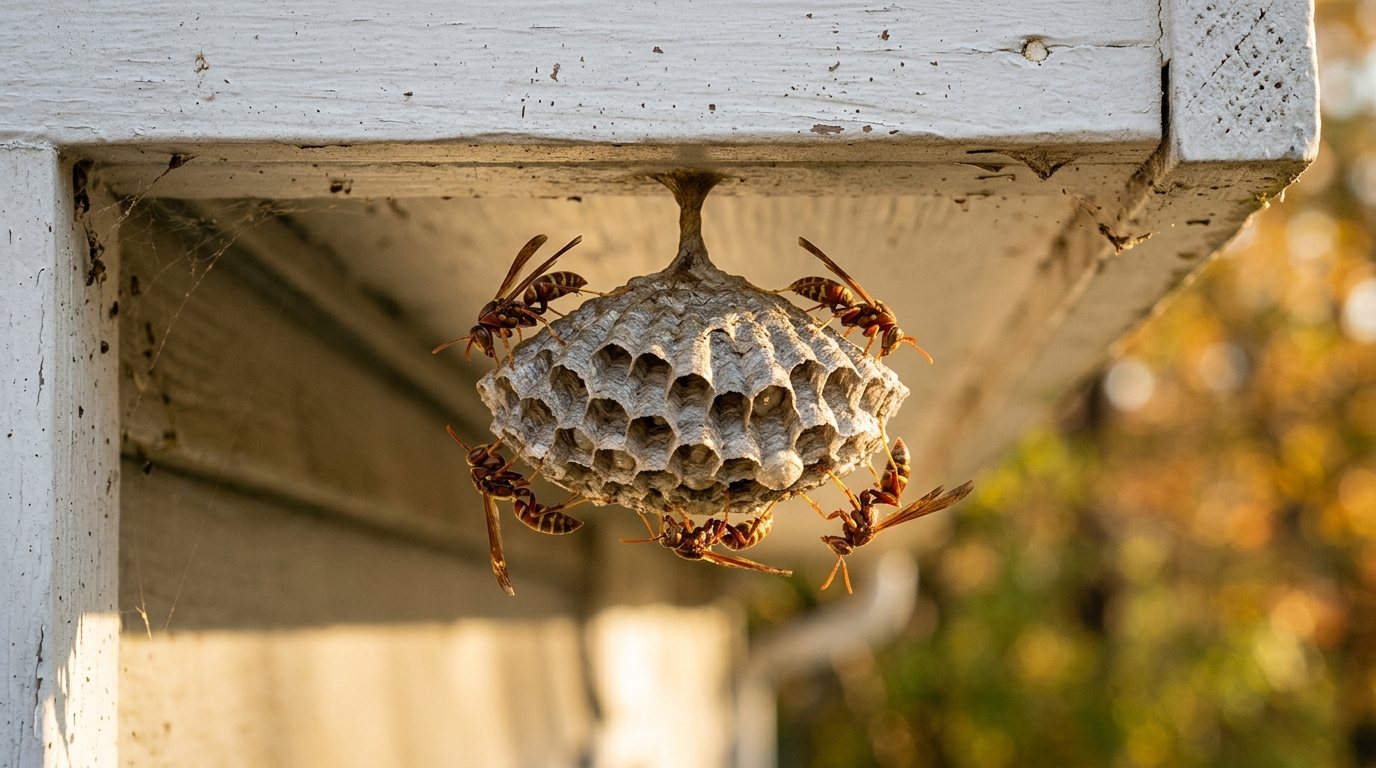
Paper wasps are about 1 inch long and slender, with long legs that dangle in flight. They build open, umbrella-shaped nests hanging from a short stalk under eaves, porch ceilings, railings and branches, and you can see the open cells from below. They’re much less defensive than yellowjackets and rarely sting unless the nest is disturbed.
Hornets
The bald-faced hornet is actually a black-and-white yellowjacket that builds large, enclosed gray paper nests in trees, shrubs and under eaves, with the entrance near the bottom. European hornets are larger brown-and-yellow wasps that usually nest in hollow trees or wall voids. Both defend their nests vigorously.
| Type | Nest | Where you’ll find it | Temperament | DIY? |
|---|---|---|---|---|
| Paper wasp | Open, umbrella-shaped comb | Eaves, porch ceilings, railings | Mild unless disturbed | Often, if small and reachable |
| Yellowjacket (ground or wall) | Enclosed, hidden | Holes in lawn, wall voids, attics | Very defensive | No, call a pro |
| Aerial yellowjacket or bald-faced hornet | Enclosed gray paper ball | Trees, shrubs, eaves | Very defensive | Only small nests within reach |
| European hornet | Hidden in cavities | Hollow trees, wall voids | Defensive | No, call a pro |
If the insects are plump and fuzzy and building wax comb, they’re bees, not wasps. Honey bees are valuable pollinators, so contact a local beekeeper or bee removal service instead of spraying them.
Is it safe to remove the nest yourself?
DIY nest treatment can be reasonable when all of these are true:
- The nest is exposed and smaller than a softball.
- You can reach it while standing on the ground.
- Nobody involved is allergic to stings.
- It’s a paper wasp nest or a small aerial nest, not in the ground or inside a wall.
Skip DIY if any of those aren’t true. Ground nests and wall nests are especially risky because you can’t see how big they are, and the nest may sit farther from the entrance than a spray can reach.
Late fall: consider waiting
UC IPM notes that most wasp colonies live for only one season. Workers die off in late fall and winter, and only new queens survive by sheltering elsewhere. If it’s late October or November and the nest isn’t next to a door or play area, waiting for a few hard freezes and then removing the empty nest is often the safest choice. In mild-winter areas, some yellowjacket colonies can survive longer, so watch for activity before you touch the nest.
Tools and materials
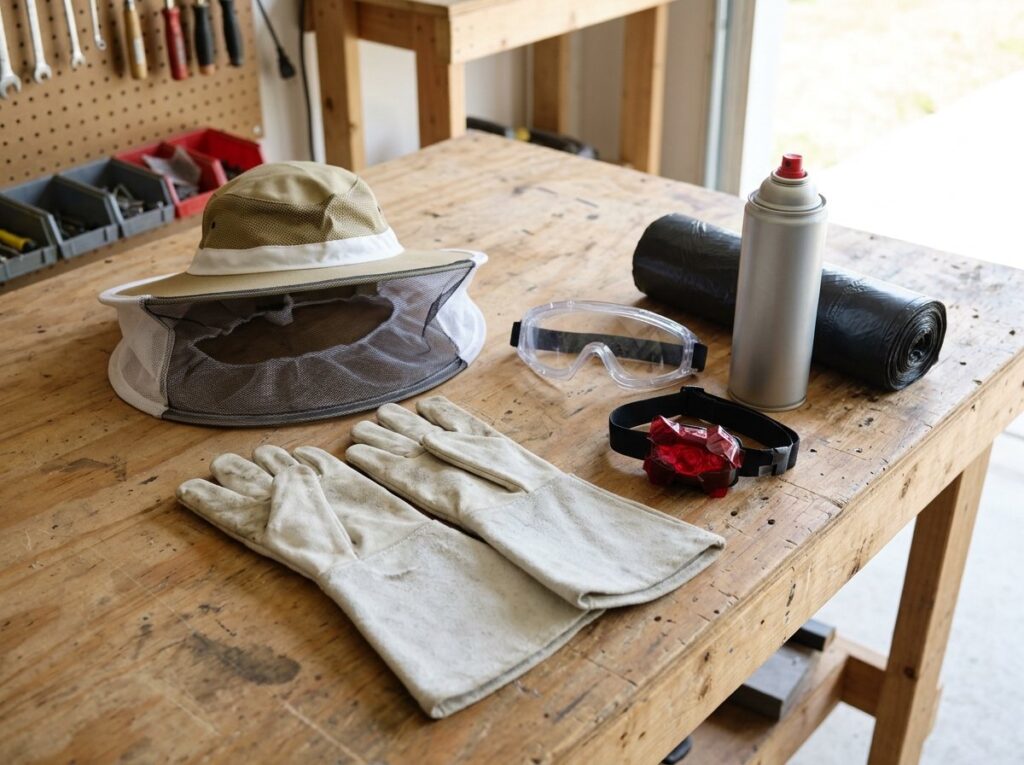
- Aerosol insecticide labeled for wasp and hornet nests (many shoot a stream up to about 20 feet)
- Bee veil or hooded beekeeping jacket
- Thick gloves taped or tucked at the cuffs
- Long pants tucked into socks, boots and a heavy long-sleeved top
- Safety glasses or goggles
- Flashlight or headlamp covered with red cellophane
- Heavy-duty trash bags and a long-handled scraper
How to remove a wasp nest step by step
These steps are for small, exposed nests that meet the DIY checklist above. Always follow the product label, which tells you how far to stand, how long to spray and how to protect people, pets and pollinators.
- Plan ahead in daylight. Note exactly where the nest entrance is, clear trip hazards, and pick an escape route into the house or garage.
- Wait until dark. UC IPM recommends treating at night, when wasps are most likely to be in the nest and less active.
- Suit up. Put on full-body protective clothing, a veil, gloves and eye protection. Keep children and pets indoors.
- Use a red light. A bright white light can draw wasps toward you, so cover your light with red cellophane and set it on the ground nearby rather than holding it.
- Check the wind. Stand upwind so spray doesn’t drift back on you, at the distance the label recommends.
- Spray the entrance. Aim at the nest opening and soak the nest as directed on the label, then walk away immediately along your escape route.
- Stay away for at least a day. Agitated wasps can still be around the next day. Watch from a distance and retreat if you see activity.
- Remove the nest when it’s quiet. Once there’s no activity, put on gloves, scrape the nest into a trash bag, seal it and put it in an outdoor bin. Scrape off the attachment point so other wasps aren’t drawn to the spot.
What not to do
- Don’t knock down, burn or hose an active nest. You’ll scatter angry wasps and risk a fire.
- Don’t pour gasoline or other fuels into ground nests.
- Don’t seal the entrance of a nest inside a wall, because the wasps may chew through into your living space.
- Don’t treat a nest from a ladder. A few stings can make you lose your balance.
Safety note: Never spray a nest you can only reach from a ladder or the roof. If a nest is high on the house, hire a pro. When you do need a ladder for other jobs, follow our ladder safety tips.
If you get stung: know the allergy danger signs
Wasp stingers aren’t barbed, so one wasp can sting several times. Most stings cause sharp pain, then redness, swelling and itching that fades over a few days. Wash the sting, apply a cold pack and keep it elevated; an over-the-counter antihistamine can ease itching.
The UC IPM guide to bee and wasp stings explains that allergic reactions can start right after a sting or up to 30 minutes later. Watch for these signs of anaphylaxis:
- Trouble breathing, wheezing or a tight throat
- Swelling of the face, lips, tongue or throat
- Hives or swelling spreading beyond the sting site
- Dizziness, fainting, confusion or a weak, rapid pulse
- Nausea, vomiting or stomach cramps after a sting
Safety note: Call 911 right away if anyone has trouble breathing, throat or tongue swelling, dizziness or fainting after a sting. If they have a prescribed epinephrine auto-injector, use it as directed while you wait. Also get emergency care for stings in the mouth or throat, or for many stings at once, especially in children or older adults.
If you’ve ever had a strong reaction, see a doctor or allergist before wasp season and ask whether you should carry epinephrine. Let someone else handle any nest near your home.
How to keep wasps away
- Keep food, drinks and pet food covered or indoors, and pour drinks into cups with lids. Wasps can crawl inside open cans.
- Use garbage cans with tight lids and empty them regularly.
- Pick up ripe and fallen fruit.
- Seal gaps in siding, soffits, vents and trim in fall so queens can’t shelter inside. Our fall home maintenance checklist covers those exterior checks.
- Look under eaves, railings and play equipment in spring. UC IPM notes that knocking down a newly started paper wasp nest early in the season usually makes the founding queen move elsewhere.
- Hang yellowjacket lure traps between nesting areas and your patio, away from where people sit. They reduce foraging wasps nearby but won’t eliminate a large population.
When to call a pro
Call a licensed pest control company if any of these apply:
- The nest is in the ground, inside a wall, attic or chimney, or you can’t see it.
- The nest is larger than a softball, or you’re dealing with yellowjackets or hornets.
- You’d need a ladder to reach it.
- Anyone in your home is allergic to stings.
- You’ve already treated the nest and wasps are still active after a few days.
According to Angi, most homeowners pay about $300 to $700 for wasp removal, with an average of around $525. Costs depend heavily on the species and nest location.
| Job | Typical cost |
|---|---|
| Paper wasp nest | $100 to $200 |
| Hornet nest | $300 to $400 |
| Yellowjacket nest | $500 to $750 |
| Nest inside a wall | $250 to $800 |
| Nest in a chimney | $400 to $600 |
| Repairs from wasp damage | $300 to $1,000 |
Frequently asked questions
Do wasps die off in winter?
In most of the US, yes. Workers and old queens die as the weather turns cold, and only newly mated queens survive the winter in sheltered spots. In very mild climates, some yellowjacket colonies can last more than one season.
Do wasps reuse old nests?
Generally no. Each spring a queen starts a new nest, which is why removing an empty nest in winter is safe and helps you spot new ones next year.
Why are wasps more aggressive in the fall?
Colonies are at their largest late in the season, and yellowjackets switch to scavenging for sugars and human food. That puts more wasps near trash, drinks and picnics just as they become more defensive.
Can I spray a wasp nest with soapy water?
Soapy water can kill wasps it soaks, but it rarely reaches the whole colony and puts you close to a defensive nest. A product labeled for wasp and hornet nests, used at night as directed, is safer and more reliable.
Can I remove a wasp nest during the day?
It’s not recommended. During the day many wasps are out foraging and will return to find you at the nest. At night most of the colony is inside and calmer.
The bottom line
Identify the wasp, then decide honestly whether the nest is a DIY job. Treat only small, exposed nests you can reach from the ground, at night, in full protective gear and exactly as the label directs. Leave ground nests, wall nests and large colonies to a pro, wait out the first freezes if it’s late in the season, and call 911 at the first sign of a severe allergic reaction.