
Gutters are easy to forget until they fail. When they clog with leaves, twigs and grit, rainwater spills over the edges instead of flowing to the downspouts. That water soaks the ground next to your foundation, stains siding, rots fascia boards, floods basements and, in cold climates, helps form ice dams that push water under your shingles.
Cleaning gutters isn’t glamorous, but it’s one of the highest-value maintenance jobs you can do. This guide explains how often to clean them, how to work safely on a ladder, step-by-step cleaning instructions, how to clear clogged downspouts, and whether gutter guards are worth it.
Quick answer: Clean gutters at least twice a year, in late spring and late fall after the leaves drop. Set your ladder on firm, level ground using the 4-to-1 rule, scoop debris into a bucket starting near the downspout, flush the gutter with a hose, and clear any downspout clogs. For two-story homes or steep roofs, consider hiring a professional.
Why gutter cleaning matters
- Protects your foundation. Overflowing water pools along the foundation, which can lead to cracks, wet basements and erosion.
- Prevents rot. Water spilling over the back of a clogged gutter soaks the fascia board and roof edge, causing wood rot.
- Reduces ice dams. In winter, clogged gutters can freeze solid, making it easier for ice dams to form at the roof edge.
- Keeps pests away. Wet, rotting debris attracts mosquitoes, ants and rodents and can even sprout seedlings.
- Extends gutter life. Heavy, waterlogged debris strains hangers and can pull gutters away from the house.
How often should you clean gutters?
For most homes, twice a year is the minimum: once in late spring after trees drop their seeds and blossoms, and once in late fall after the leaves have fallen. If your home is surrounded by tall trees, especially pines that shed needles year-round, you may need to clean them three or four times a year. Check them after major storms, too.
Ladder safety comes first
Falls from ladders send many people to the emergency room every year, and gutter cleaning is a common cause. Take these precautions seriously:
- Use the right ladder. An extension ladder for most homes, or a sturdy step ladder for single-story gutters within safe reach. Check the duty rating for your weight plus tools.
- Follow the 4-to-1 rule. For every 4 feet of height to the point where the ladder rests, set the base 1 foot away from the wall.
- Set it on firm, level ground. Use leg levelers on uneven ground. Never set a ladder on loose gravel, wet grass or on top of something to gain height.
- Use a ladder stabilizer. A standoff arm keeps the ladder off the gutter, protecting the gutter and giving you a steadier platform.
- Keep three points of contact when climbing, and never stand on the top rungs.
- Move the ladder often. Don’t overreach. Your belt buckle should stay between the ladder rails.
- Stay away from power lines, and use a fiberglass ladder if you work anywhere near electrical service.
- Have a helper hold the ladder and hand you tools, and skip the job in wind, rain or icy conditions.
Safety note: If your home is two stories or more, has a steep roof, or you’re not comfortable on a ladder, hire a professional gutter cleaner. It’s not worth the risk.
Tools and supplies
- Extension ladder with a stabilizer, or a sturdy step ladder
- Thick waterproof gloves
- Safety glasses
- A plastic gutter scoop or a small garden trowel
- A bucket with a hook to hang on the ladder, or a tarp on the ground below
- A garden hose with a spray nozzle
- A plumber’s snake or drain auger for stubborn downspout clogs
- Optional: a telescoping gutter wand or a wet/dry vac attachment for cleaning from the ground
How to clean gutters: step by step
Step 1: Prepare the area
Lay a tarp on the ground below to catch debris and protect plants. Pick a dry day: dry leaves are lighter and easier to remove, though slightly damp debris doesn’t blow around as much.
Step 2: Start near a downspout
Position your ladder near a downspout and work away from it. Remove the large debris near the downspout opening first so water can flow when you flush the gutter later.
Step 3: Scoop out the debris
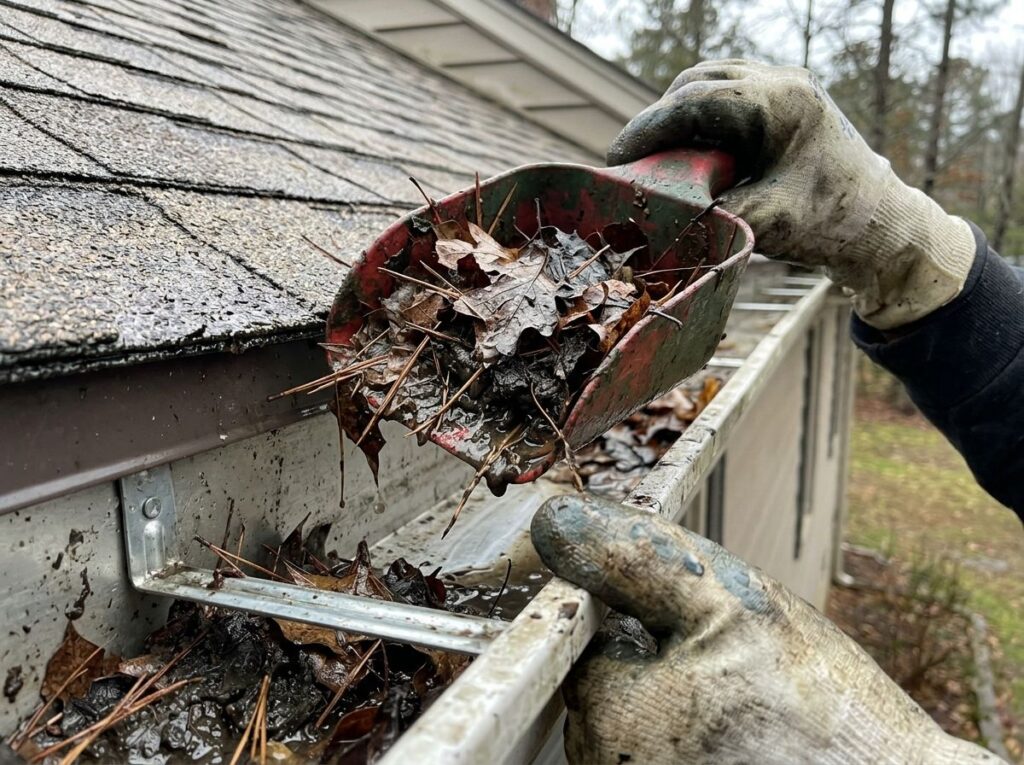
Use a gutter scoop to lift leaves, twigs and sludge into your bucket or onto the tarp. Work in sections, moving the ladder as you go. Don’t lean out to reach farther.
Step 4: Flush the gutter
Once the bulk of the debris is out, run water from a hose along the gutter, starting at the end farthest from the downspout. This washes out fine grit and shows you whether water flows freely toward the downspout. Watch for standing water, which means the slope may be off.
Step 5: Clear the downspouts
If water backs up, the downspout is clogged. Try these in order:
- Spray the hose down into the downspout from the top at full pressure.
- If that doesn’t work, spray up from the bottom outlet to loosen the clog.
- Tap along the downspout to find the blockage; a clogged section often sounds dull.
- Feed a plumber’s snake into the downspout to break up the clog, then flush again.
- For a stubborn clog at an elbow, you may need to remove the downspout section by unscrewing it and clear it on the ground.
Step 6: Inspect while you’re up there
Look for loose or missing hangers, sagging sections, rust spots, holes, leaking seams and gutters pulling away from the fascia. Small leaks at seams can often be sealed with gutter sealant once the gutter is clean and dry. Note larger problems for repair.
Step 7: Check where the water goes
Downspouts should discharge water well away from the foundation. Add downspout extensions or splash blocks so water exits several feet from the house, and make sure the ground slopes away.
Gutter problems to watch for
| What you see | Likely cause | What to do |
|---|---|---|
| Water spilling over the front | Clog or downspout blockage | Clean gutter and clear downspout |
| Standing water in the gutter | Incorrect slope or sagging | Re-hang or adjust hangers |
| Water dripping behind the gutter | Gutter pulled away from the fascia, or missing drip edge | Re-secure gutter; check flashing |
| Drips at seams or corners | Failed sealant | Clean, dry and reseal |
| Peeling paint or rot on fascia | Long-term overflow | Repair wood; fix the gutter problem |
| Erosion or puddles near the foundation | Short downspouts, poor grading | Add extensions; regrade soil |
Simple gutter repairs you can do
Many gutter problems you find during cleaning are easy fixes. Loose gutters can often be re-secured by replacing old spike-and-ferrule fasteners with hidden hanger brackets screwed into the fascia. Small holes and leaking seams can be sealed with a gutter sealant or a patch of flashing and sealant once the area is clean and completely dry. If a section holds water, loosen the hangers and adjust that section so it slopes gently toward the downspout. Replace bent or crushed downspout elbows, which are inexpensive and snap or screw into place. If the fascia board behind the gutter is soft or rotten, the wood needs to be repaired before the gutter can be reattached securely, and that’s often a job for a carpenter or gutter contractor.
Are gutter guards worth it?
Gutter guards cover your gutters to keep out leaves and debris while letting water in. They can reduce how often you need to clean, but no guard is completely maintenance-free.
- Screens: inexpensive and easy to install, but small debris and seeds can still get through or sit on top.
- Micro-mesh guards: block even fine debris and pine needles, but cost more and need occasional brushing off.
- Reverse-curve or surface-tension guards: water curls into the gutter while debris slides off. They can be effective but may overflow in very heavy rain.
- Foam and brush inserts: sit inside the gutter and block large debris, but can trap smaller debris and need periodic cleaning.
Guards make the most sense if you have many trees and find yourself cleaning gutters often. Even with guards, inspect your gutters at least once or twice a year.
Cleaning gutters from the ground
If you’d rather stay off the ladder, telescoping gutter cleaning wands attach to a garden hose and let you flush gutters from the ground. Some leaf blowers and wet/dry vacuums offer gutter attachments with curved extension tubes. These tools work best for single-story homes and light debris. Heavy, packed sludge usually still needs scooping.
Frequently asked questions
How much does professional gutter cleaning cost?
Prices vary by region, home size, height and how clogged the gutters are. Two-story homes and homes with lots of trees usually cost more. Get a few quotes and ask whether downspout clearing and a basic inspection are included.
Can I clean gutters in winter?
It’s best to clean them in late fall before freezing weather. Working on a ladder in snow or ice is dangerous, and frozen debris is hard to remove.
What do I do with gutter debris?
Leaves and organic matter can often go into compost or yard waste collection. Bag anything mixed with shingle grit or trash.
How do I know if my gutters are clogged without climbing up?
Watch them during a rainstorm. Water spilling over the edges, little or no water coming out of downspouts, plants growing in the gutters or sagging sections are all signs of a clog.
Should gutters be sloped?
Yes. Gutters need a slight slope toward the downspouts so water drains. A common guideline is about a quarter inch of drop for every 10 feet of gutter.
The bottom line
Clean gutters are cheap insurance against foundation damage, rot, basement leaks and ice dams. Clean them at least twice a year, put ladder safety first, flush and clear the downspouts, and make sure water exits well away from the house. If heights aren’t your thing or your home is tall, hire a pro, and consider gutter guards if trees keep your gutters full.