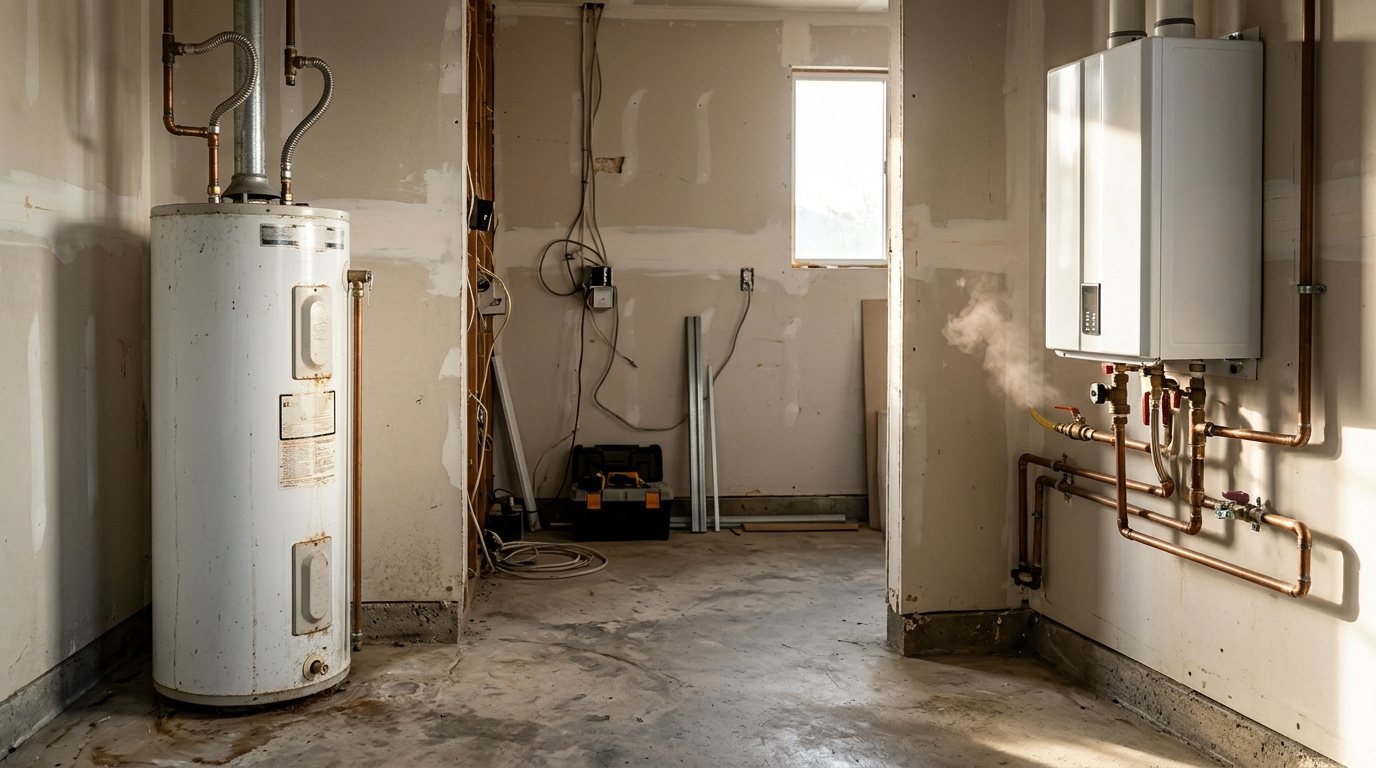
Your old water heater is near the end of its life, or it has already quit, and now you’re facing the big question: replace it with another tank, or switch to tankless? The sales pitch for tankless sounds great, with endless hot water and lower bills, but the upfront price and installation work can be a surprise.
This guide compares tankless and tank water heaters side by side: upfront and operating costs, lifespan, flow rate, space and installation needs. You’ll see what ENERGY STAR and the Department of Energy say about real energy savings, and which type suits which kind of home, so you can choose with clear numbers instead of marketing claims.
Quick answer: A tank water heater costs much less to buy and install and is usually a simple swap, but it wastes some energy keeping stored water hot and typically lasts around 8 to 12 years. A tankless heater often costs about twice as much installed, more if gas, venting or electrical upgrades are needed, but it uses less energy, lasts longer and never runs out, as long as it’s sized for how many fixtures you run at once. Tankless pays off best if you’ll stay in the home for years and have gas available; a tank makes sense on a tight budget or when a like-for-like swap is easy.
How each type works
Tank (storage) water heaters
A tank heater keeps a supply of water, typically 40 to 50 gallons in most homes, hot and ready at all times. When you open a hot tap, hot water leaves the top of the tank and cold water refills the bottom to be heated. Because the water sits in the tank around the clock, some heat escapes through the tank walls, which is called standby loss. Once you use up the stored hot water, you have to wait for the tank to recover.
Tankless (on-demand) water heaters
A tankless heater has no storage. When you open a hot tap, water flows through a heat exchanger, and a gas burner or electric elements heat it on the spot. You never run out of hot water, but the unit can only heat so many gallons per minute. Ask for more than that, such as two showers and the dishwasher at once, and the water turns lukewarm or the flow drops.
Tankless vs tank: side-by-side comparison
| Factor | Tank water heater | Tankless water heater |
|---|---|---|
| Installed cost | $650 to $2,500+ (Bob Vila); $590 to $700 for a 50-gallon (Fixr) | $1,171 to $3,331, often about $2,216 (Bob Vila); $1,140 to $1,500 (Fixr) |
| Operating cost | Higher, due to standby heat loss | Lower; ENERGY STAR gas tankless saves a family of four about $95 a year vs a standard gas tank |
| Lifespan | About 8 to 12 years (Bob Vila) | About 20 years (ENERGY STAR) |
| Hot water supply | Limited to tank size, then recovery time | Unlimited, but limited in gallons per minute |
| Simultaneous use | Handles several fixtures at once until the tank runs low | Depends on unit size; an undersized unit struggles with several fixtures |
| Space | Floor space for a tank 16 to 36 inches across (Fixr) | Compact wall-mounted box; some models mount outdoors |
| Installation | Usually a straightforward swap using existing connections | Often needs new venting, a larger gas line or major electrical upgrades |
| Maintenance | Annual flushing; check the anode rod | Periodic descaling and cleaning the inlet filter |
| Power outage | Many gas tanks keep working | Most models need electricity to run, even gas units |
Upfront cost and installation needs
The price gap is the biggest reason people stick with tanks. Bob Vila puts tank installation at $650 to $2,500 or more depending on size, while tankless runs $1,171 to $3,331, with many homeowners spending around $2,216. For a like-for-like comparison, Fixr lists an installed 50-gallon tank at $590 to $700 against $1,140 to $1,500 for tankless, before extra work.
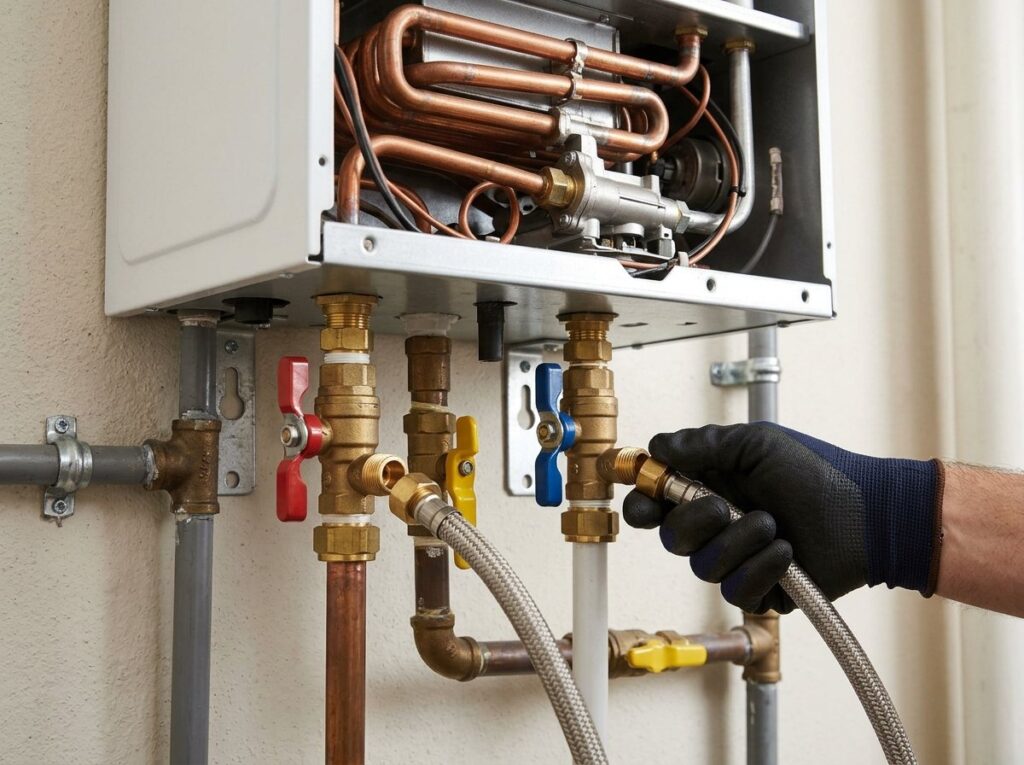
That extra work is where tankless costs climb. A tank replacement usually reuses the existing gas line, vent and water connections. A switch to tankless often involves some or all of these:
- Gas line: gas tankless units need a high burst of gas, and the existing line may be too small, requiring a larger one.
- Venting: tankless units use different vents than tanks, so the old flue often can’t be reused.
- Condensate drain: high-efficiency condensing models produce acidic water that needs a drain line.
- Electrical: whole-house electric tankless units draw a lot of power and may need new high-amperage circuits or even a panel upgrade.
- Water treatment: in hard water areas, a softener or scale filter helps protect the heat exchanger.
Safety note: Gas water heaters of either type must vent combustion gases safely outdoors, and a poorly installed vent can leak carbon monoxide into your home. Have any gas or venting changes done by a licensed plumber with a permit, and keep working CO alarms near sleeping areas. Our guide to a carbon monoxide detector going off explains what to do if one sounds.
Energy savings: what ENERGY STAR and DOE say
Tankless heaters save energy mainly by avoiding standby loss, since nothing is kept hot between uses. According to ENERGY STAR, a certified gas tankless water heater can save a family of four about $95 a year on gas, or about $1,800 over its lifetime, compared with a standard gas storage model. Natural Resources Canada, which runs ENERGY STAR there, says certified tankless units use about 30% less energy on average than storage tanks.
How much you save depends on how much hot water you use. Fixr, citing the U.S. Department of Energy, reports that homes using 41 gallons of hot water a day or less can use 24% to 34% less energy with a tankless unit. In percentage terms, smaller households tend to see the biggest gains, because a tank’s standby loss is a bigger share of their total water heating energy.
Keep the payback math realistic. If tankless costs you, say, $1,000 more installed and saves about $95 a year, it takes roughly 10 years to break even on energy alone. The longer lifespan helps close that gap, since a tank may need replacing once or twice during the life of one tankless unit. For other ways to trim energy use this winter, see our guide on how to lower your heating bill.
Flow rate and simultaneous use
This is where people get disappointed with tankless. A tankless unit is rated by how many gallons per minute (gpm) it can heat at a given temperature rise, which is the difference between your incoming cold water and the hot water you want. The colder your incoming water, the fewer gallons it can heat. That matters in northern states and Canada, where groundwater gets very cold in winter.
To size one, add up the flow of the fixtures you might run at the same time. The EPA notes that standard showerheads use 2.5 gpm, and WaterSense models use no more than 2.0 gpm. Two standard showers alone call for 5 gpm, before you add a faucet or the dishwasher. A plumber should size the unit to your peak demand and your winter inlet temperature, not to the average day.
A tank, by contrast, can supply several fixtures at full flow until the stored hot water runs low. That makes tanks forgiving for households with several back-to-back showers in the morning, as long as the tank is big enough.
Pro tip: Tankless doesn’t deliver hot water faster at the tap. You still wait for hot water to travel through the pipes, and some units briefly send a slug of cold water when a tap is turned off and on again quickly. A recirculation system can shorten the wait with either type.
Lifespan and maintenance
Tank heaters wear out mainly from internal corrosion. Bob Vila puts typical tank life at about 8 to 12 years. Flushing sediment once a year and checking the anode rod can help a tank reach the top of that range; our guide on how to flush a water heater walks you through it.
ENERGY STAR gives tankless water heaters a life expectancy of about 20 years. They still need care: scale from hard water builds up in the heat exchanger, so most manufacturers call for periodic descaling with a pump and vinegar or descaling solution, plus cleaning the inlet screen. Skipping that maintenance can shorten the unit’s life and void the warranty.
Which homes suit each type
Tankless is a good fit if:
- You plan to stay in your home long enough to recover the higher upfront cost.
- You have natural gas or propane and room to vent the unit properly.
- Space is tight and you’d like to reclaim a closet or corner.
- Your household rarely runs more than two hot water fixtures at once, or you’re willing to buy a larger unit.
- You want long showers without worrying about running out.
A tank is a good fit if:
- You need to replace a failed heater quickly and on a budget.
- Your existing venting and gas or electrical service suit a straight swap.
- Your home has electric service that can’t easily support a whole-house electric tankless unit.
- You often run several showers, laundry and the dishwasher at the same time.
- You’d like hot water during a power outage, which many gas tanks provide.
If you have electric-only service, also ask about a heat pump water heater. It is a tank-style unit that is far more efficient than a standard electric tank, and ENERGY STAR certifies those too.
When to call a pro
Replacing a water heater involves gas, venting, high-voltage wiring and pressure relief valves, so most homeowners should hire a licensed plumber, and many areas require a permit. Call a pro right away if you smell gas, see water pooling around the base, notice rust-colored hot water or hear popping and rumbling from a tank. If you simply have no hot water, run through our no hot water troubleshooting steps first.
Expect installed costs of about $650 to $2,500 or more for a tank and $1,171 to $3,331 for tankless, per Bob Vila, with plumber labor typically $45 to $150 per hour. Get at least two quotes, and make sure tankless quotes list any gas line, venting and electrical work. You can compare figures in Fixr’s tank vs tankless comparison and see certified models on the ENERGY STAR tankless page.
Frequently asked questions
Is a tankless water heater worth it?
It’s worth it if you’ll stay in the home long enough for the energy savings and longer lifespan to offset the higher installation cost. ENERGY STAR estimates savings of about $95 a year for a family of four with a certified gas tankless unit. If the switch requires major gas, venting or electrical work, payback takes longer.
Can a tankless water heater run out of hot water?
It can’t run out the way a tank does, because it heats water as it flows. It can, however, be overwhelmed if you run more fixtures than its gpm rating allows, which makes the water lukewarm. Proper sizing for your peak use and winter water temperature prevents this.
How long do tankless water heaters last compared to tanks?
ENERGY STAR gives tankless units a life expectancy of about 20 years. Tank heaters typically last around 8 to 12 years, according to Bob Vila. Regular descaling for tankless units and flushing for tanks helps both reach their full lifespan.
Do tankless water heaters work during a power outage?
Most don’t, even gas models, because they rely on electricity for controls, ignition and the venting fan. Many gas tank heaters with a standing pilot keep working without power. If outages are common where you live, factor that into your choice.
Should I replace my tank with tankless when it fails?
A failed tank is a natural time to consider tankless, but the conversion takes longer to plan and install. If you need hot water quickly, a same-size tank is the faster fix. If you can wait a few days, get tankless quotes so you can compare the full installed cost.
The bottom line
A tank water heater is the cheaper, simpler choice upfront, while tankless costs more to install but uses less energy, lasts longer and never runs out when it’s sized correctly. Run the numbers for your home: the installed price difference, about $95 a year in ENERGY STAR-estimated gas savings, how long you’ll stay and how many fixtures you use at once. If gas and venting work in your favor and you’re staying put, tankless is a smart upgrade; if not, a new efficient tank is a perfectly good choice.