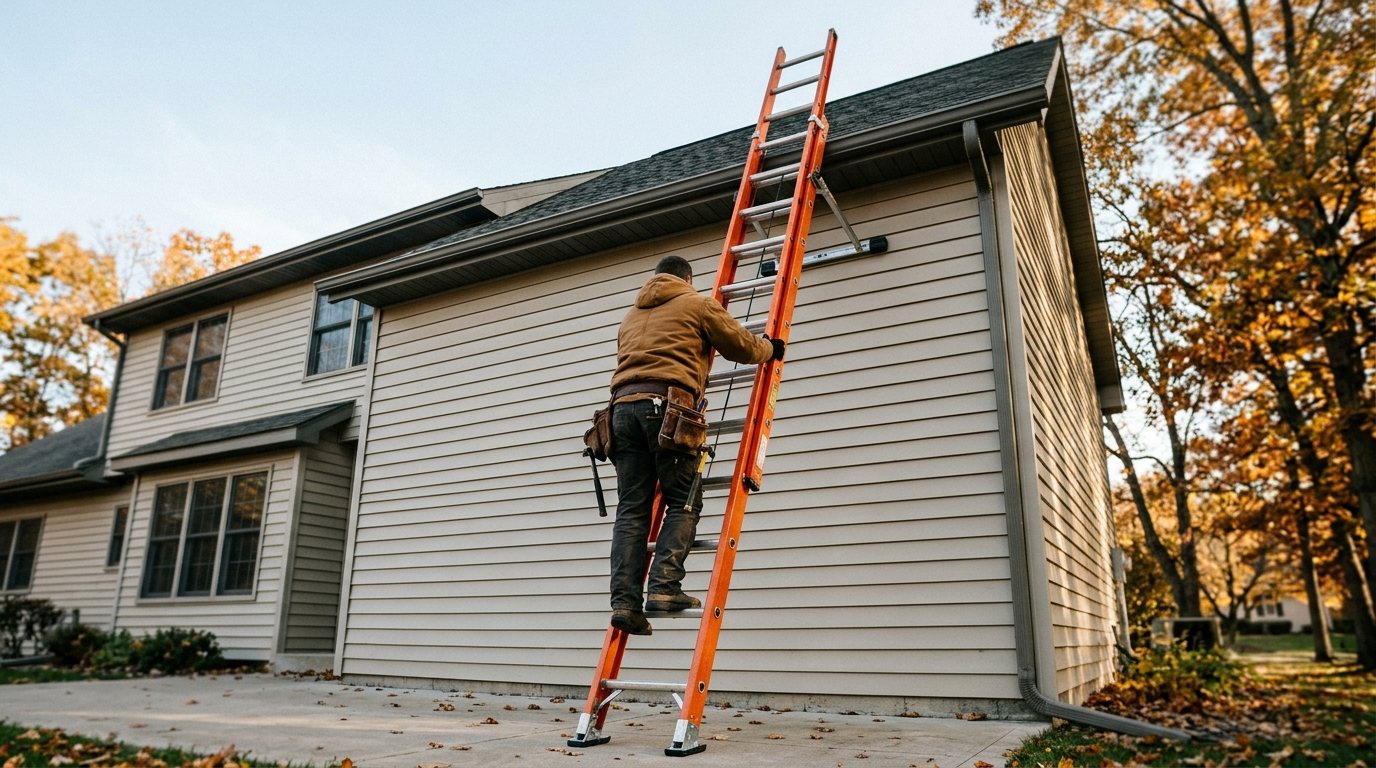
Most ladder accidents happen during ordinary jobs: changing a light bulb, cleaning gutters, hanging holiday lights. You have climbed a ladder a hundred times, so it is easy to skip the setup, reach a little too far, or stand one step higher than you should. That is usually when things go wrong.
This guide covers the ladder safety tips that matter most at home: how to choose the right type and duty rating, how to set up an extension ladder with the 4-to-1 rule, how to use a stepladder correctly, how to climb with three points of contact, how to stay clear of power lines, and how to handle soft or uneven ground. The advice follows OSHA guidance and the ANSI A14 ladder standards.
Quick answer: Pick a ladder tall enough that you never stand on the top step of a stepladder or the top three rungs of an extension ladder, with a duty rating above your weight plus tools. Set extension ladders on firm, level ground with the base 1 foot out for every 4 feet of height, extend them 3 feet above the roof edge, and keep three points of contact while climbing. Stay at least 10 feet from overhead power lines.
Choose the right ladder for the job
Stepladder or extension ladder?
A stepladder is self-supporting and is for indoor and low outdoor jobs where there is nothing to lean on, such as ceiling lights, painting walls or trimming shrubs. An extension ladder leans against a structure and is for reaching higher, such as gutters, second-story windows and rooflines. Multi-position ladders can work as either, but only in the configurations shown on their labels.
| Ladder type | Best for | Key rules |
|---|---|---|
| Stepladder | Ceilings, light fixtures, painting, indoor work | Fully open, spreaders locked, never lean it closed against a wall, no standing on top cap or top step |
| Platform stepladder | Longer jobs at one height | Stand only on the platform; use the guardrail as a handhold |
| Extension ladder | Gutters, roof access, siding, high windows | 4-to-1 angle, 3 feet above the landing, locks engaged, no standing on top three rungs |
| Multi-position ladder | Stairways, varied jobs | Every hinge locked; use only in labeled positions |
Material: aluminum, fiberglass or wood
Aluminum ladders are light and inexpensive but conduct electricity. Fiberglass ladders are heavier and cost more but have nonconductive side rails, which makes them the right choice for any work near wiring, light fixtures or outdoor electrical lines. Wood ladders are uncommon today and should be inspected carefully for splits and rot.
Duty rating
Ladders built to the ANSI A14 standards carry a label showing their duty rating, which is the maximum total weight it is designed to hold. That total includes you, your clothing and shoes, and everything you carry or stage on the ladder.
| ANSI type | Duty rating | Maximum load |
|---|---|---|
| Type IAA | Special duty | 375 lb |
| Type IA | Extra heavy duty | 300 lb |
| Type I | Heavy duty | 250 lb |
| Type II | Medium duty | 225 lb |
| Type III | Light duty | 200 lb |
Add your body weight to the weight of tools, a paint can or a bundle of shingles, then choose a rating comfortably above that total. Higher-rated ladders are also stiffer and feel steadier underfoot, which many homeowners find worth the extra weight.
Height
Choose a ladder tall enough that you can work without standing on the top cap or top step of a stepladder, or on the top three rungs of an extension ladder. For extension ladders, remember that the sections overlap, the ladder leans at an angle, and it must extend 3 feet above the roof edge, so you need a ladder noticeably longer than the height you want to reach. Check the manufacturer’s height chart before buying.
Inspect the ladder before every use
OSHA’s portable ladder safety QuickCard calls for an inspection before each use. It takes a minute.
- Rails and rungs are straight, with no cracks, dents, bends or splits.
- Rung locks, spreader braces and hinges lock fully and are not bent.
- Feet have their slip-resistant pads and swivel freely.
- Rungs and steps are free of mud, paint, oil and ice.
- Ropes and pulleys on extension ladders are not frayed.
- Labels, including the duty rating, are readable.
If anything is damaged, take the ladder out of service and mark it so nobody else uses it until it is repaired or thrown away.
How to set up an extension ladder: the 4-to-1 rule
Most extension ladder falls start with the base sliding out or the top slipping sideways. Getting the angle and footing right prevents both.
- Look up first. Check for overhead power lines, tree branches and the service cable running to your house before you raise the ladder.
- Raise it close to the wall. Place the feet against the base of the house, walk the ladder upright hand over hand, then move the base out.
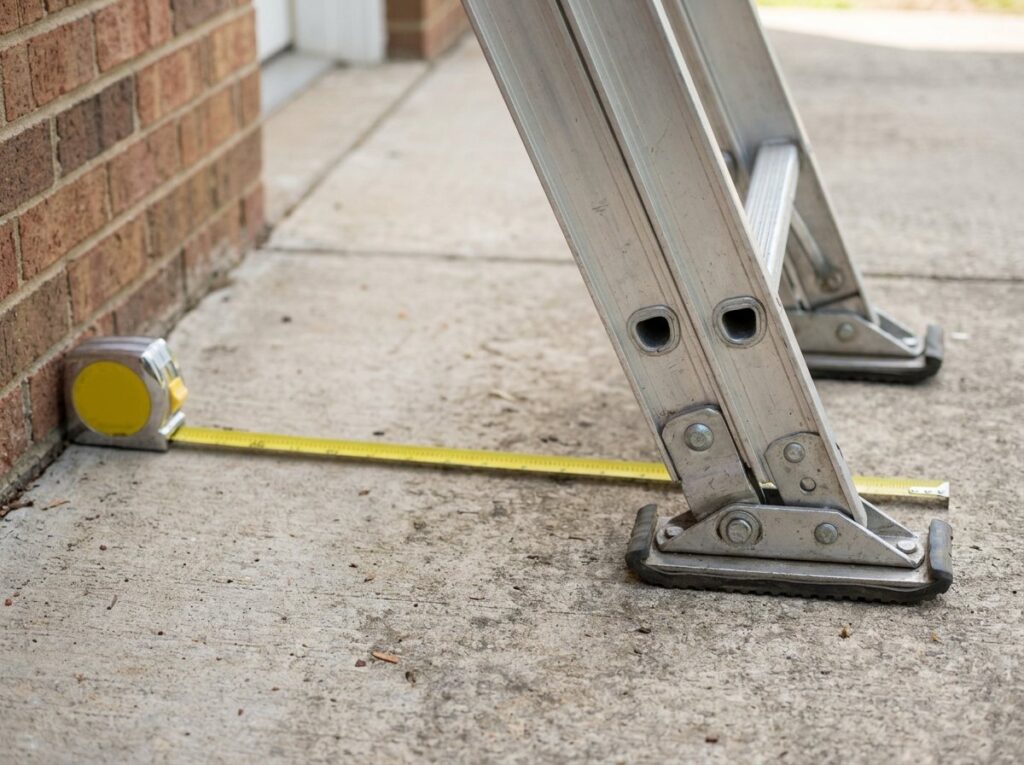
- Apply the 4-to-1 rule. Set the base 1 foot away from the wall for every 4 feet of height to the point where the ladder rests. For a ladder touching a gutter 16 feet up, the feet go 4 feet out.
- Check the angle. Stand with your toes touching the ladder’s feet and stretch your arms straight out. Your palms should rest naturally on a rung at shoulder height.
- Extend 3 feet above the landing. If you are stepping onto a roof, the rails must extend at least 3 feet above the roof edge so you have something to hold as you step on and off.
- Engage the locks. Confirm both rung locks are fully hooked over a rung before climbing.
- Secure it. Tie the top to a solid anchor where possible, and have a helper foot the base or stake it on soft ground.
Safety note: Never rest a ladder against a gutter that is loose, a window pane, or a downspout. Use a ladder standoff (stabilizer) so the top bears on the wall or roof instead, which also keeps the ladder from denting gutters. For the full gutter routine, see our guide to cleaning gutters safely.
Using a stepladder correctly
Stepladders feel safer because they are shorter, but they cause plenty of falls. These rules apply every time:
- Open it fully and push the spreader braces down until they lock.
- Set all four feet on a firm, level surface.
- Never use a stepladder folded and leaned against a wall like a straight ladder; OSHA specifically warns against it.
- Do not stand on the top cap or the top step unless the ladder is designed for it. Most labels mark these as no-standing zones.
- Do not climb the back side unless it has steps designed for climbing.
- Face the ladder and keep your belt buckle between the rails.
- Move the ladder instead of leaning sideways to reach.
If you are working on a ceiling fixture, a fiberglass stepladder adds a layer of protection. Our guide to replacing a light fixture walks through shutting off and testing the power first.
Climb with three points of contact
Three points of contact means two hands and one foot, or two feet and one hand, on the ladder at all times. It is the single most important climbing habit.
- Face the ladder going up and coming down.
- Keep your hands free. Carry tools in a tool belt or pull them up with a rope and bucket once you are in position.
- Stay centered. Keep your body between the side rails. If you have to stretch past them, climb down and move the ladder.
- One person at a time, unless the ladder is designed for two.
- Wear clean, dry shoes with good soles. No sandals or socks.
- Step down, do not jump from the last rung.
Stay away from power lines
A metal ladder touching an overhead line can be fatal, and you do not need to be on the ladder for it to happen. People are often hurt while carrying or raising a long ladder.
For people who are not trained electrical workers, OSHA’s electrical safety standard requires keeping yourself and any conductive object, including a ladder, at least 10 feet from energized overhead lines up to 50 kV. Treat every overhead line, including the service drop to your house, as live. Use a fiberglass ladder for any work near electricity, carry ladders horizontally, and lower them before moving them. If your job requires getting closer, call your utility or a licensed electrician. Our holiday lights electrical safety guide covers the outdoor wiring side of rooftop decorating.
Setting up on soft or uneven ground
OSHA guidance is simple: use ladders only on stable, level surfaces unless they are secured, and never set a ladder on boxes, bricks, barrels or other unstable bases to gain height or level it.
- Soft ground: many extension ladders have pivoting feet that flip so the spurs dig into soil or turf. Use pads on hard surfaces and spurs on soft ground.
- Slopes and steps: use leg levelers or a leveling accessory designed for your ladder, installed per the manufacturer’s directions. Do not shim a leg with scrap wood.
- Slippery surfaces: wet decks, ice and polished floors call for a helper at the base, a non-slip mat designed for ladders, or a different day.
- Doorways: do not set up in front of a door unless it is locked, blocked or guarded.
- Weather: skip ladder work in strong wind, rain, ice or lightning.
Tools and accessories that make ladders safer
- Fiberglass ladder for electrical work
- Ladder standoff or stabilizer for gutters and walls
- Leg levelers designed for your ladder
- Tool belt or bucket with a hook
- Rope for hauling materials and tying off the top
- Non-slip, clean work shoes
- A helper to foot the base and hand up materials
When to call a pro
Some jobs are better left to someone with the right equipment, training and insurance. Call a pro if:
- The job is near overhead power lines or the electrical service to your house.
- You would need to work on a steep or wet roof, or above the first story.
- The ground is too sloped or soft to set a ladder securely, even with levelers.
- The task requires both hands for long periods or carrying heavy materials up the ladder.
- You have balance problems, take medications that cause dizziness, or would be working alone.
Handyman help is often affordable compared with the cost of a fall. Taskrabbit’s handyman cost guide puts typical US rates at about $50 to $125 per hour, and roofing, gutter and electrical work near lines should go to specialists in those trades.
Frequently asked questions
What is the 4-to-1 rule for ladders?
For every 4 feet of height to the point where the ladder rests, set the base 1 foot out from the wall. A ladder resting 20 feet up should have its feet 5 feet from the wall. This angle keeps the base from kicking out and the top from tipping back.
What does three points of contact mean?
It means keeping two hands and one foot, or two feet and one hand, on the ladder at all times while climbing. That leaves your hands free of tools, so carry them on a belt or haul them up once you are in position.
What duty rating ladder do I need?
Add your weight to your clothing, tools and materials, then choose a rating above that total. Type III ladders hold 200 pounds, Type II 225, Type I 250, Type IA 300 and Type IAA 375. Many homeowners choose Type I or IA for extra margin and stiffness.
Can you stand on the top step of a stepladder?
No. OSHA guidance says not to use the top step or rung as a step unless it was designed for it, and most stepladder labels prohibit standing on the top cap and the step below it. If you need to stand that high, use a taller ladder.
How far should a ladder be from power lines?
OSHA requires unqualified people and conductive objects like ladders to stay at least 10 feet from energized overhead lines up to 50 kV. Treat all overhead lines as live, use fiberglass ladders near electricity, and call your utility if work must happen closer.
How do you set up a ladder on uneven ground?
Use leg levelers or a leveling accessory made for your ladder, and on soft soil, flip the feet to their spur position. Never prop a leg on bricks, boards or boxes. If the ground is too uneven to make the ladder stable, choose another approach or call a pro.
The bottom line
Ladder safety comes down to the right ladder and the right setup. Choose a duty rating above your total load and a height that keeps you off the top steps, inspect it every time, set extension ladders at a 4-to-1 angle with 3 feet above the landing, and keep three points of contact. Look up for power lines before you lift, never improvise on uneven ground, and when a job feels beyond your setup, let a pro handle it.