You’re building shelves, fixing a squeaky stair or replacing a deck board, and you have a coffee can full of nails and a box of screws. Screws seem stronger, but carpenters still frame entire houses with nails, so which one should you actually use?
This guide explains the real difference between screws and nails, including shear strength versus holding strength, when each fastener is the right choice, and the common types you’ll find at the hardware store. You’ll also learn which coatings to use outdoors and which connections you should never improvise.
Quick answer: Nails flex instead of snapping, so they’re better for connections that carry sideways (shear) loads, like framing and trim. Screws grip the wood with threads and resist pulling out, so they’re better where parts might pull apart or need to come apart later, like decking, cabinets, subfloors and drywall. For structural hardware such as joist hangers, always use the exact fasteners the manufacturer specifies.
Shear strength vs holding strength
Shear strength
Shear is a force that tries to slide two pieces past each other, like the weight of a floor pushing down on the nails that hold a joist in place. Nails are made from relatively soft, ductile steel, so under heavy shear they bend rather than break. That flexibility also lets wood swell and shrink with the seasons without the fastener snapping.
Holding (withdrawal) strength
Withdrawal strength is how well a fastener resists being pulled straight out. Screw threads lock into the wood fibers, so screws hold far better against pull-out than smooth nails. That’s why screws are the go-to choice for subfloors, cabinets, railings and anything that might be pulled, pried or loaded in tension.
Why the steel matters
Many common screws, especially drywall screws, are hardened to drive easily. Hardened steel is strong in tension but brittle, so it can snap under sideways loads instead of bending. Structural screws are a different product: they’re engineered and tested to replace lag screws and some nailed connections.
Screws vs nails at a glance
| Factor | Nails | Screws |
|---|---|---|
| Shear (sideways) loads | Better; bend instead of snapping | Ordinary screws can snap; structural screws are rated |
| Pull-out resistance | Lower; ring and spiral shanks help | Higher; threads lock into wood |
| Speed | Very fast, especially with a nail gun | Slower, but quick with a drill or impact driver |
| Removal | Hard; often damages the wood | Easy to back out and reuse the hole |
| Seasonal wood movement | Flexes with the wood | Holds tight; can loosen or crack thin stock |
| Cost per fastener | Usually lower | Usually higher |
| Best for | Framing, trim, sheathing, siding, roofing | Decking, subfloors, cabinets, drywall, hinges |
When to use nails
- Wall and roof framing: Common nails handle the shear loads in studs, plates and rafters, and building codes specify nail sizes and schedules for these connections.
- Trim and baseboards: Finish and brad nails hold molding with tiny holes that are easy to fill and paint.
- Sheathing, siding and roofing: Ring-shank, spiral and roofing nails go in fast and flex with seasonal movement.
- Structural connectors: Joist hangers and framing anchors are designed around specific nails or connector screws, not ordinary screws.
Ring-shank nails close much of the holding gap with screws. According to this nails vs screws guide, ring-shank nails can increase holding power by 40 percent or more compared with smooth-shank nails.
When to use screws
- Decking: Exterior-rated deck screws resist the pull-out and board cupping that loosen nails over time.
- Subfloors and stairs: Screws pull plywood tight to the joists and stop squeaks; see our guide on how to fix squeaky floors.
- Drywall: Drywall screws hold tighter and are far less likely to pop than drywall nails. If you’re dealing with pops now, read how to fix drywall nail pops.
- Cabinets, shelves and furniture: Screws resist the pulling loads of hanging cabinets and let you adjust or remove parts later.
- Hinges, brackets and hardware: Anything you might remove or adjust belongs on screws.
- Hanging heavy items: Screws into studs, or toggle bolts where there’s no stud.
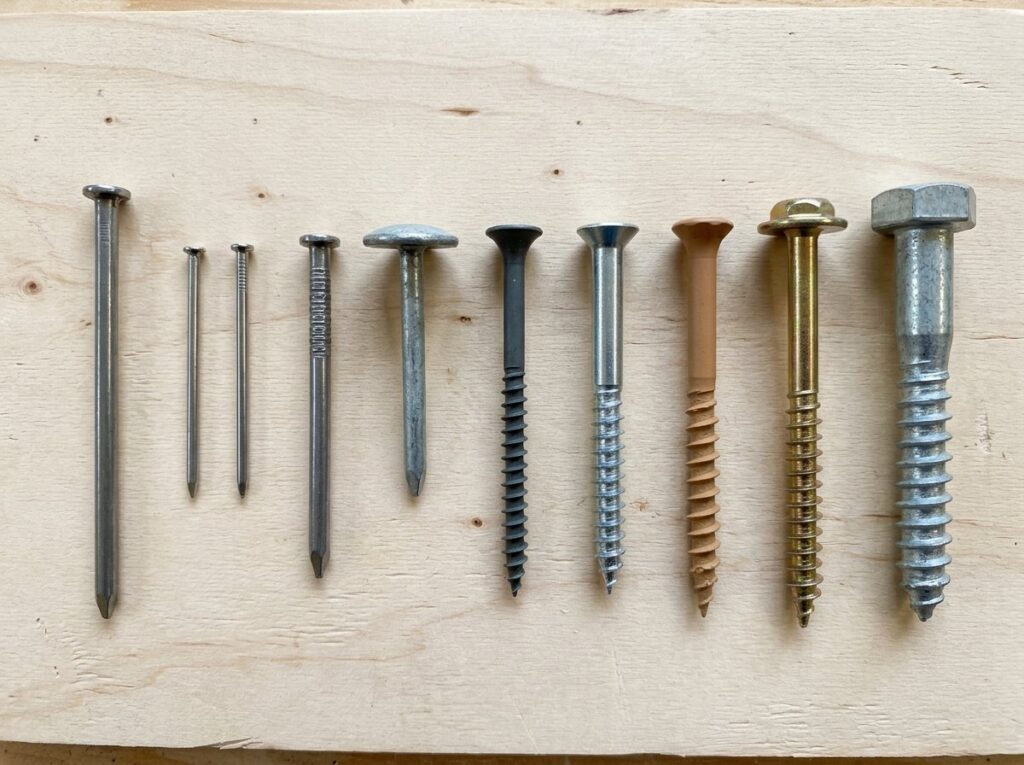
Common nail and screw types
| Fastener | Typical use | Notes |
|---|---|---|
| Common nail (16d, 3-1/2 in) | Wall framing | Thick shank for strength; bright finish is for indoor use |
| Common nail (8d, 2-1/2 in) | Sheathing, plates to subfloor | The “d” stands for penny, an old sizing system |
| Box nail | Light framing, thin boards | Thinner shank splits less but holds less |
| Finish and brad nails | Trim, molding, cabinets | Small heads sink below the surface |
| Ring-shank nail | Subfloors, siding, decking | Rings add holding power |
| Roofing nail | Asphalt shingles | Large head, galvanized |
| Wood screw (#8, #10) | General woodworking, shelves | Coarse threads; pre-drill hardwoods |
| Drywall screw | Drywall to studs | Bugle head; brittle, not for structural or outdoor use |
| Deck screw | Deck boards, fences | Exterior-coated or stainless; 1-5/8 to 4 in |
| Structural screw | Ledgers, beams, posts | Engineered replacement for lag screws; no pre-drilling |
| Lag screw | Heavy wood connections | Needs a pilot hole and a socket wrench or impact driver |
| Concrete screw | Wood or metal to masonry | Pre-drill with a masonry bit |
Choosing the right finish
The coating matters as much as the fastener type, because a rusted fastener loses strength and stains the wood.
- Bright (uncoated): Dry indoor use only.
- Zinc-plated: Indoors or protected areas; not enough for treated lumber.
- Hot-dip galvanized: Outdoor work and pressure-treated lumber.
- Stainless steel: Cedar, redwood, composite decking and coastal homes.
For decks, the American Wood Council’s deck construction guide requires fasteners used with preservative-treated wood to be hot-dip galvanized, stainless steel, silicon bronze or copper, and calls for stainless steel within 300 feet of salt water. It also says fasteners and connectors should be the same corrosion-resistant material.
How to size nails and screws
Nail sizes
Nails are still sold by the penny system, written as a number followed by “d.” A 16d nail is 3-1/2 inches long, a 10d is 3 inches and an 8d is 2-1/2 inches. A traditional rule of thumb is to choose a nail about three times as long as the thickness of the board you’re fastening, so most of the nail ends up in the thicker piece below.
Screw sizes
Screws are sized by gauge (shank diameter) and length. A #6 screw is about 9/64 inch thick and suits light hardware, #8 at about 5/32 inch is the everyday choice for shelves and general woodworking, and #10 at about 3/16 inch handles heavier brackets and framing repairs. Longer isn’t always better: a screw that pokes through the back of a cabinet or into a pipe causes more trouble than it solves.
How to drive nails and screws without splitting wood
- Keep fasteners at least 3/4 inch from board ends and edges when you can, and stagger them instead of lining them up along the grain.
- Drill pilot holes for screws in hardwood, near board ends and in thin trim. Match the bit to the screw’s inner shaft so the threads still bite.
- For nails near an edge, tap the point with a hammer to blunt it slightly. A blunt tip crushes through the fibers instead of wedging them apart.
- Set the drill’s clutch so screw heads stop flush. Overdriven screws lose holding power and break the surface of drywall and softwood.
- Finish trim nails with a nail set, leaving the head just below the surface for filler.
Adding glue for a stronger joint
Fasteners and adhesive work well together. Construction adhesive under subfloor sheets, combined with screws or ring-shank nails, helps prevent squeaks, and wood glue plus screws makes shelves and furniture joints far stiffer than either alone. The fasteners clamp the joint while the glue cures. Our guide to what glue to use explains which adhesive suits each material.
Tools and materials
- Claw hammer and a nail set for finish nails
- Drill/driver for pilot holes and screws; impact driver for long screws (see impact driver vs drill)
- Square, Torx and Phillips driver bits
- Nails and screws sized and coated for the job
- Safety glasses
Pro tip: For wood screws, choose a length that lets the tip go about two-thirds of the way into the bottom board. Square and Torx drives resist stripping far better than Phillips, and a pilot hole prevents splits near board ends and in hardwood.
Safety note: Wear safety glasses when hammering or using a nail gun, since nails can ricochet off knots and hard spots. On a nail gun, use the sequential (single-shot) trigger mode when you can, keep your free hand well away from the nailing spot, and disconnect the air or battery before clearing a jam.
When to call a pro
Most everyday fastening is DIY-friendly, but structural connections are not the place to guess:
- Attaching a deck ledger to your house, or repairing deck joists, beams and posts
- Rusted joist hangers, loose railings or a deck that moves when you walk on it
- Repairs to load-bearing walls, headers, rafters or floor joists
- Any job that needs a building permit in your area
For smaller repairs, Angi reports handymen typically charge about $40 to $140 per hour, while structural work calls for a licensed contractor and may need an engineer.
Frequently asked questions
Are screws stronger than nails?
It depends on the direction of the load. Screws resist pulling out better, while nails handle sideways shear loads better because they bend instead of snapping. Engineered structural screws are the exception, since they’re rated for structural loads.
Can I use drywall screws for framing or outdoor projects?
No. Drywall screws are brittle and usually not corrosion-resistant, so they can snap under load or rust outdoors. Use framing nails, structural screws or exterior-rated deck screws instead.
Should I use nails or screws for a deck?
Use exterior-rated screws or ring-shank nails for deck boards, and follow your deck plans and local code for framing. Joist hangers, ledgers and posts need the specific nails, structural screws or bolts listed by the hardware maker and the code.
Can I use screws instead of nails for framing?
Not ordinary screws. Some engineered structural screws are approved for specific framing connections, but building codes list nails for most framing, so check the screw maker’s approvals and your local code before substituting.
Nails or screws for baseboards and trim?
Finish or brad nails are standard because their small holes are easy to fill. Use trim-head screws where trim keeps pulling away from the wall.
The bottom line
Think about how the joint will be loaded. Use nails where wood carries sideways loads and needs to flex, like framing and trim, and screws where parts could pull apart or need adjustment, like decking, cabinets and subfloors. Match the coating to the location, and never substitute ordinary screws for the fasteners that structural hardware requires.