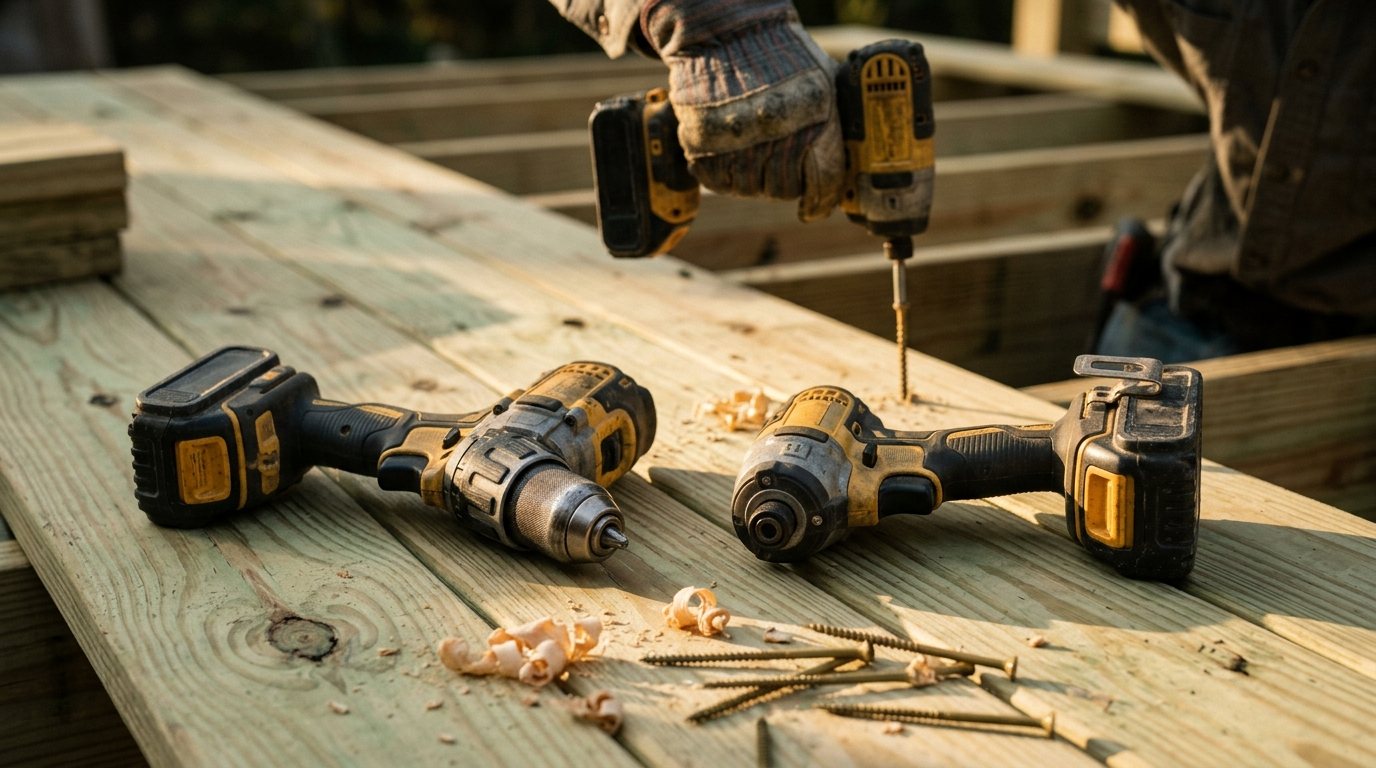
You’re standing in the tool aisle looking at two cordless tools that seem almost identical. One is a drill, the other is an impact driver, and they often come bundled together. Do you really need both, and if you only buy one, which should it be?
This guide explains how an impact driver and a drill actually work, what torque numbers mean, how their chucks and bits differ, and which jobs suit each tool. You’ll finish with a clear answer on which to buy first and a use-case table you can come back to.
Quick answer: A drill/driver spins steadily with an adjustable clutch, so it drills holes of all sizes and drives screws with control. An impact driver adds rapid rotational hammer blows that sink long screws and lag bolts with far less effort, but it takes only 1/4-inch hex bits and has less finesse. If you’re buying one tool, get the drill first, then add an impact driver when you start building decks, fences or other projects with lots of long screws.
How a drill and an impact driver work
Drill/driver
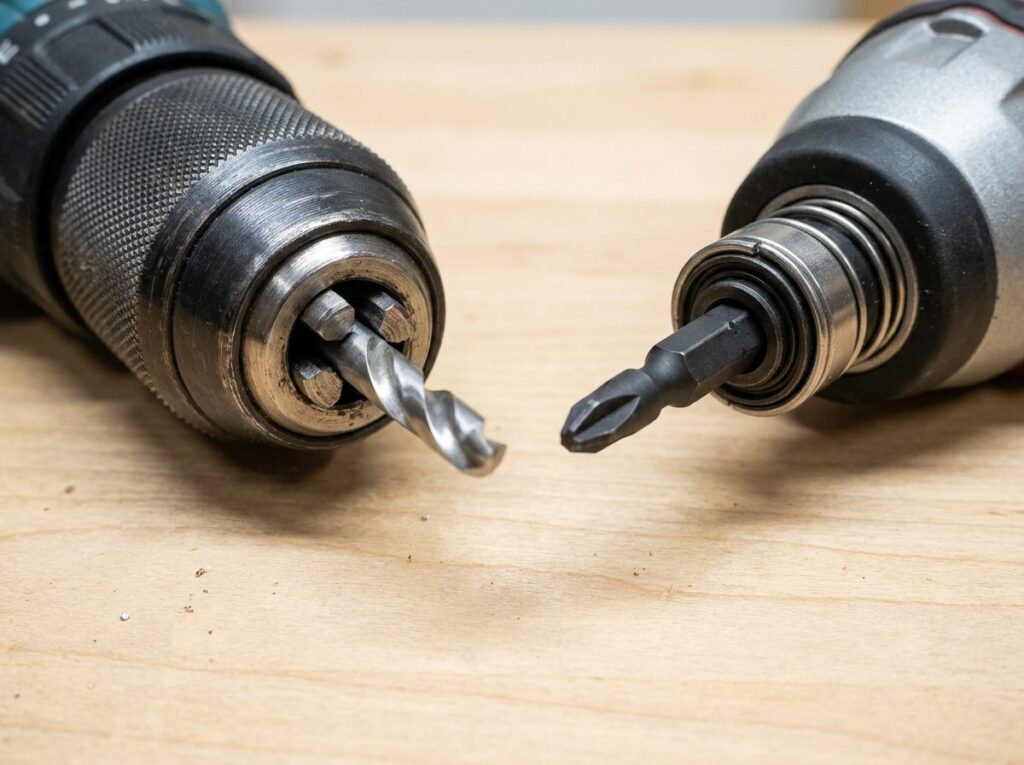
A drill/driver’s motor turns the chuck continuously, and you control speed with the trigger and a two-speed gear switch. The numbered collar behind the chuck is the clutch: it slips once the screw reaches a set resistance, so you don’t strip the screw or sink it too deep. A three-jaw chuck grips round bits, hex bits, hole saws and accessories from tiny to large.
Some drills also have a hammer mode that adds a forward pounding action for drilling into brick and concrete. That’s called a hammer drill, and it’s a different mechanism from an impact driver.
Impact driver
An impact driver starts like a drill, but when the screw resists, an internal hammer and anvil begin striking the output shaft thousands of times per minute. Those blows twist the fastener in short, powerful bursts, which is why an impact driver can drive a 3-inch deck screw with little wrist strain. The impact drivers reviewed in a recent impact driver buying guide were rated at roughly 3,200 to 4,300 impacts per minute.
The bit locks into a 1/4-inch hex quick-release collet, so the tool is shorter and lighter than most drills. Most impact drivers have no clutch, so control comes from your trigger finger or from speed modes on higher-end models.
Impact driver vs drill: side by side
| Feature | Drill/driver | Impact driver |
|---|---|---|
| How it turns | Steady rotation | Rotation plus rapid rotational impacts |
| Chuck | 3/8-inch or 1/2-inch keyless, three-jaw | 1/4-inch hex quick-release collet |
| Bits it takes | Round and hex shanks, hole saws, mixers | 1/4-inch hex shank only, ideally impact-rated |
| Clutch | Yes, adjustable | Usually no; some have speed or assist modes |
| Torque | Lower, steady | Much higher in short bursts |
| Size and weight | Longer, heavier with a 1/2-inch chuck | Compact and short |
| Noise | Moderate | Very loud once impacting starts |
| Best at | Drilling holes, controlled driving | Long screws, lag bolts, repetitive driving |
Torque explained
Torque is turning force, usually listed in inch-pounds (in-lbs). The same buying guide suggests about 800 in-lbs is plenty for general household jobs, while decking and framing call for 1,500 in-lbs or more. The 18V and 20V impact drivers it reviewed ranged from about 1,375 to 2,000 in-lbs.
Drill torque is harder to compare because some brands rate drills in unit watts out (UWO), a figure that mixes torque and speed. Some makers also list torque in foot-pounds; multiply by 12 to convert to inch-pounds. Brushless motors deliver more of the battery’s power as torque and usually run longer per charge, so they’re worth the extra cost on either tool.
Higher torque isn’t always better. On small screws, cabinet hardware or soft materials, an impact driver’s power can snap screw heads, crack trim or bury screws below the surface. That’s when a drill’s clutch earns its keep.
Chucks and bits
Drill chucks
A 3/8-inch chuck is lighter and spins faster, which suits most household drilling. A 1/2-inch chuck holds larger bits and handles big hole saws and mixing paddles, but the drill is usually heavier. Hand-tighten the chuck firmly so the bit doesn’t slip.
Impact driver bits
Impact drivers accept only 1/4-inch hex-shank bits. Use impact-rated driver bits, which flex slightly to absorb the blows instead of shattering, and impact-rated sockets rather than chrome sockets if you use a socket adapter. You can drill small holes with hex-shank drill bits, but for anything larger or more precise, switch to the drill. Our guide to types of drill bits covers which bits work in each tool.
Which tool for which job
| Job | Better tool | Why |
|---|---|---|
| Drilling holes in wood, metal or drywall | Drill | Accepts every bit type with steady speed |
| Holes over 1/2 inch, hole saws, spade bits | Drill | Steady torque and a side handle on bigger models |
| Drilling concrete or brick | Hammer drill | Neither a plain drill nor an impact driver is built for masonry |
| Assembling furniture, hinges, cabinet hardware | Drill (low clutch setting) | Clutch prevents stripping and cracking |
| Hanging shelves and TV mounts into studs | Either; impact for lag screws | Impact drives long screws with less effort |
| Building a deck or fence, 3-inch screws | Impact driver | Drives hundreds of long screws without wrist strain |
| Lag screws and structural screws | Impact driver | High torque in short bursts |
| Loosening stuck or rusted screws | Impact driver | Impacts break fasteners free without camming out |
| Mixing paint or thinset | Drill (1/2-inch chuck) | Steady, controllable speed |
| Drywall screws | Drill with clutch or a drywall screw gun | Easy to overdrive with an impact driver |
How to get the best from each tool
Using a drill/driver
- Use the low gear (usually marked 1) for driving screws and large bits, and the high gear (2) for small drill bits.
- Start with a low clutch number when driving screws, then turn it up one step at a time until the screw sits flush.
- Drill pilot holes in hardwood and near the ends of boards so the wood doesn’t split.
- Switch the collar to the drill symbol when drilling holes so the clutch doesn’t slip.
Using an impact driver
- Squeeze the trigger gently at first so the bit seats in the screw head before the impacts start.
- Keep the driver in line with the screw and push firmly to prevent the bit from slipping out.
- Let off the trigger as soon as the head is flush. A second or two too long can snap a small screw or crush the wood fibers.
- Use the lowest speed mode, if your model has one, for small screws and soft materials.
The cousins: hammer drills and impact wrenches
A hammer drill is a drill with a pounding action for masonry, and it can also do everything a regular drill does. An impact wrench is a larger version of the impact driver with a square drive for sockets, built for big bolts and lug nuts. Most homeowners never need an impact wrench, but a hammer drill is worth considering if you often drill into brick or concrete.
Which should you buy first?
For most homeowners, buy a drill/driver first. It drills every kind of hole and drives most screws around the house, and experienced renovation pros agree the drill is the more versatile of the two. If you only own one, it should be the one that does both jobs reasonably well.
Add an impact driver when you start projects with lots of long screws, like decks, fences, sheds or framing. Many people find that once they own both, the drill stays loaded with a drill bit and the impact driver stays loaded with a driver bit, which saves constant bit swapping.
Buying tips
- Pick one battery platform and stay with it so batteries work across tools. Our guide to 18V vs 20V batteries explains the labels.
- Choose brushless motors if the budget allows, for longer runtime and more power.
- Consider 12V tools if you mainly do light household jobs and want something compact.
- Look for a kit with two batteries and a charger, and check whether a drill and impact combo kit costs much more than the drill alone.
- Look for a drill with a 1/2-inch chuck if you plan to use large bits or mixing paddles.
Safety note: Impact drivers are loud enough to warrant hearing protection, and both tools can throw chips or snap bits. Wear safety glasses, hold the tool firmly, and expect a drill with a large bit to twist hard if the bit catches; use the side handle when one is provided. Remove the battery before changing bits.
When to call a pro
Choosing a tool is easy, but some jobs need more than the right tool:
- Attaching a deck ledger board to your house, which affects structure and usually needs a permit
- Drilling large holes through joists, beams or load-bearing studs
- Mounting heavy items above beds, stairs or fireplaces
- Any job near wiring or plumbing you can’t see
For smaller jobs, Angi reports that handymen typically charge about $40 to $140 per hour, depending on the work and your location.
Frequently asked questions
Can an impact driver drill holes?
Yes, for small holes, as long as you use hex-shank drill bits. It’s less precise than a drill and isn’t designed for large holes, so use a drill for anything bigger or cleaner.
Do I need an impact driver if I already have a drill?
Not for most household tasks. It becomes worth buying when you drive lots of long screws or lag bolts, or when your wrist is tired of fighting the drill on big fasteners.
Is an impact driver the same as a hammer drill?
No. A hammer drill pounds forward to chip masonry, while an impact driver adds twisting blows to drive fasteners. For concrete and brick, you need a hammer drill with masonry bits.
Can I use regular bits in an impact driver?
Only if they have a 1/4-inch hex shank. Round-shank bits won’t fit, and standard driver bits can crack under impact, so choose impact-rated bits.
Can I use an impact driver to remove lug nuts?
A compact impact driver with a socket adapter may loosen small nuts, but it usually lacks the power for car lug nuts and the adapter can break. Use an impact wrench or a breaker bar instead, and always tighten lug nuts to the vehicle’s specification with a torque wrench.
Why does my impact driver strip or snap screws?
It’s delivering more torque than a small screw can handle. Ease off the trigger, use a lower speed mode if your tool has one, or switch to a drill with the clutch set low. Learn more about fastener choices in our screws vs nails guide.
The bottom line
A drill is the more versatile tool and the right first purchase for almost every homeowner. An impact driver is a specialist for long screws, lag bolts and repetitive driving, and it’s the natural second tool once your projects get bigger. Choose both on the same battery platform and keep one loaded for drilling and the other for driving. For the rest of your starter kit, see our basic home tool kit.