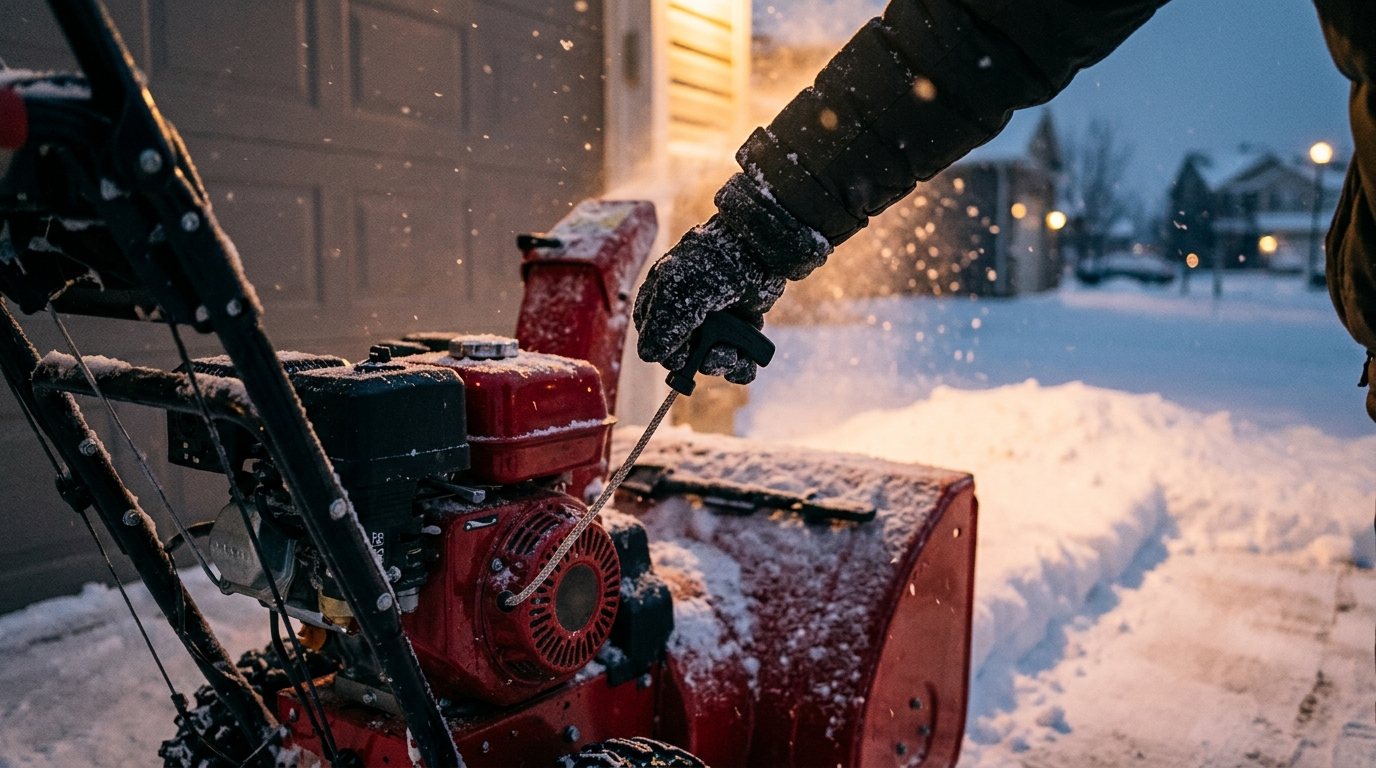
The first real snowstorm arrives, you roll the snow blower out of the garage, and it won’t start. You pull until your shoulder aches, or the electric starter cranks and cranks without the engine catching. Meanwhile, the driveway is filling up.
The good news is that most no-start problems come down to a handful of simple causes, and the biggest one is the fuel that sat in the machine all summer. This guide walks you through the starting checklist, the common causes in order from easiest to hardest, how to clean a clogged carburetor jet, what to do when the engine runs but the auger won’t turn, and the pre-season prep that keeps this from happening next year.
Quick answer: Drain last season’s gas and refill with fresh fuel, then go through the starting sequence: key fully in, fuel valve open, throttle to fast, full choke and two or three pushes of the primer on a cold engine. If it still won’t fire, check that the spark plug is clean, dry and connected. A machine that ran on old gas often has a gummed-up carburetor jet, which you can usually clean yourself with basic tools.
Safety first
Safety note: Before you work on the auger, chute or carburetor, shut off the engine, remove the safety key and pull the spark plug wire so the engine can’t start. Never run a snow blower in a closed garage, since the exhaust contains carbon monoxide; the CDC warns against running engines in an attached garage even with the door open. Refuel only when the engine is cold, outdoors, away from pilot lights and heaters.
Quick troubleshooting table
| Symptom | Likely cause | What to do |
|---|---|---|
| Won’t start at all, no sputter | Stale fuel, key not in, fuel valve closed | Fresh fuel, then full starting sequence |
| Sputters, then dies when choke is off | Partly clogged carburetor jet | Clean the main jet and float bowl |
| Strong gas smell, won’t catch | Flooded engine | Choke off, wait, pull with throttle on fast |
| Fuel is fresh but no fire | Fouled or disconnected spark plug | Clean, test or replace the plug |
| Electric starter doesn’t spin | No power at outlet, bad cord or starter | Check outlet, GFCI and cord; use the pull cord |
| Recoil cord won’t pull | Auger frozen in ice or engagement lever on | Release levers, thaw the machine indoors |
| Runs, but auger won’t turn | Broken shear pin or worn belt | Replace pins with OEM parts, check belt |
Common reasons a snow blower won’t start
1. Stale or ethanol-damaged fuel
Gas left in the tank from last winter is the most common reason a snow blower won’t start. Gasoline loses the lighter compounds that help it ignite, and the ethanol in most pump gas attracts moisture and leaves a sticky varnish as it evaporates. That varnish clogs the tiny passages in a small-engine carburetor.
Drain the old fuel into an approved container (a siphon pump makes this easy) and refill with fresh gas from a station. Use regular unleaded with no more than 10 percent ethanol. The EPA prohibits using E15 in nonroad equipment such as mowers and chain saws, and the same applies to snow blowers. Take the old gas to a household hazardous waste drop-off.
2. Choke, primer and controls set wrong
Many no-starts are simply a missed step. Follow your manual, but the typical cold-start sequence is:
- Insert the safety key all the way. Many machines won’t start if it’s even partly out.
- Open the fuel shutoff valve, if your engine has one.
- Move the throttle to fast and make sure the auger and drive levers are released.
- Set the choke to full.
- Push the primer bulb two or three times, pausing between pushes. Skip the primer on a warm engine.
- Pull the cord or press the electric start. Once the engine catches, ease the choke off gradually as it warms up.
3. A flooded engine
Too many primer pushes or repeated pulls on full choke can flood the engine with fuel. You’ll smell gas, and the spark plug may come out wet. Turn the choke off, set the throttle to fast, wait several minutes for the excess fuel to evaporate and try again without priming.
4. Spark plug problems
If fuel is fresh and the controls are right, check the spark plug. Pull off the boot, remove the plug with a spark plug socket and inspect it. Black, oily or wet deposits, a cracked insulator or a worn electrode mean it should be cleaned with a wire brush or replaced. Set the gap listed in your manual before installing a new one.
To confirm the engine is getting spark, use an inexpensive inline spark tester between the plug and boot, which is safer than holding a plug against the engine. Never crank the engine with the plug removed and the wire loose. No spark with a new plug points to an ignition coil or kill switch problem, which is a job for a repair shop.
5. A clogged carburetor jet
If the engine starts only on full choke or with a spray of fuel, then dies, the carburetor’s main jet is likely partly blocked by varnish. This is especially common after a machine sits with untreated gas. Cleaning the jet is a reasonable DIY job on most single-cylinder engines; the steps are below.
6. Electric start issues
Most snow blowers with electric start use a 120-volt starter that plugs into a household outlet with a heavy-duty outdoor extension cord. The starter only spins the engine, so if it cranks but the engine doesn’t fire, the problem is fuel or spark, not the starter. If it doesn’t spin at all, check that the outlet works, reset a tripped GFCI (see our guide on a GFCI outlet that keeps tripping) and inspect the cord. Crank in short bursts with rests in between, as your manual directs, and use the recoil cord as a backup.
7. Frozen parts or low oil
If the pull cord won’t move, ice may be locking the auger or impeller. Let the machine thaw in a garage and never try to free a frozen auger by hand while the engine could start. Also check the dipstick. Running with little or no oil can damage the engine, and some engines have a low-oil sensor that prevents starting.
How to clean a clogged carburetor jet
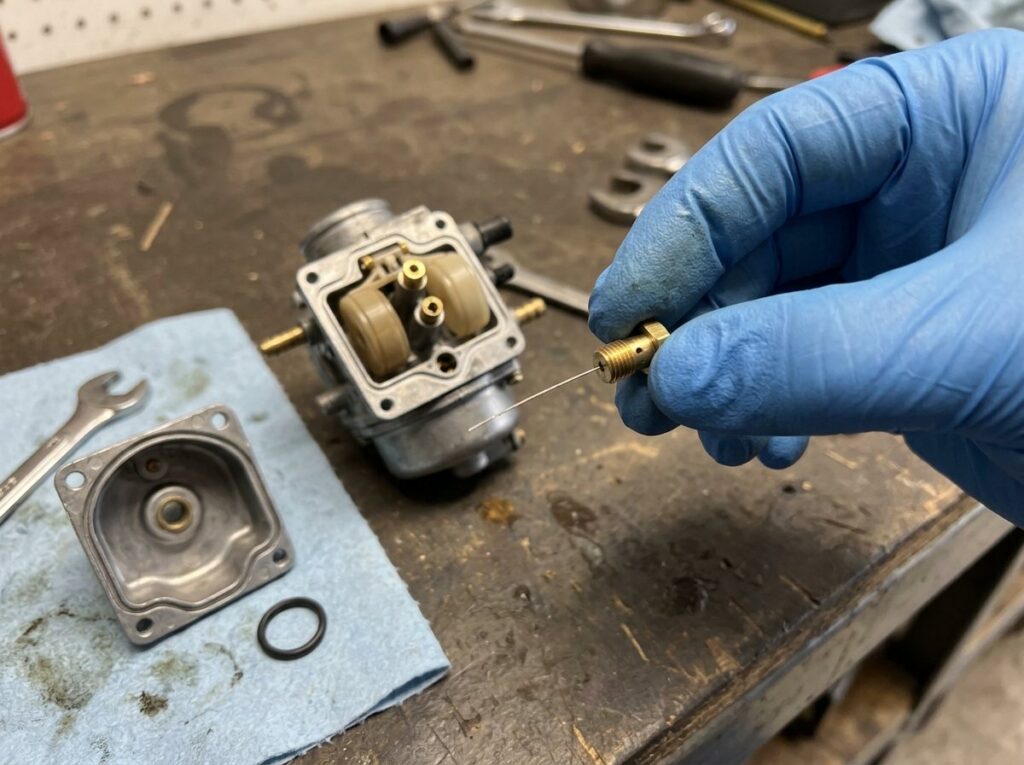
This process applies to the float-type carburetors on most single-cylinder snow blower engines. Work outdoors or in a ventilated area, away from flames, with the spark plug wire disconnected.
- Shut off and drain the fuel. Close the fuel valve or pinch the fuel line, and have a small container and rags ready.
- Remove the float bowl. Under the carburetor, remove the bolt holding the bowl in place. On many engines, this bolt contains the main jet, a tiny hole drilled through its side or center.
- Clean the jet. Spray carburetor cleaner through the bolt’s holes and gently push a single strand of fine wire through the jet opening. Don’t enlarge the hole with a drill bit. Hold it up to the light to confirm it’s clear.
- Clean the bowl. Wipe out any varnish, sediment or water, and check the rubber gasket. Replace it if it’s cracked, shrunken or stretched.
- Reassemble and test. Reinstall the bowl and bolt snugly without overtightening, open the fuel valve, check for leaks and start the engine with fresh fuel.
If the engine still surges or won’t run without choke, the internal passages need a full cleaning or the carburetor needs to be rebuilt or replaced. Replacement carburetors are available for many common engines, but a repair shop can confirm the right part.
It starts, but the auger won’t turn
On a two-stage machine, shear pins (also called shear bolts) connect the auger to its shaft. They are designed to snap when the auger hits a newspaper, rock or chunk of ice, protecting the expensive gearbox. If the engine runs and the impeller spins but one or both sides of the auger stop, look for a broken pin in the center of the auger spirals.
Replace broken pins only with the manufacturer’s shear pins, never ordinary hardware-store bolts. Manufacturers such as Troy-Bilt warn that a standard bolt won’t break when it should and can lead to injury and gearbox damage. If the pins are fine, inspect the drive belts for cracking or glazing and check the cable adjustment in your manual.
Safety note: Never clear a clogged chute or auger with your hands or feet. Release the controls, shut off the engine, wait until everything has stopped and use the clean-out tool. Packed snow can hold tension, so parts may move when the clog is released.
Pre-season prep checklist
A little prep in October or November saves a no-start on the first storm. Follow your manual, but cover these items:
- Drain any old fuel and refill with fresh gas, treated with a fuel stabilizer if it may sit for weeks.
- Check the oil level and change it if it’s due, using the oil type your manual recommends for cold weather.
- Inspect, clean or replace the spark plug.
- Check the belts for wear, cracks and fraying.
- Look over the skid shoes and scraper bar and adjust or replace worn ones.
- Buy spare shear pins and keep them with the machine.
- Check tire pressure, lubricate the points listed in your manual and test every control.
- Start the machine and let it run for several minutes so you know it’s ready before the snow falls.
At the end of the season, Troy-Bilt’s storage guidance recommends adding stabilizer, filling the tank and running the engine for five minutes so treated fuel reaches the carburetor, rather than leaving the system empty, where metal parts can rust and seals can dry out. Some other manufacturers recommend running the tank dry instead, so follow your own manual. Add the snow blower to your fall home maintenance checklist so it doesn’t get forgotten.
Tools and materials
- Fresh gasoline (E10 or less) and fuel stabilizer
- Siphon pump and approved fuel container
- Spark plug socket, wire brush and replacement plug
- Inline spark tester
- Carburetor cleaner, fine wire and a float bowl gasket
- Socket set, screwdrivers and rags
- OEM shear pins and a heavy-duty outdoor extension cord
- Safety glasses and chemical-resistant gloves
When to call a pro
Take the machine to a small-engine repair shop if:
- There’s no spark even with a new plug, which suggests an ignition coil or switch problem.
- The engine still won’t run after a jet cleaning, or fuel leaks from the carburetor.
- You hear knocking, see smoke or find metal shavings or milky oil.
- The electric starter is dead with a working outlet and cord.
- The auger gearbox is damaged, or the machine keeps breaking shear pins.
Repair shops get busy after the first storm, so schedule tune-ups in the fall. Before approving a major repair, compare it with the cost of a new machine: Consumer Reports notes that snow blowers range from as little as $200 to well over $1,000. A repair often makes sense on a sturdy two-stage model but may not on an old single-stage one.
Frequently asked questions
Why does my snow blower start and then die?
The most common cause is a partly clogged carburetor jet, which lets enough fuel through to start on choke but not enough to keep running. A clogged fuel cap vent, water in the fuel or turning the choke off too soon can do the same. Start with fresh fuel, then clean the jet.
Should I use starting fluid on a snow blower?
It’s best avoided. Starting fluid is harsh on small engines and is a fire risk near a hot muffler. If you want to test whether the problem is fuel, fixing the fuel supply and carburetor is the real solution, so check your manual before using any spray.
Can I use regular gas in my snow blower?
Yes. Use fresh regular unleaded with no more than 10 percent ethanol (E10), unless your manual says otherwise. Never use E15 or higher blends, which are not approved for small nonroad engines.
How many times should I prime a snow blower?
Usually two or three pushes on a cold engine, and none on a warm one, but check your manual, since some engines need more in very cold weather. Over-priming floods the engine.
Why does my snow blower only run with the choke on?
That’s a classic sign of a fuel starvation problem, almost always varnish in the carburetor’s main jet. Cleaning the jet and float bowl usually fixes it. If not, the carburetor may need a rebuild or replacement.
The bottom line
When a snow blower won’t start, start with fresh E10 fuel and the correct choke, primer and key sequence, then check the spark plug and clean the carburetor jet. If it runs but won’t throw snow, look at the shear pins and belts. A short pre-season checkup prevents most of these problems. Once the machine is running, our guide on how to melt ice on a driveway covers what comes after the snow is cleared.