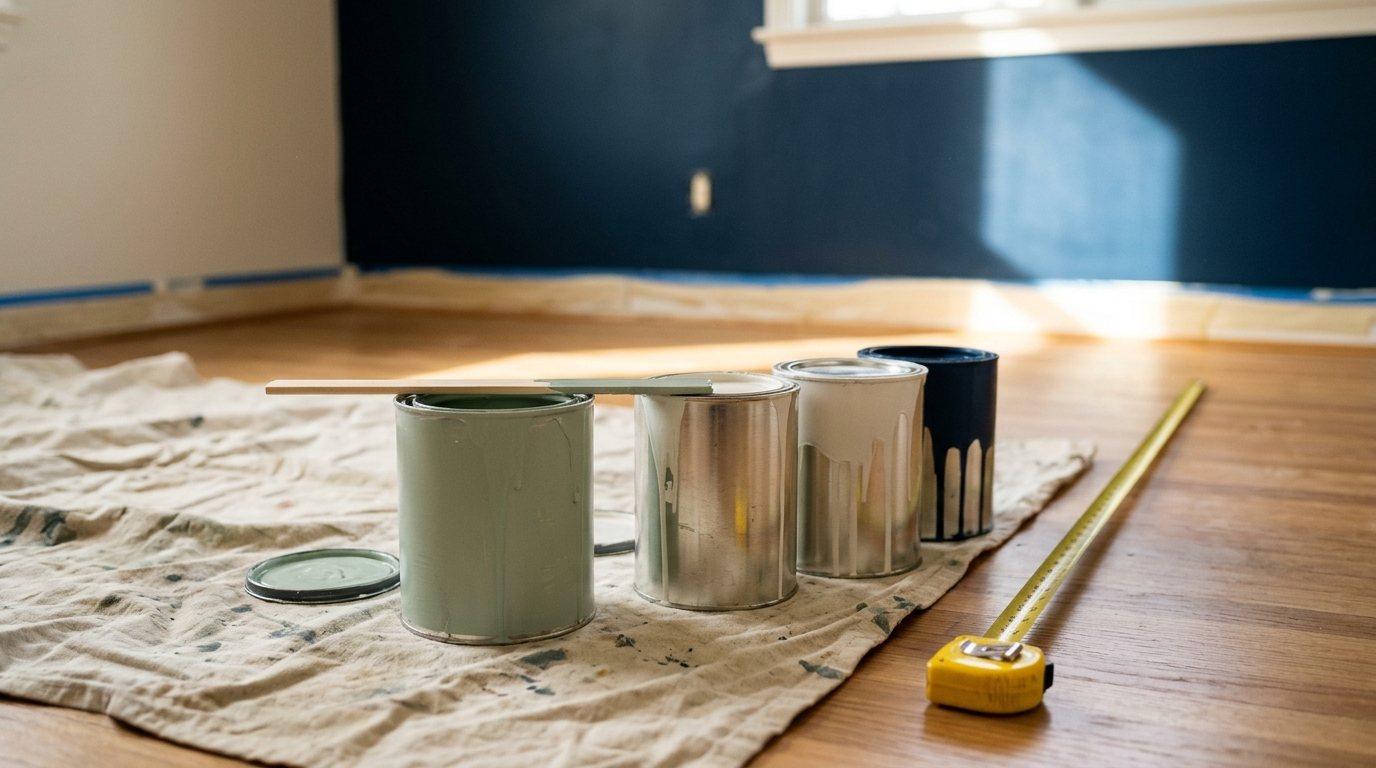
You’re standing in the paint aisle trying to decide between two gallons and three, and the last thing you want is to run out halfway through the second coat or end up with a garage full of half-used cans. Buying the right amount of paint isn’t guesswork. It comes down to a few measurements and one simple formula.
This guide explains how much area a gallon of paint covers, how to calculate what your room needs, how coats, primer, textured walls, ceilings and trim change the math, and it includes a table of worked examples for common room sizes. If you’d rather skip the arithmetic, the free CozyFixer paint calculator does it for you in seconds.
Quick answer: One gallon of wall paint covers about 350 to 400 square feet per coat on smooth walls. Measure the wall area (room perimeter times wall height), subtract about 20 square feet per door and 15 per window, multiply by the number of coats, and divide by 350. A typical 12 x 12 foot bedroom with 8 foot walls needs about 2 gallons for two coats, plus about 1 gallon for the ceiling.
How much does a gallon of paint cover?
According to Sherwin-Williams’ coverage guidance, a gallon of paint covers about 350 to 400 square feet and a quart covers about 100 square feet, while a gallon of primer covers less, around 200 to 300 square feet. Those figures assume a smooth, previously painted surface and a normal roller application.
Real-world coverage drops on rough, porous or unpainted surfaces, with deep colors, and when you apply paint thickly. That’s why it’s smart to plan with the low end of the range, 350 square feet per gallon, or lower for textured walls. Always check the coverage printed on your specific can, since it varies by brand and product line.
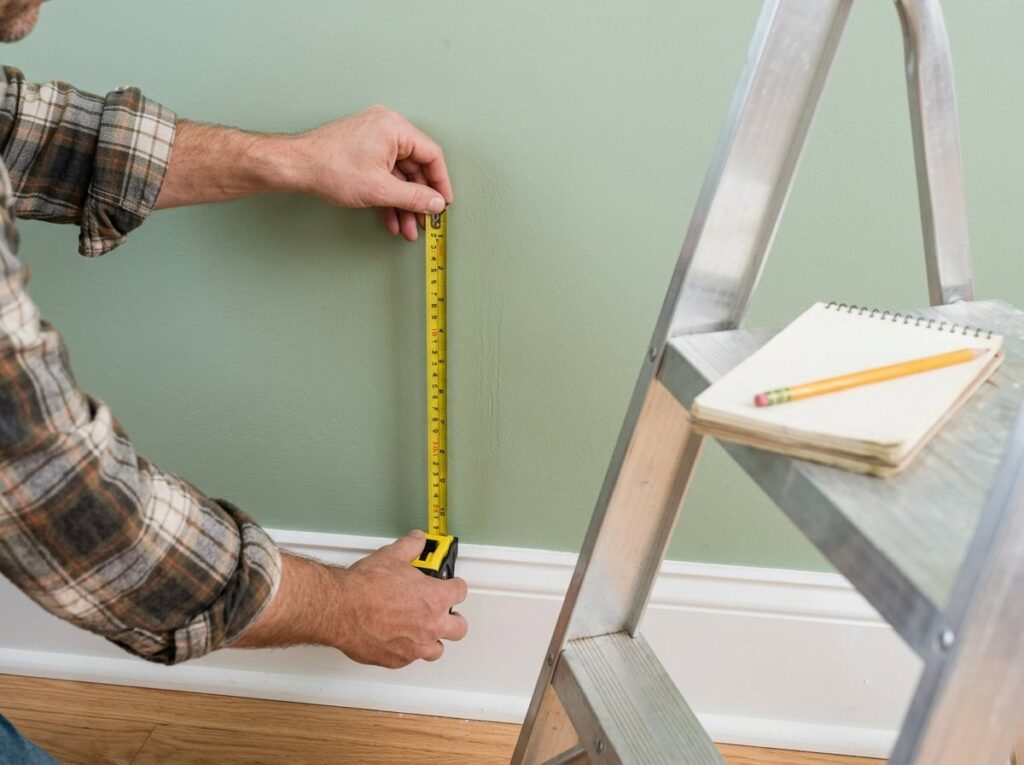
Tools you’ll need to measure
- Tape measure (a 25 foot tape is easiest for room lengths)
- Notepad or your phone to jot down each wall
- A calculator, or the CozyFixer paint calculator described below
- Step ladder for measuring wall height accurately
The paint formula, step by step
- Find the perimeter. Measure the length of each wall and add them together. A 12 x 14 foot room has a perimeter of 12 + 14 + 12 + 14 = 52 feet.
- Multiply by wall height. Measure from the floor to the ceiling. 52 feet x 8 feet = 416 square feet of wall.
- Subtract doors and windows. Take off about 20 square feet for each standard door and 15 square feet for each average window. With one door and two windows: 416 – 20 – 30 = 366 square feet.
- Multiply by the number of coats. For two coats: 366 x 2 = 732 square feet.
- Divide by coverage. 732 / 350 = about 2.1 gallons.
- Round up sensibly. Buy 2 gallons plus 1 quart, or 3 gallons if you want extra for touch-ups.
Pro tip: If you need more than one gallon of the same color, pour all the cans into a 5 gallon bucket and mix them before you start. This is called boxing, and it hides slight color differences between cans that can show up as a visible line on the wall.
Skip the math with the CozyFixer paint calculator
The free CozyFixer paint calculator uses the same method as the formula above, so you get the same answer without the arithmetic. It works in feet or meters and takes less than a minute:
- Enter the room’s length, width and wall height.
- Add the number of doors and windows so they’re subtracted from the wall area.
- Pick the wall surface: smooth or previously painted, standard drywall, or textured, new or porous.
- Choose one, two or three coats, and tick the box if you’re painting the ceiling too.
It shows the paintable area, the total square footage to cover with all coats, and how much paint to buy in gallons and liters. Run it once for each room, and again with three coats if you’re making a big color change, so you know the range before you shop.
How much paint for common room sizes
These worked examples assume 8 foot walls, two coats, 350 square feet per gallon, and smooth or previously painted walls. Wall figures subtract the doors and windows listed. Ceilings assume two coats of flat ceiling paint.
| Room | Doors / windows | Wall area to paint | Wall paint (2 coats) | Ceiling paint (2 coats) |
|---|---|---|---|---|
| 5 x 8 ft bathroom | 1 / 1 | 173 sq ft | 1 gallon | 1 quart |
| 10 x 10 ft bedroom | 1 / 1 | 285 sq ft | 2 gallons | 1 gallon |
| 10 x 12 ft bedroom | 1 / 2 | 302 sq ft | 2 gallons | 1 gallon |
| 12 x 12 ft bedroom | 1 / 2 | 334 sq ft | 2 gallons | 1 gallon |
| 12 x 14 ft room | 1 / 2 | 366 sq ft | 2 gallons + 1 quart | 1 gallon |
| 14 x 16 ft room | 1 / 2 | 430 sq ft | 2 gallons + 2 quarts | 1 gallon + 2 quarts |
| 16 x 20 ft living room | 2 / 3 | 491 sq ft | 3 gallons | 2 gallons |
Taller walls add up quickly. The same 12 x 12 foot bedroom with 9 foot walls has 432 square feet of wall before openings, about 48 square feet more than with 8 foot walls, which adds roughly a quart over two coats. For vaulted ceilings, stairwells or odd-shaped rooms, measure each wall section separately and add them together.
What changes how much paint you need
Number of coats
Two coats is the standard for an even, durable finish, so most estimates assume two. One coat can be enough when you’re refreshing a wall in the same color with a good-quality paint. Plan on three coats, or a tinted primer plus two coats, when you’re going from dark to light or using deep reds, yellows and other low-hiding colors.
Primer
Primer covers less area than paint, roughly 200 to 300 square feet per gallon, so a single coat over a 12 x 12 foot room’s walls usually takes 1 to 2 gallons. You need it on new drywall, patched areas, stains and glossy surfaces. A primer tinted toward your new color can often save you a whole topcoat on big color changes.
Textured, new or porous walls
Knockdown and orange-peel textures, brand-new drywall and bare plaster all soak up more paint. For these surfaces, plan with about 300 square feet per gallon, the low end of the range our calculator uses, or choose the “Textured, new or porous” surface option in the paint calculator. A thicker roller nap also holds and leaves more paint on the wall.
Ceilings
Ceiling area is simply length times width: a 12 x 12 foot room has a 144 square foot ceiling. Two coats is 288 square feet, so 1 gallon of ceiling paint is plenty. Popcorn and heavily textured ceilings use noticeably more, so add extra if yours is textured.
Trim, doors and baseboards
Trim takes far less paint than you might expect. Baseboards in a 12 x 12 foot room are only about 48 linear feet, and at 4 inches tall that’s around 16 square feet per coat. One quart, which covers about 100 square feet, usually handles baseboards, door casings and window trim for one average room with two coats.
A standard flat door is about 20 square feet per side, so a quart covers roughly one door, both sides, with two coats. See our guide on how to paint trim and baseboards for technique.
Color, sheen and application method
Covering a dark color with a light one, or using a bright, saturated color, usually takes extra coats. Spraying uses more paint than rolling because some is lost as overspray. Sheen itself doesn’t change coverage much, but it affects which paint you buy for each surface; our guide to paint finishes explained can help you choose.
How to avoid buying too much or too little
- Round up, but use quarts. If your total is 2.2 gallons, 2 gallons plus a quart is usually cheaper than a third gallon.
- Keep a little for touch-ups. A small amount of leftover paint makes future scuffs easy to fix with an exact color match.
- Buy one color at a time. Finish the walls of one room before buying for the next, so you can adjust based on how far the first gallons actually went.
- Save the formula. Write the color name, sheen and where you used it on the lid so you can reorder later.
- Store leftovers well. Wipe the rim, seal the lid tightly and keep the can where it won’t freeze.
When to call a pro
Calculating paint is easy, but some jobs are worth handing to a painter: rooms with very high or vaulted ceilings, stairwells that need scaffolding, extensive drywall repairs, or whole-house projects where time matters more than savings. A professional quote should include the number of coats and the paint product, so you can compare bids fairly.
According to Angi’s room painting cost guide, most homeowners pay $400 to $1,600 to have a room professionally painted, and pros typically charge $2 to $6 per square foot. A 12 x 12 foot room usually costs about $290 to $870. If you’re doing it yourself, our guide on how to paint a room walks through every step.
Frequently asked questions
How many square feet does a gallon of paint cover?
Most wall paints cover about 350 to 400 square feet per gallon per coat on smooth, previously painted walls. Expect less on textured, new or porous surfaces, and check the label on your can for its specific coverage.
How much paint do I need for a 12 x 12 room?
With 8 foot walls, one door and two windows, a 12 x 12 foot room has about 334 square feet of wall. Two coats need just under 2 gallons, so buy 2 gallons for the walls and about 1 gallon if you’re also painting the ceiling.
Is one gallon of paint enough for a room?
Usually not for two coats, unless the room is small, like a bathroom or a walk-in closet. One gallon covers about 350 square feet, which is roughly one coat on the walls of a 10 x 12 foot bedroom.
Do I really need two coats of paint?
Two coats give more even color, better sheen and a tougher finish, so most painters plan on two. One coat can work for a same-color refresh with quality paint over a clean, sound wall.
How much paint do I need for a ceiling?
Multiply the room’s length by its width, then by the number of coats, and divide by 350. A 12 x 12 foot ceiling with two coats is 288 square feet, so 1 gallon covers it, with extra needed for textured ceilings.
How much paint do I need for trim and baseboards?
One quart usually covers the baseboards, door casings and window trim of an average room with two coats. For several rooms or a whole house of trim, a gallon or more is more economical.
The bottom line
To figure out how much paint you need, measure the wall area, subtract doors and windows, multiply by the number of coats and divide by about 350 square feet per gallon, then round up with quarts. Allow extra for textured walls, primer and big color changes. For a fast, accurate number for your room, use the free CozyFixer paint calculator before you head to the store.