
You’ve seen outlets with TEST and RESET buttons in the bathroom and breakers with test buttons in the panel, and an electrician or home inspector has mentioned AFCI and GFCI protection. They sound alike, they both trip, and it’s not obvious which one does what or which your home actually needs.
This guide explains what each device protects against, where electrical codes typically require each one, how combination AFCI/GFCI devices work, how to test them every month and what to do about nuisance trips.
Quick answer: A GFCI (ground-fault circuit interrupter) protects people from electric shock by cutting power when current leaks to ground, and it’s required in wet areas like bathrooms, kitchens, garages and outdoors. An AFCI (arc-fault circuit interrupter) protects against electrical fires by cutting power when it detects dangerous arcing in wiring or cords, and it’s required on most living-area circuits in newer homes. They are not interchangeable, but dual-function devices provide both. Test both monthly.
What a GFCI does
A GFCI constantly compares the current flowing out on the hot wire with the current returning on the neutral. If some current is missing, it’s leaking to ground by another path, which could be through water or a person. The device then cuts power in a fraction of a second.
According to EC&M’s explanation of the differences between AFCIs and GFCIs, a GFCI trips at a current imbalance of 6 milliamps or more and does not trip below 4 milliamps. That is a tiny amount of current, which is why a GFCI can stop a shock before it becomes deadly. A GFCI is a people-protection device: it doesn’t detect arcing, and a GFCI receptacle doesn’t protect against overloads the way a breaker does.
What an AFCI does
An AFCI watches the electrical waveform on a circuit for the signature of dangerous arcing. Arcing happens when current jumps across a gap, for example at a loose connection, a cord crushed under furniture, a cable pierced by a nail or old insulation that has cracked. Those arcs can be too small to trip a standard breaker but hot enough to ignite nearby material.
The Electrical Safety Foundation’s AFCI questions and answers describes AFCIs as replacing standard breakers to give greater fire protection, and notes that the CPSC has estimated AFCIs could prevent more than half of the electrical fires that occur each year. Most AFCIs sold for homes today are combination-type AFCIs, which detect arcing both along a single wire and between wires.
AFCI vs GFCI at a glance
| Feature | GFCI | AFCI |
|---|---|---|
| Main purpose | Protects people from shock and electrocution | Protects the home from fires caused by arcing |
| What it detects | Current leaking to ground (hot and neutral out of balance) | Arcing patterns from damaged wires, cords or loose connections |
| Typical locations | Bathrooms, kitchens, garages, outdoors, basements, laundry areas, near sinks | Bedrooms, living and family rooms, hallways, closets, kitchens, laundry areas |
| Common forms | Receptacle, breaker, portable plug-in unit | Breaker, or a receptacle at the first outlet on a circuit |
| Test schedule | Monthly, with the TEST button | Monthly, with the TEST button |
| Combined option | Dual-function device adds arc-fault protection | Dual-function device adds ground-fault protection |
Where codes typically require each
In the US, requirements come from the National Electrical Code (NFPA 70), which states and towns adopt on their own schedules, often with local amendments. The lists below reflect recent code editions as summarized by EC&M; your local building department has the final word on what applies to your home.
GFCI protection in homes
- Bathrooms
- Garages and accessory buildings used for work or storage
- Outdoors
- Crawl spaces at or below grade, and basements (finished and unfinished)
- Kitchen countertops, and within 6 feet of any sink
- Within 6 feet of a tub or shower outside a bathroom
- Laundry areas and other indoor damp or wet locations
- Dishwasher outlets, and boathouses where receptacles are installed
AFCI protection in homes
AFCI protection is required on 15- and 20-amp, 120-volt branch circuits supplying outlets in kitchens, family rooms, dining rooms, living rooms, bedrooms, closets, hallways, laundry areas and similar rooms. Bathrooms, garages and outdoor outlets are not on the AFCI list, though they need GFCI protection.
What about older homes?
Codes generally don’t force you to upgrade an existing home just because the rules changed. However, when a circuit in a required area is modified, replaced or extended, AFCI protection is generally required for it, with a narrow exception for short extensions that add no outlets. That’s why an electrician may add AFCI protection when you replace a panel or extend a bedroom circuit. Even where not required, adding GFCI protection in wet areas of an older home is a smart, inexpensive safety upgrade.
Outside the US, the terms differ. In the UK and Australia, shock protection comes from RCDs (residual current devices), and Canada uses GFCI and AFCI terminology under its own electrical code.
Combination AFCI/GFCI devices
Some locations, such as kitchens and laundry areas, need both kinds of protection. Rather than stacking two devices, you can use a dual-function device that does both jobs.
Dual-function breakers
A dual-function AFCI/GFCI breaker replaces a standard breaker in the panel and protects the entire circuit, including the wiring between the panel and the first outlet. Installing one means working inside the electrical panel, which is a job for a licensed electrician.
Dual-function receptacles
A dual-function receptacle installs like a GFCI outlet at the first outlet on a circuit and protects that outlet plus everything wired downstream from its LOAD terminals. EC&M notes that in some cases a dual-function receptacle is the best solution, especially where a panel won’t accept the matching breakers. Reset happens right at the outlet instead of at the panel.
Pro tip: When a receptacle-type GFCI or AFCI protects outlets further down the circuit, label those downstream outlets “GFCI protected” (stickers usually come in the box). It saves a lot of confusion when one of them goes dead and the reset button is in another room. If an outlet stops working, our guide to an outlet that’s not working walks through the checks.
How to test AFCIs and GFCIs every month
Both devices contain electronics that can fail without any warning sign, so the only way to know they work is to test them. ESFI recommends testing AFCIs after installation and once a month, and replacing any that won’t trip. Test GFCIs on the same monthly schedule, following the instructions printed on the device.
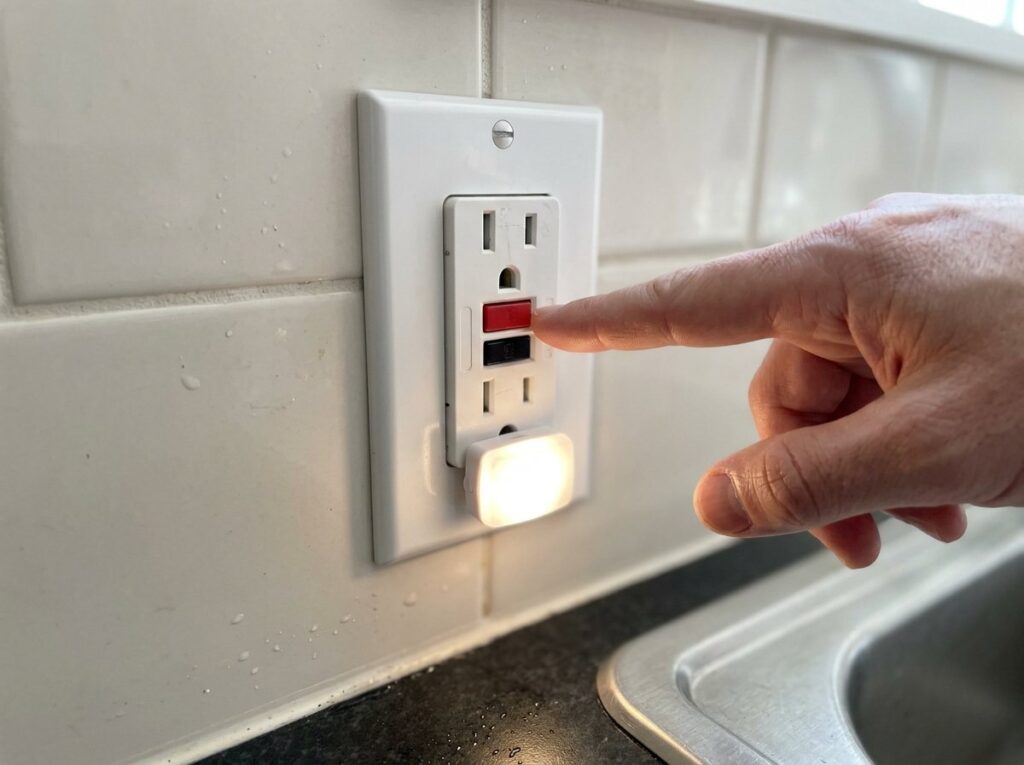
- GFCI receptacle: plug a lamp or nightlight into it and turn it on. Press TEST; the light should go out and the RESET button should pop out. Press RESET firmly to restore power.
- GFCI or AFCI breaker: press the breaker’s test button. The handle should move to the tripped position and power on that circuit should cut off. Push the handle fully to OFF, then back to ON.
- Dual-function devices: follow the manufacturer’s test steps, which often include an indicator light that shows which protection tripped.
- If it doesn’t trip: the device isn’t protecting you. Stop relying on it and have it replaced promptly.
Winter storms make this especially important. After a power outage, walk around and confirm that GFCI-protected outlets feeding a sump pump, freezer or garage refrigerator have power, since a GFCI can trip during a surge and leave equipment off without you noticing.
Nuisance trips: causes and fixes
A trip is usually the device doing its job. Before you assume a device is faulty, look for the cause.
Common GFCI trip causes
- Moisture in outdoor or garage outlet boxes, especially after rain, snow or condensation
- Older appliances, heaters or tools with worn insulation that leak a little current
- Damaged extension cords or holiday light strings
- Too many outlets protected by one GFCI, where small leakages add up
Common AFCI trip causes
- Damaged cords, plugs or appliances, including vacuums and space heaters
- Loose connections at outlets or switches on the circuit
- A nail or screw through a cable from recent wall work
- Wiring problems such as a neutral touching ground or a neutral shared between circuits
Unplug everything on the circuit, reset the device, then plug items back in one at a time to see which one causes the trip. Our guides on a GFCI outlet that keeps tripping and a circuit breaker that keeps tripping go deeper on tracking down the culprit.
Safety note: Never replace an AFCI or GFCI with a standard breaker or outlet to stop trips, and never tape or hold a breaker in the ON position. If a device trips immediately on reset with nothing plugged in, leave it off and call a licensed electrician, since that points to a wiring fault.
When to call a pro
Pressing test buttons and resetting devices is homeowner territory, and replacing a standard outlet with a GFCI receptacle is a manageable DIY job for some, as covered in our guide on how to replace an outlet. Always turn off the breaker and verify with a tester first. Hire a licensed electrician for:
- Any work inside the electrical panel, including AFCI, GFCI or dual-function breakers
- A device that trips instantly with nothing plugged in, or won’t reset
- Repeated trips you can’t trace to an appliance or cord
- Scorch marks, a burning smell, or warm outlets and breakers
- Old two-wire wiring, aluminum wiring or panel upgrades, which may need a permit
For cost, Angi’s GFCI breaker vs outlet guide puts professional GFCI outlet installation at about $120 on average, with the outlet itself typically $7 to $25, and professional GFCI breaker installation at about $300 to $360. HomeServe’s cost guide lists AFCI outlets at around $25 to $50 each, with electrician labor typically $50 to $130 per hour.
Frequently asked questions
Can I use a GFCI instead of an AFCI?
No. They protect against different hazards: a GFCI stops shocks from ground faults, while an AFCI stops fires caused by arcing. Where both are required, use a dual-function device or one of each.
Does a kitchen need AFCI or GFCI protection?
Typically both under recent code editions. Countertop and sink-area receptacles need GFCI protection, and kitchen branch circuits need AFCI protection. A dual-function breaker or receptacle is a common way to cover both.
Do older homes need AFCI breakers?
Existing homes generally don’t have to be upgraded just because the code changed. When circuits in required areas are modified, replaced or extended, AFCI protection is usually required. Ask your local building department what applies where you live.
Why does my AFCI breaker keep tripping?
Common causes include a damaged cord or appliance, a loose connection, a nail through a cable, or wiring issues like a neutral touching ground. Unplug everything and reset; if it still trips, call an electrician rather than swapping in a standard breaker.
How often should I test GFCI and AFCI devices?
Once a month. Press the TEST button, confirm the power cuts off, then reset. If a device won’t trip or won’t reset, have it replaced.
The bottom line
GFCIs protect people from shock in wet areas, and AFCIs protect your home from fires caused by arcing in living spaces. Many rooms now need both, which dual-function devices handle neatly. Test every device monthly, treat repeated trips as a warning rather than a nuisance, and leave panel work to a licensed electrician.