A pipe just burst, the toilet supply line is spraying, or you’re about to replace a faucet and need the water off. In that moment, the last thing you want is to be hunting through a dark basement for a valve you’ve never seen. Knowing exactly where your main shutoff is, and that it actually works, is one of the most useful things you can learn about your home.
This guide shows you where to find the main shutoff in a basement, crawlspace, garage, slab home or meter box, how to tell a gate valve from a ball valve, what to do when one is stuck, and where each fixture shutoff hides. It also covers emergency leak steps and how to label everything so anyone at home can act fast.
Quick answer: Find the main shutoff where the water line enters your house, usually on a front basement or crawlspace wall, near the water heater, or in a garage or utility closet. Turn a round gate valve handle clockwise until it stops, or turn a lever ball valve a quarter turn so the handle sits across the pipe. Then open the lowest faucet in the house to drain the lines. If you can’t find or close it, call your water utility about the curb valve.
Where to find your main water shutoff valve
There is no single standard location, but the valve is almost always close to where the water service line comes through the foundation. That line usually enters on the side of the house facing the street, where the water meter or curb box is. Start there and follow the largest incoming pipe.
Basement
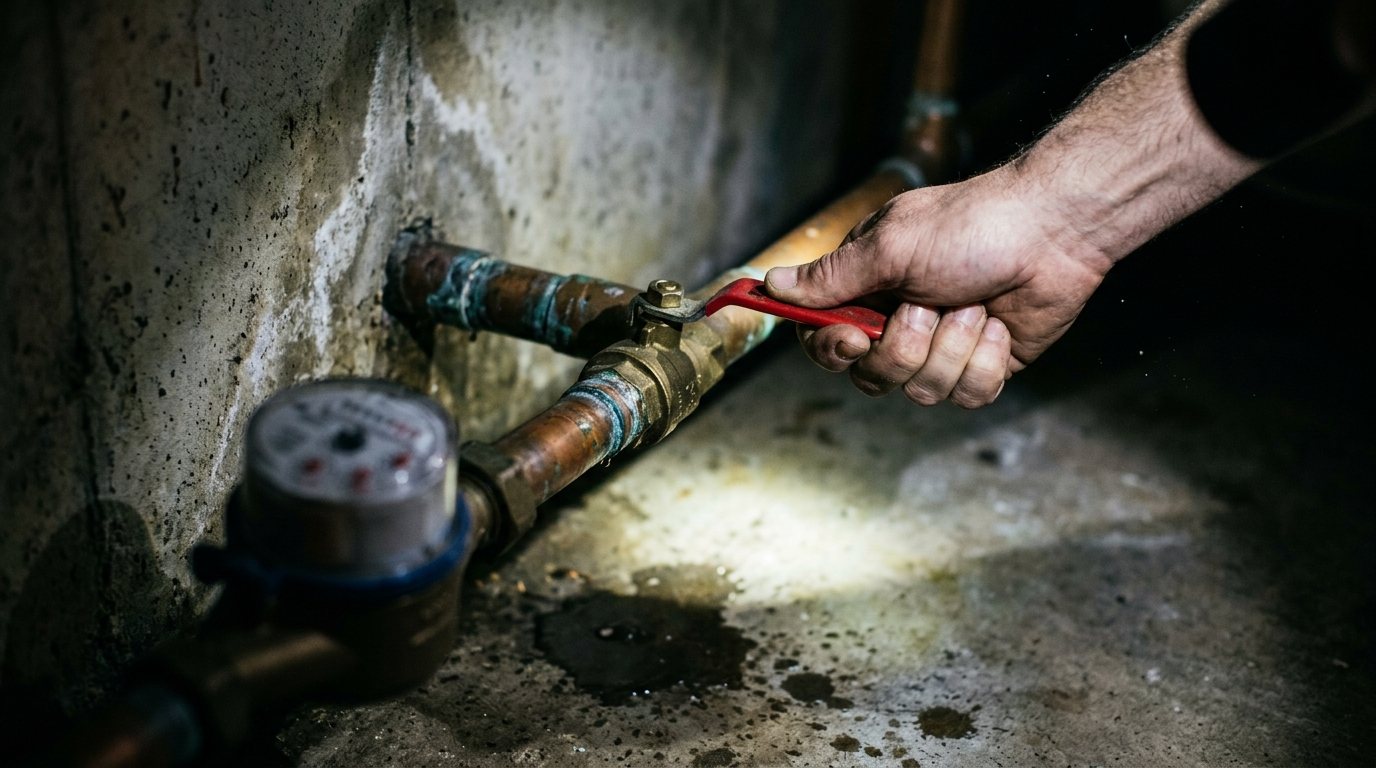
Look along the front foundation wall, at the point where a pipe comes through the concrete. The valve is usually within a few feet of that spot, often right next to the indoor water meter in older homes. It may also be near the water heater, laundry area or an outdoor hose faucet on the same wall.
Crawlspace
In a crawlspace home, the main valve is often just inside the crawlspace access or along the front wall. Some builders add a second valve in a more convenient spot, like under the kitchen sink or in a utility closet, so check those places before you crawl under the house.
Garage, utility closet or slab home
Homes built on a slab often have the main shutoff in the garage, a utility closet, near or on top of the water heater, or behind an access panel. In warm climates, the valve may be outside on an exterior wall, often close to a hose faucet, and sometimes inside a small box or under an insulating cover.
Outside: the meter box and curb stop
If the meter isn’t inside, look for a rectangular or round lid in the ground near the street or sidewalk. Inside you’ll find the water meter and a curb stop valve, and sometimes a second valve on the house side of the meter that belongs to you. The curb stop is often the utility’s property and may need a special meter key. Check with your water utility before you operate it; some utilities don’t allow homeowners to use it at all.
Homes on a private well
If you have a well, the main shutoff is usually on the pipe just after the pressure tank. In an emergency, turn off the breaker for the well pump first so it doesn’t keep running, then close the valve after the tank.
Pro tip: Your home inspection report usually notes where the main shutoff is, sometimes with a photo. If you rent, ask your landlord to show you. Find it now, on a calm day, rather than during a leak.
Gate valve vs ball valve
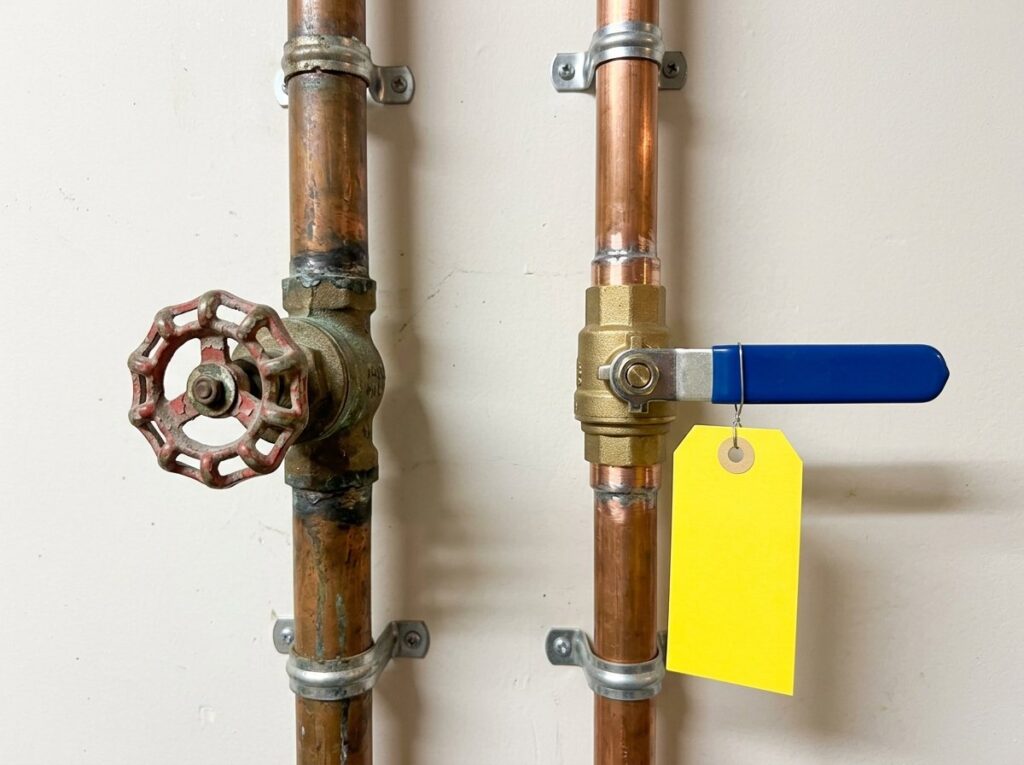
Most main shutoffs are one of two types, and they turn differently. Knowing which you have tells you how to close it and how far to trust it.
| Feature | Gate valve | Ball valve |
|---|---|---|
| Handle | Round wheel | Straight lever |
| How to close | Turn clockwise several turns until it stops | Quarter turn until the lever sits across the pipe |
| Open or closed at a glance | Hard to tell | Lever in line with the pipe is open; across it is closed |
| Common in | Older homes | Newer homes and replacement valves |
| Reliability | Can seize, leak at the stem or fail to close fully | Less likely to seize or leak |
If you have an old gate valve, plan to replace it with a full-port ball valve. It is a small job for a plumber, and it means your shutoff will close in seconds when you need it.
How to shut off water to your house
- Find the main valve and check which type it is.
- For a gate valve, turn the wheel clockwise by hand until it stops. Don’t force it past firm resistance.
- For a ball valve, turn the lever 90 degrees until it sits perpendicular to the pipe.
- Open a faucet on the lowest level of the house, both hot and cold, to drain the water left in the pipes and relieve pressure.
- Open a faucet on the top floor too, which lets air in and helps the lines drain faster.
- If the water will be off for a long time or you’re draining the system, turn the water heater off or to its vacation setting.
- Check that the flow stops. A trickle that slows to nothing is normal; steady flow means the valve isn’t sealing.
Emergency leak: what to do first
When water is pouring out, speed matters more than anything else. Work through these steps in order.
- Shut off the nearest fixture valve if the leak is at a sink, toilet or appliance. If not, or if you’re not sure, go straight to the main.
- Close the main shutoff and open the lowest faucet to drain the lines.
- If water is near outlets, cords or the electrical panel, don’t wade through it. Turn off power at the panel only if you can reach it while standing on a dry floor.
- Move valuables, rugs and electronics out of the water, and start mopping or using a wet/dry vacuum.
- Take photos and video of the damage before cleanup for your insurance claim.
- Call a plumber. For a pipe you can reach, our guide on how to fix a leaking pipe covers temporary repairs while you wait.
Safety note: Never stand in water to operate an electrical panel or unplug appliances. If water has reached the panel or outlets and you can’t cut power from a dry spot, leave the area and call your electric utility.
What to do if the main valve is stuck
A gate valve won’t turn
Gate valves that haven’t moved in years often seize from mineral buildup. Spray penetrating oil on the stem where it enters the valve body, wait 10 to 15 minutes, then try again with gentle, steady pressure. Use groove-joint pliers or a pipe wrench on the handle only if hand pressure fails, and brace the pipe with your other hand. Old valves and pipes can snap if you force them, which turns a small problem into a flood.
The valve turns but water still flows
If a gate valve won’t fully close, try opening it a turn and closing it again a few times to work sediment loose. If the handle spins freely with no resistance, the stem may have separated from the gate inside, and the valve needs replacing. In the meantime, call your water utility’s emergency line about closing the curb stop; the number is often printed on the meter box lid.
The valve leaks at the stem
A drip from under the handle after you turn an old gate valve usually comes from the packing nut. Tighten that nut about an eighth of a turn with a wrench. Don’t overtighten, which can make the handle hard to turn or crack the nut.
Individual fixture shutoffs
You don’t need to shut off the whole house to fix a faucet or a toilet. Most fixtures have their own small valve, called a stop valve or supply stop. They turn clockwise to close, and quarter-turn versions close with a lever. If one is seized or drips after you use it, it’s an easy part to replace once the main is off. Our guide to a leak under the kitchen sink shows how these valves connect.
| Fixture | Where to look for its shutoff |
|---|---|
| Toilet | On the wall or floor behind and below the tank |
| Bathroom or kitchen sink | Under the sink, one valve each for hot and cold |
| Dishwasher | Usually under the kitchen sink on the hot line |
| Refrigerator ice maker | Behind the fridge, under the sink or on a basement line below |
| Washing machine | Hot and cold valves in a wall box behind the washer |
| Water heater | On the cold inlet pipe at the top of the tank |
| Tub or shower | Behind an access panel, if there is one; otherwise use the main |
| Outdoor faucets | An indoor valve on the pipe feeding the hose bib in many cold-climate homes |
With winter coming, close any indoor shutoffs that feed outdoor faucets, then open the outside faucet to drain it. That simple step is one of the best ways to prevent frozen pipes.
How to turn the water back on
Close all the faucets you opened, except one on the top floor. Open the main valve slowly, a little at a time, so the pipes refill gently. Opening it all at once can cause a loud bang called water hammer. Let the open faucet run until it flows smoothly with no sputtering air, then close it and check the main valve and any repair spots for leaks. Turn the water heater back on once the tank is full.
Label and test your valves
Once you’ve found the main shutoff, make it impossible to miss. Hang a bright tag on it that says “Main water shutoff” with an arrow showing which way to turn, save a photo on your phone and show everyone in the household where it is. Keep groove-joint pliers, and a meter key if the valve is outside, right next to it.
Roto-Rooter recommends testing your shutoff valve at least once a year. Close and reopen it on a calm day so you know it works before an emergency.
Tools and materials
- Flashlight or headlamp
- Groove-joint pliers or an adjustable wrench
- Penetrating oil for stuck valves
- Water meter key, if your shutoff is in a curb box
- Bright tags or labels and a permanent marker
- Bucket and towels
When to call a pro
Call a licensed plumber if:
- The main valve won’t turn, won’t close fully, or leaks after you use it.
- The handle spins freely without closing the valve.
- You have an old gate valve and want a reliable ball valve installed.
- Your main valve is buried in a wall, behind a furnace or otherwise hard to reach.
- Water is leaking from the line between the meter and the house.
HomeAdvisor lists typical plumber service calls at $100 to $350, usually including the first hour, with most plumbers charging $70 to $120 per hour. After-hours calls can cost time-and-a-half to triple the normal rate, according to HomeAdvisor’s plumber cost guide. Compared with water damage restoration, which HomeAdvisor puts at $1,000 to $6,000, replacing a bad valve is cheap insurance. Angi’s main shutoff valve guide has more on finding valves by foundation type.
Frequently asked questions
Which way do you turn a water valve to shut it off?
Turn round gate valve handles clockwise, “righty-tighty,” until they stop. Turn a ball valve lever a quarter turn so it sits across the pipe instead of in line with it. If a valve won’t move with firm hand pressure, stop and use the steps for stuck valves rather than forcing it.
Can I turn off the water at the meter myself?
You can usually use a homeowner valve on the house side of the meter. The curb stop is often utility property and may need a meter key, and some utilities don’t allow homeowners to operate it. Call your water company first, especially outside of emergencies.
Is it bad to turn off the main water valve?
No, shutting it off is safe as long as you don’t force it. The risk is with old gate valves, which can leak at the stem or fail to reopen after years without use. That’s why testing the valve once a year, and replacing a weak one, is worth doing.
Do I need to turn off the water heater when the water is off?
For a short repair, usually not. If the water will be off for a long time, or you’re draining the pipes, turn the heater off or to vacation mode. An electric water heater should never run with an empty tank, since that can burn out its elements.
Why is water still coming out after I shut off the main?
Some water stays in the pipes after you close the valve, so faucets will run for a short time as the lines drain. If water keeps flowing steadily, the valve isn’t sealing fully. Call your water utility about closing the curb stop, then have the valve replaced.
The bottom line
Find your main water shutoff today, before you need it. Follow the incoming line to the valve, learn whether it’s a gate or ball valve, label it, and test it once a year. Know where each fixture shutoff is too, so a small leak never forces you to shut down the whole house. If the main valve is stuck, leaks or is an old gate valve, have a plumber swap it for a ball valve.