The ice bin is empty, the tray is dry or frozen into one block, and the dispenser just clicks. Maybe the ice maker quit after a move, after a filter change, or for no obvious reason at all. It is frustrating, but most ice makers that stop working are not broken.
This guide walks through the checks in the order that finds the problem fastest: the shutoff arm or switch, freezer temperature, a frozen fill tube, the water filter, the supply line and inlet valve. You will also find reset steps, what to do about slow production, a troubleshooting table and typical repair costs.
Quick answer: Make sure the ice maker is switched on and the wire arm is down, then confirm the freezer is at 0°F (-18°C). If the tray stays dry, check for ice blocking the fill tube, replace a filter older than six months, and make sure the water supply valve is fully open. Then reset the ice maker and give it up to 24 hours to produce a full batch.
Start here: is water reaching the ice maker?
Two quick observations split the problem in half. Pull out the ice bin and look at the tray, then try the water dispenser if your fridge has one.
- Tray is full of frozen cubes that never drop: water is getting in, so look at the arm or switch, the freezer temperature, a jammed ejector or the ice maker itself.
- Tray is dry or barely filled: water is not getting in, so look at the fill tube, the filter, the supply line, water pressure and the inlet valve.
- Water dispenser works but the tray stays dry: the house supply is fine, so the fault is the fill tube, the ice maker’s half of the inlet valve or the ice maker.
- Bin has ice but nothing comes out: cubes have melted and refrozen into a clump that is jamming the auger or chute.
Common causes and how to fix them
1. The ice maker is switched off
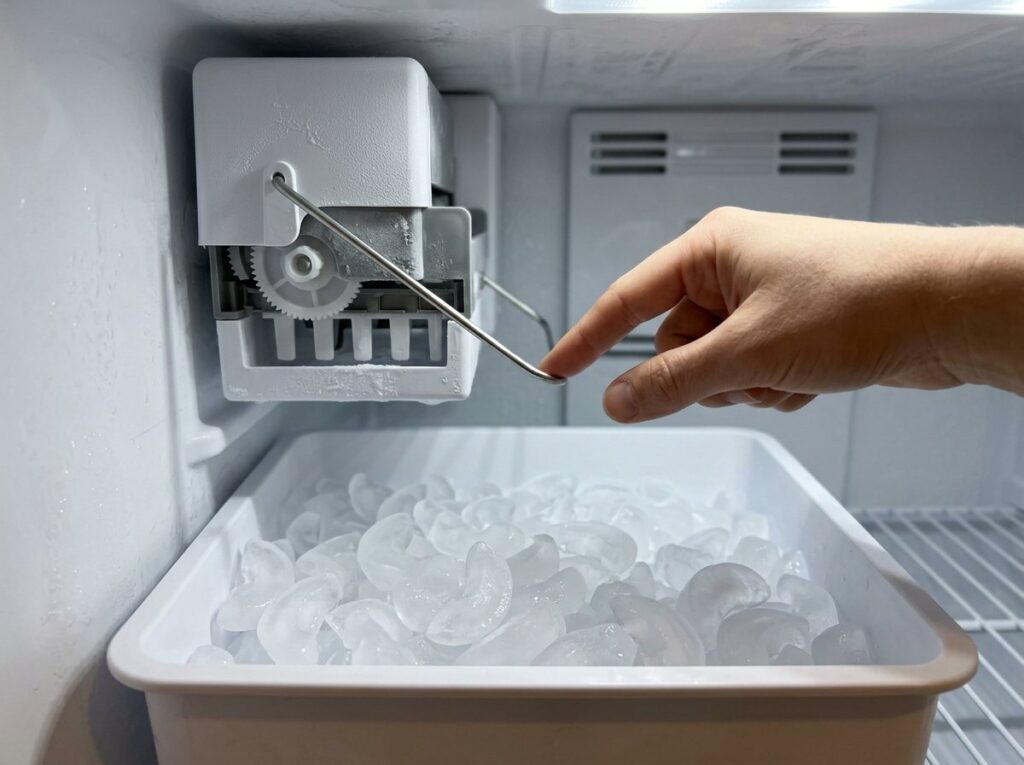
Most ice makers have a way to turn them off, and it is easy to bump. Older and many current models use a wire bail arm on the side of the ice maker: arm up means off, arm down means on. Others use a rocker switch near the ice maker, a sensor that reads the level in the bin, or a setting on the front control panel.
Lower the arm, flip the switch to on, or turn the “ice off” setting off. Make sure the bin is seated fully, because on many models a bin that is not pushed all the way in stops production. If the display showed an ice-off setting, it can take up to 12 hours before new cubes appear.
2. Freezer temperature is wrong
Ice makers are designed around a freezer at 0°F (-18°C). If the freezer runs warmer than about 10°F, the tray thermostat will not signal a harvest and production slows or stops. A freezer that runs much colder than needed can freeze the fill tube.
- Put an appliance thermometer between frozen packages and read it after 24 hours.
- Adjust the freezer control toward 0°F and wait another 24 hours before judging.
- Check that the door closes on its own and the gasket seals all the way around. Overpacked shelves and blocked vents also cause warm spots.
- If the fresh food section is warm too, the problem is the refrigerator, not the ice maker. Our guide to a refrigerator not cooling covers dirty condenser coils and fan problems.
3. Frozen fill tube
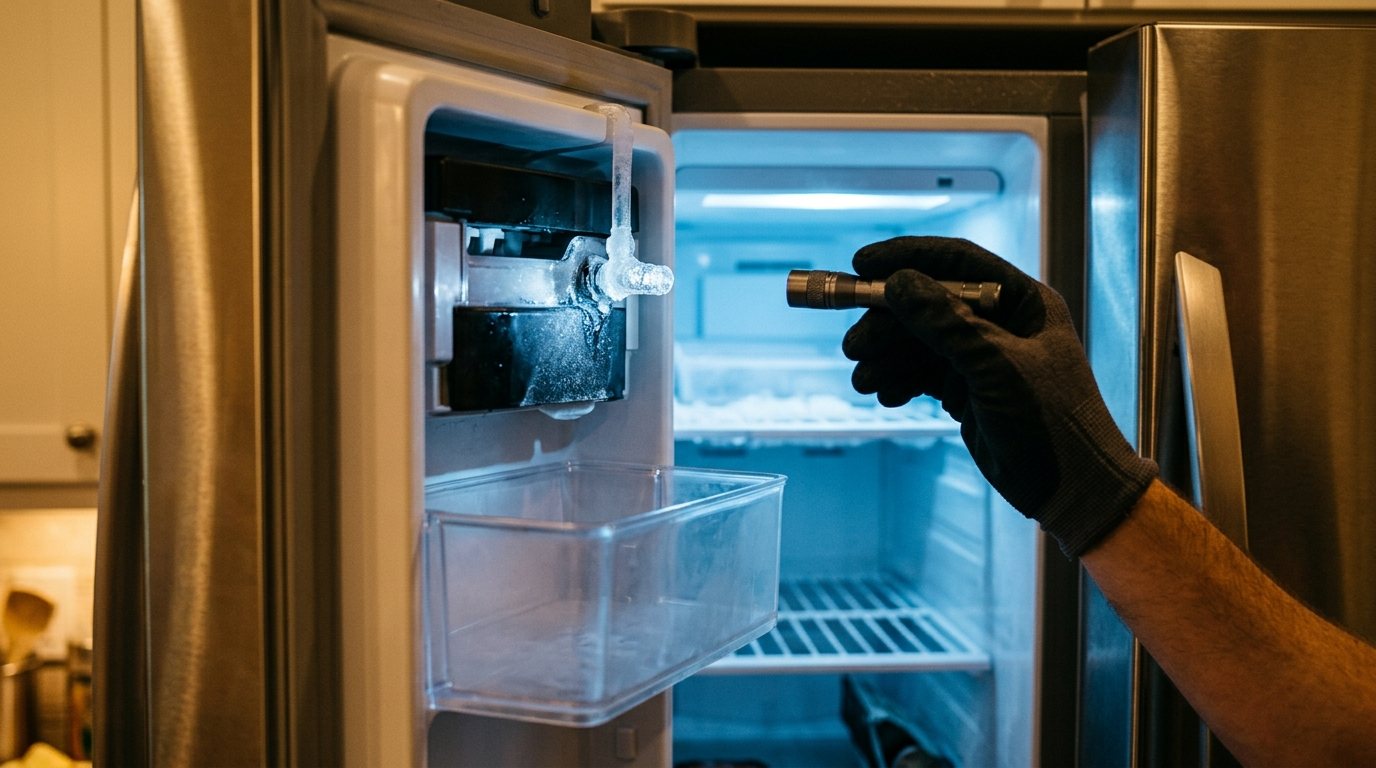
The fill tube is the short tube or spout that drips water into the back of the tray. If water trickles in slowly, from low pressure or a valve that seeps, it can freeze in the tube and block every fill after that. Look at the back of the ice maker with a flashlight. A plug of clear ice in the tube or cup is the giveaway.
- Turn the ice maker off, or unplug the refrigerator for safety.
- Remove the ice bin. On some models you may need to unclip the ice maker to see the tube.
- Melt the ice with a hair dryer on low held several inches away, or squeeze warm (not boiling) water into the fill cup with a turkey baster. Keep towels underneath to catch the runoff.
- Never chip at the tube with a knife or screwdriver, which can crack it or puncture a nearby line.
- Dry the area, restore power and switch the ice maker back on.
If the tube refreezes within days, find the cause: low pressure, a freezer set too cold, a leaking door gasket that lets in humid air, or an inlet valve that drips when it should be closed.
Safety note: Keep a hair dryer away from standing water and never let it get wet. Unplug the refrigerator before reaching behind the ice maker or removing any covers, because the ice maker has a heater and wiring inside. If the supply line itself has frozen, Bob Vila’s guide suggests emptying the freezer and leaving the unit unplugged with the door open for at least eight hours to thaw it fully.
4. Clogged water filter
A filter packed with sediment restricts flow, which leads to small or hollow cubes, slow production and eventually no ice. Most manufacturers recommend changing it about every six months, and sooner if you have hard or sandy water. Some refrigerators stop sending water to the ice maker once the filter passes its replacement date.
Replace the filter with the model listed in your manual, then run water through the dispenser for a few minutes to purge air and loose carbon. A filter that is not fully seated can also block water, so if problems started right after a change, remove it and twist it back in until it locks.
5. Supply line, shutoff valve and water pressure
Pull the refrigerator out carefully and look at the water line behind it. Make sure the shutoff valve feeding it is fully open, and that the line is not kinked from pushing the fridge back against the wall. Older self-piercing saddle valves on a copper pipe often clog over time and are worth replacing with a proper shutoff valve.
Ice makers need steady pressure to fill in the few seconds the valve stays open. Many models need at least 20 psi, and Samsung lists 30 psi as the minimum for its refrigerators. Samsung’s support guide suggests a simple test: dispense water into a measuring cup for 10 seconds and expect at least 150 ml (about 5 ounces). If pressure is low at every faucet, see our guide to low water pressure in the house.
If you need to replace the line or valve, shut off the water first. Our guide on how to shut off the water to your house helps if there is no local valve.
6. Faulty water inlet valve
The inlet valve sits at the bottom rear of the refrigerator, behind a small panel, and opens electrically to send water to the ice maker and dispenser. Its screen can clog with sediment, or its solenoid can fail. With the fridge unplugged and the water off, a multimeter test across the ice maker solenoid usually reads roughly 500 to 1,500 ohms on a healthy valve. A reading far outside that range, or a valve that gets power and good pressure but will not fill, means it needs replacing.
7. Jammed ejector or failed ice maker module
If the tray has frozen cubes but the ejector arm is stuck partway through its turn, the motor may be jammed by a cube or have failed. Clear any wedged ice and run a test cycle as described below. If the test does nothing, or the motor hums without turning, the ice maker assembly or its control is likely at fault. On many models the whole unit unplugs and unscrews from the freezer wall, so replacing it is a manageable DIY job.
How to reset an ice maker
Reset methods vary by brand, so check your manual, but most models use one of these. According to Whirlpool’s reset guide, first cubes may appear within a few hours and full production can take up to 24 hours.
- Power switch or arm: turn the switch off, or raise the arm, wait a few seconds, then turn it back on.
- Reset or test button: some ice makers have a button on the front, side or underside. Press and hold it for a few seconds, often until you hear a chime. Samsung says its test cycle takes about six minutes and warns against pressing it repeatedly, which can overfill the tray.
- Power cycle: unplug the refrigerator or switch off its breaker for about five minutes, then restore power.
Throw away the first batch or two after a reset, a new filter or a new installation, since they can contain air bubbles, carbon fines or off flavors.
Why is my ice maker slow?
Ice makers produce less than most people expect. Samsung, for example, says its ice makers produce around 120 cubes a day. To measure yours, empty the bin and count what it makes in 24 hours with the door kept closed as much as possible.
If production is well below normal, the usual causes are a warm freezer, a partly clogged filter, low water pressure or a slow-filling inlet valve. Frequent door openings, a room that is very hot and a bin that is full of old clumped ice also slow things down. Small, hollow or crescent-shaped cubes point to restricted water flow.
Ice maker troubleshooting table
| Symptom | Likely cause | What to try |
|---|---|---|
| No ice, tray dry | Frozen fill tube, closed valve, clogged filter | Thaw the tube, open the supply valve, replace the filter |
| No ice, tray has frozen cubes | Arm up, switch off, jammed ejector, warm freezer | Lower the arm, set freezer to 0°F, run a test cycle |
| Water works, no ice | Fill tube frozen or ice maker fault | Thaw tube, reset, test the module |
| Small or hollow cubes | Restricted water flow | New filter, check pressure and line kinks |
| Slow production | Warm freezer, low pressure, old filter | Check temperature, measure flow, replace filter |
| Ice in bin, none dispensed | Clumped ice jamming the auger or chute | Empty the bin, break up and clear the clump |
| Fill tube keeps refreezing | Low pressure, leaking valve, poor door seal | Fix pressure, test the valve, check the gasket |
| Nothing happens on test | Failed ice maker module or wiring | Replace the module or call a technician |
Tools and materials
- Appliance thermometer
- Flashlight
- Hair dryer or turkey baster and warm water
- Towels
- Replacement water filter
- Measuring cup and timer
- Nut driver or screwdriver
- Multimeter (for testing the inlet valve)
When to call a pro
Call an appliance technician if the freezer will not hold 0°F, the inlet valve or ice maker module tests bad and you are not comfortable replacing it, or water is leaking behind or under the refrigerator. Also call for help if you smell burning, see scorched wiring, or the fill tube keeps freezing after you have fixed the obvious causes.
Costs vary with the part and brand. Angi’s refrigerator repair cost guide puts most refrigerator repairs at about $200 to $300 on average, with an ice maker repair averaging around $330, and notes that a replacement ice maker can cost about $60 to $200, so replacing the unit can be the cheaper route. Expect a diagnostic fee of roughly $60 to $100, which some technicians waive if you hire them for the repair.
Frequently asked questions
How do I know if my ice maker is broken or just frozen?
Check the fill tube and tray first. Visible ice in the tube or a dry tray with a working water dispenser usually means a freeze-up, which you can thaw. If the tray has water or cubes, the arm is down, the freezer is at 0°F and a test cycle does nothing, the ice maker itself has likely failed.
How long does it take an ice maker to make ice after a reset?
You may see the first cubes within a few hours, but allow up to 24 hours for normal production. After a new installation, Samsung says to expect no ice for at least 12 hours. Discard the first batch or two.
Can a clogged water filter stop the ice maker?
Yes. A clogged filter slows water flow, which causes small cubes, slow production and eventually no ice. Some refrigerators also stop supplying water once the filter is overdue.
Why did my ice maker stop working after I changed the filter?
The new filter may not be fully locked in, or air trapped in the line is blocking flow. Reseat the filter, then run water through the dispenser for a few minutes to purge the air.
Is it worth repairing a refrigerator ice maker?
Usually, if the refrigerator is otherwise in good shape. Many problems cost nothing to fix, and a replacement ice maker module is often cheaper than a technician repair. On an old refrigerator with other faults, weigh the repair against replacement.
The bottom line
Most ice makers stop because they are switched off, the freezer is too warm, the fill tube is frozen or the water supply is restricted. Work through those checks, replace an old filter, reset the unit and give it a full day. If the tray still will not fill or cycle, the inlet valve or ice maker module is the likely culprit, and both are common, affordable repairs.