You open the microwave and there it is: dried tomato sauce on the ceiling, a crusty ring on the turntable and a smell of last week’s burnt popcorn. Scrubbing hardened splatters with a dry sponge takes forever and can scratch the interior, so most people put the job off until it gets worse.
This guide shows you the easiest way to clean a microwave: the steam method with lemon or vinegar water, then a quick wipe-down in the right order. It also covers the turntable, the door and seal, stubborn stains and odors, what you should never put inside and the safety points that matter most.
Quick answer: Heat a microwave-safe bowl of water with lemon juice or white vinegar on high until it boils and the window steams up, then leave the door closed for 5 minutes. Carefully remove the hot bowl, take out the turntable and wipe the ceiling, walls, floor and door with a soft cloth. Wash the turntable in warm soapy water, dry everything and you are done.
Tools and materials
- A large microwave-safe glass or ceramic bowl
- 1 lemon, or about 1 cup of white vinegar
- Baking soda for stains and odors
- Mild dish soap and warm water
- Soft sponge with a non-scratch side, plus two microfiber cloths
- Oven mitts or a thick towel for lifting the hot bowl
- Soft toothbrush for the door edges and turntable track
How to clean a microwave with the steam method
Steam softens dried food so it wipes away instead of needing a scrub. Lemon and vinegar both work; lemon leaves a fresher smell, while vinegar is a little better at cutting grease and hard water spots. Check your manual first, because some models have their own cleaning or steam program and specific instructions.
Lemon water method
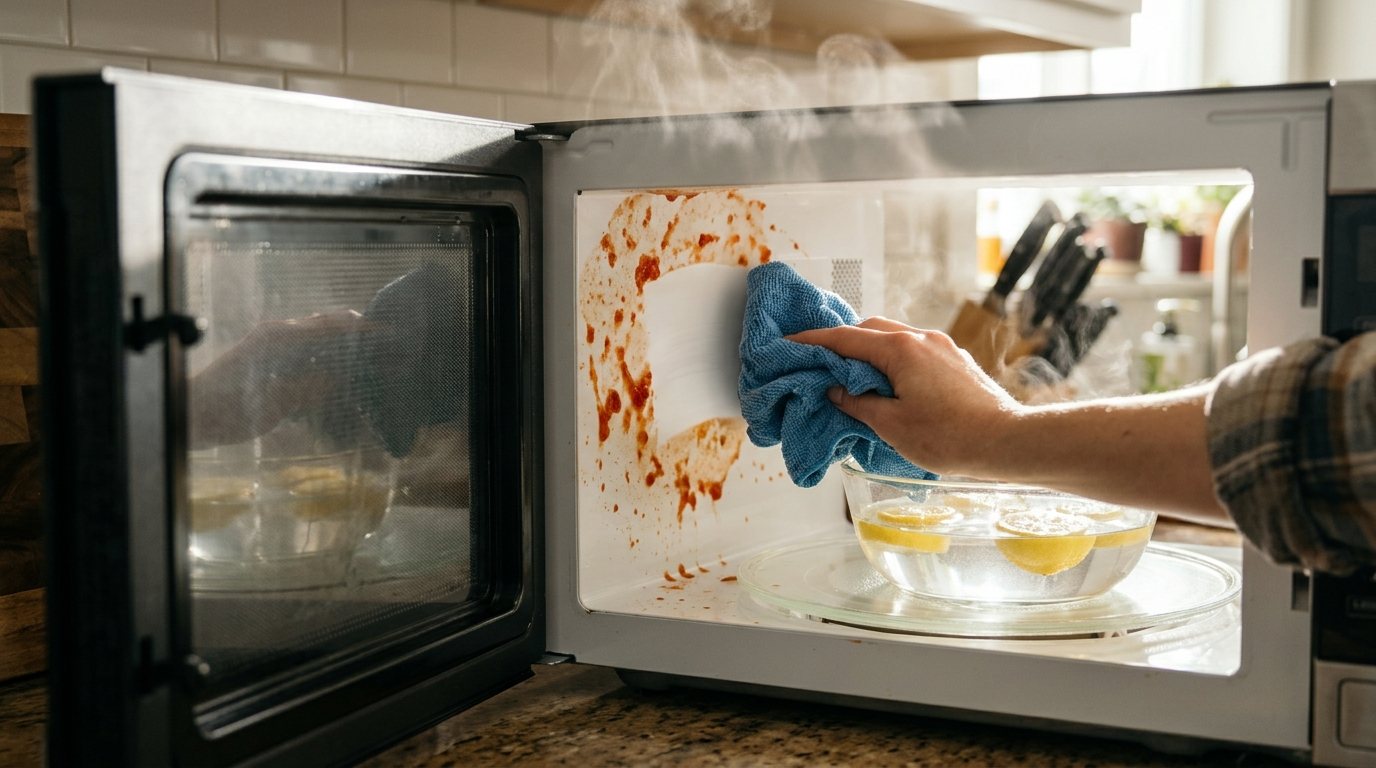
- Cut a lemon in half and squeeze the juice into a microwave-safe bowl. Drop in both halves.
- Add about half a cup to a cup of water. Leave the turntable in place so the bowl rotates.
- Heat on high until the water boils and the window fogs up. Home Depot’s version uses about 2 minutes; a lower-wattage microwave may need longer.
- Leave the door closed for about 5 minutes so the steam can soak into dried splatters.
- Open the door slowly, lift the bowl out with oven mitts and set it on a heat-safe surface.
Vinegar water method
- Mix equal parts white vinegar and water in a large microwave-safe bowl. Home Depot’s method uses 1 cup of each.
- Heat on high for about 5 minutes, until the mixture boils and the interior fills with steam.
- Keep the door closed a few more minutes, then remove the bowl carefully.
- Dip your cloth in the warm solution for the wipe-down. Leave the door open afterward so the vinegar smell clears.
Wipe in the right order
Once the bowl is out, unplug the microwave if you can reach the plug, then remove the turntable and roller ring. Wipe from the top down: ceiling first, then the back and side walls, then the floor, so loosened food falls onto areas you have not cleaned yet. Finish with the inside of the door and the frame it closes against. Use the soft side of a sponge for any stubborn spots, never steel wool or a stiff scouring pad.
Be gentle with the small cardboard-like panel on one inside wall. That is the waveguide cover, and it protects the part that sends microwaves into the cavity. Wipe it lightly with a barely damp cloth and never soak it or scrub it hard.
| Cleaner | Best for | How to use it | Notes |
|---|---|---|---|
| Lemon water | Routine splatters, mild odors | Steam, then wipe | Leaves a fresh smell |
| Vinegar and water | Grease, heavy splatters | Steam, then wipe with the warm solution | Air out the smell afterward |
| Baking soda paste | Dried stains, yellowing on the floor | Apply, wait 5 minutes, wipe | Use a soft sponge only |
| Dish soap and water | Turntable, door, exterior | Wipe or hand wash | Gentle on every surface |
How to clean the turntable and roller ring
The glass tray catches most spills, so it often needs the most work. Let it cool fully if you just used the microwave, because a hot glass tray can crack if it hits cold water.
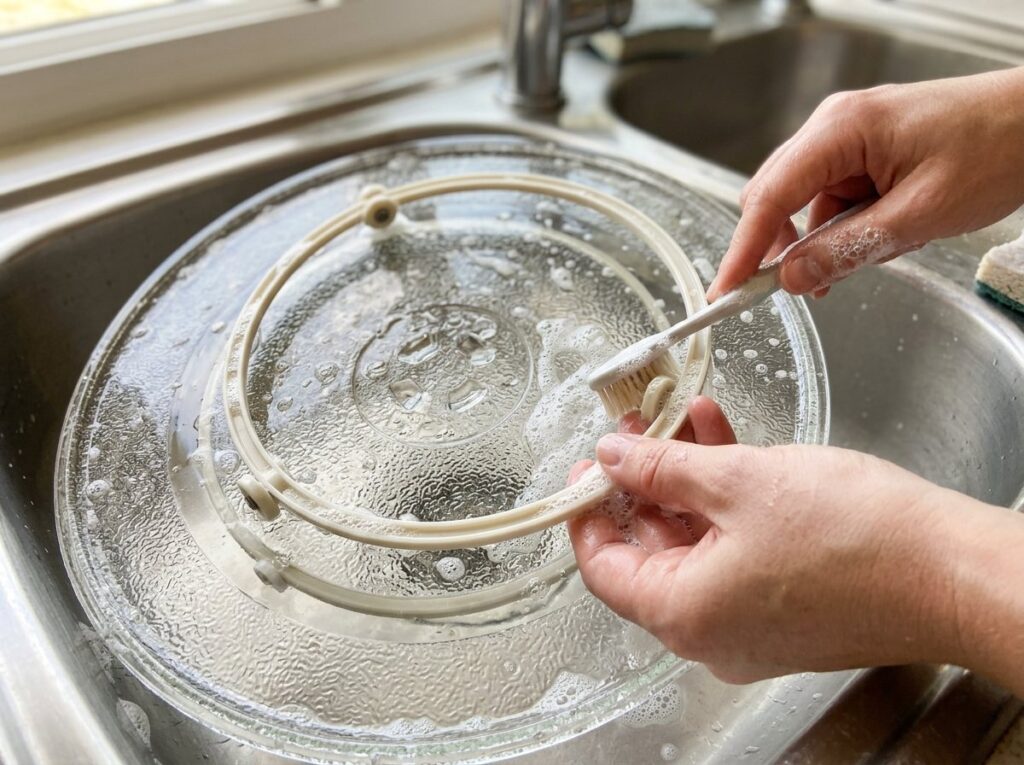
- Lift out the glass tray and the roller ring underneath it.
- Wash both in warm soapy water. For baked-on spots, soak the tray for 15 minutes first.
- Use a soft toothbrush on the roller wheels to remove crumbs and grease.
- Wipe the track on the microwave floor where the wheels run, since buildup there can make the tray wobble or stick.
- Dry everything and set the ring and tray back in place, making sure the tray sits on the center coupling.
Many glass trays are dishwasher-safe, but check your manual before putting the tray or ring in the dishwasher.
How to clean the door, glass and door seal
The door seal area matters for more than looks. The FDA advises regularly cleaning the cavity, its outer edge and the door with water and mild detergent, and avoiding abrasives such as steel wool or scouring pads. You do not need a special microwave cleaner.
- Wipe the inside of the door glass with your steam solution or soapy water.
- Clean the flat sealing surfaces around the door edge and the front of the cavity where the door closes.
- Run a soft toothbrush lightly along gaps where crumbs collect. Do not pry into seams or force anything into them.
- Dry with a microfiber cloth, then close the door and check that it shuts firmly and latches cleanly.
Safety note: According to the FDA, you should not use a microwave whose door does not close firmly or is bent, warped or damaged, and you should stop using one immediately if it keeps running with the door open. Contact the manufacturer or a repair technician instead of trying to adjust hinges or latches yourself.
Removing stubborn stains, burnt spots and odors
Dried-on food splatters
Repeat the steam step rather than scrubbing harder. A second round of steam usually loosens what the first one missed. For a stubborn patch, lay a cloth soaked in hot soapy water over it for 5 minutes, then wipe.
Yellow or brown stains
Mix about 2 tablespoons of baking soda with enough water to make a spreadable paste. Apply it to the stain, wait 5 minutes and wipe with the soft side of a damp sponge, then rinse with a clean wet cloth. Some old discoloration on plastic interiors is permanent, but this removes most surface staining.
Burnt popcorn and smoke smells
Burnt smells cling to every surface, including the door seal and vents. Clean the interior fully first, since a scent cannot fix residue that is still there. Then steam a bowl of lemon water, wipe again and leave the door open for several hours. An open bowl of baking soda left inside overnight with the door closed can absorb what remains.
Fish, garlic and other strong food odors
Wipe the interior with a solution of a tablespoon of baking soda in a cup of warm water, then let it air out with the door open. Covering strong-smelling food with a microwave-safe lid or paper towel next time keeps the odor out of the cavity.
How to clean the outside, controls and vents
Spray cleaner onto a cloth, never directly onto the microwave, so liquid stays out of the vents and control panel. Wipe the keypad and handle with a barely damp soapy cloth and dry them. For a stainless steel front, wipe in the direction of the grain; our guide to cleaning stainless steel appliances covers streaks and fingerprints in more detail.
Over-the-range microwaves also have a metal grease filter under the unit. Slide it out, soak it in hot water with dish soap, scrub gently with a soft brush and let it dry before reinstalling. If your model has a charcoal filter for recirculating air, it cannot be washed; replace it on the schedule in your manual.
What never to put in a microwave
Many messes and most microwave damage start with the wrong item going inside. The FDA says metal pans and aluminum foil should generally not be used because they reflect microwaves, which can cook food unevenly and damage the oven.
| Avoid | Why |
|---|---|
| Metal pans, aluminum foil, dishes with metallic trim | Reflect microwaves, can spark and damage the oven |
| Containers not labeled microwave-safe | Can warp, melt or leach into food |
| Sealed jars, lidded containers, whole eggs in the shell | Steam builds pressure and can burst |
| Nothing at all (running it empty) | Without food or water to absorb energy, the oven can be damaged |
| Steel wool, oven cleaner, bleach | Scratch or damage the interior coating |
If you clean your regular oven with a heavy-duty cleaner, keep it out of the microwave. Our guide on how to clean an oven covers the right products for that job.
Microwave safety while cleaning
- Watch for superheated water. The FDA warns that water heated in a microwave can become superheated and erupt when disturbed, causing burns. Do not exceed the heating time you need, let the bowl stand before opening the door and lift it out slowly with mitts.
- Keep liquids out of openings. Never pour or spray liquid into vents, the control panel or the base.
- Do not run it empty. Always have the bowl of water inside when the microwave is on.
- Stop if you see sparks. Arcing during the steam step usually means food residue or a damaged waveguide cover. Turn it off, clean the area and inspect the cover before using it again.
How often to clean a microwave
Wipe up spills as soon as the microwave cools, because fresh splatters come off with a damp cloth in seconds. Give the interior a quick wipe weekly if you use it daily, and do a full steam clean with the turntable and door about once a month. Over-the-range grease filters usually need a soak every month or two, depending on how much you cook on the stove below.
When to call a pro
Cleaning will not fix a mechanical or electrical fault. Stop using the microwave and call an appliance repair technician if you notice:
- Sparking that continues after the cavity is clean
- A burning or electrical smell that is not from food
- A door that does not latch, damaged hinges or a cracked door
- The microwave runs with the door open, or does not heat at all
- Rust or flaking paint inside the cavity
If the microwave keeps tripping a breaker, our guide on why a circuit breaker keeps tripping explains what to check. HomeAdvisor’s microwave repair cost guide lists typical repairs at $100 to $200, averaging about $175, with service call fees of $50 to $100. Typical part ranges include $50 to $100 for a door switch, $100 to $200 for a magnetron and $200 to $500 for a full door assembly. HomeAdvisor suggests a budget countertop unit over 10 years old is usually cheaper to replace than repair.
Frequently asked questions
How long do you microwave lemon water to clean a microwave?
Heat it on high until it boils and the window steams up, usually about 2 to 5 minutes depending on the amount of water and your microwave’s power. Then leave the door closed for about 5 minutes. Lift the bowl out carefully because it will be very hot.
Is vinegar or lemon better for cleaning a microwave?
Both work well with the steam method. Vinegar is slightly better on greasy buildup, while lemon leaves a fresher smell and is pleasant for routine cleaning. If you dislike the vinegar smell, add a few slices of lemon to the vinegar water.
Can I clean the inside of a microwave with bleach or glass cleaner?
Avoid bleach and harsh chemical cleaners inside the cavity, because residue can linger on surfaces that touch food. The FDA notes that water and mild detergent are enough for the cavity and door. Glass cleaner is fine on the exterior if you spray it onto a cloth first.
How do you get a burnt smell out of a microwave?
Remove all burnt residue first, then steam a bowl of lemon or vinegar water and wipe every surface, including the door seal. Leave the door open to air out, and place an open bowl of baking soda inside overnight if the smell lingers.
Can you put a microwave turntable in the dishwasher?
Many glass turntables are dishwasher-safe, but check your manual first. Hand washing in warm soapy water is always safe. Let a hot tray cool completely before washing it to avoid cracking the glass.
The bottom line
The fastest way to clean a microwave is to let steam do the hard work: boil lemon or vinegar water inside, wait a few minutes, then wipe from the top down with a soft cloth. Wash the turntable, clean the door seal gently and never use abrasives or run the oven empty. A quick wipe after spills and a monthly steam clean keep it fresh and working safely.