There’s no worse way to start a cold morning than a silent furnace and a house that’s getting colder by the minute. Before you call for an emergency service visit, take a breath. A surprising number of “broken” furnaces are caused by something simple: a thermostat setting, a tripped switch, a clogged filter or a loose access panel.
This guide walks you through 10 checks to try when your furnace won’t turn on, in the order that solves the most problems fastest. Most of them take a few minutes and need no tools. You’ll also learn what the blinking status light is telling you, and which problems are a clear sign to call a licensed HVAC technician.
Quick answer: Check that the thermostat is set to Heat and above room temperature, replace its batteries, and make sure the furnace’s power switch and breaker are on. Replace a dirty air filter, confirm the furnace door is closed tightly, and check that the gas valve is open. If the furnace starts and then shuts off, a dirty flame sensor is a common cause.
First, stay safe
Safety note: If you smell gas (a rotten egg odor), don’t touch any switches, don’t try to light anything, and leave the house immediately. Call your gas utility or 911 from outside. If your carbon monoxide alarm is sounding, get everyone out and call for help. Don’t attempt any troubleshooting in either situation.
10 things to check when your furnace won’t turn on
1. Check the thermostat settings
It sounds too obvious, but it’s the most common cause. Make sure the thermostat is set to Heat, not Cool, Off or Auto in a way you didn’t expect. Raise the temperature setting at least 3 to 5 degrees above the current room temperature. If you have a programmable or smart thermostat, check that a schedule, vacation mode or an app setting isn’t overriding your choice.
2. Replace the thermostat batteries
Many thermostats run on AA or AAA batteries even if they’re wired to the system. A blank or dim screen is the giveaway, but weak batteries can cause problems before the display dies. Swap them for fresh ones and wait a few minutes.
3. Check the breaker and the furnace switch
Your furnace needs electricity even if it burns gas, because the blower, igniter and control board are electric. Look at your electrical panel for a tripped breaker labeled “furnace” or “HVAC” and reset it once. Then find the furnace service switch, which usually looks like an ordinary light switch on or near the furnace. It’s easy to flip off by accident, mistaking it for a light. Make sure it’s on.
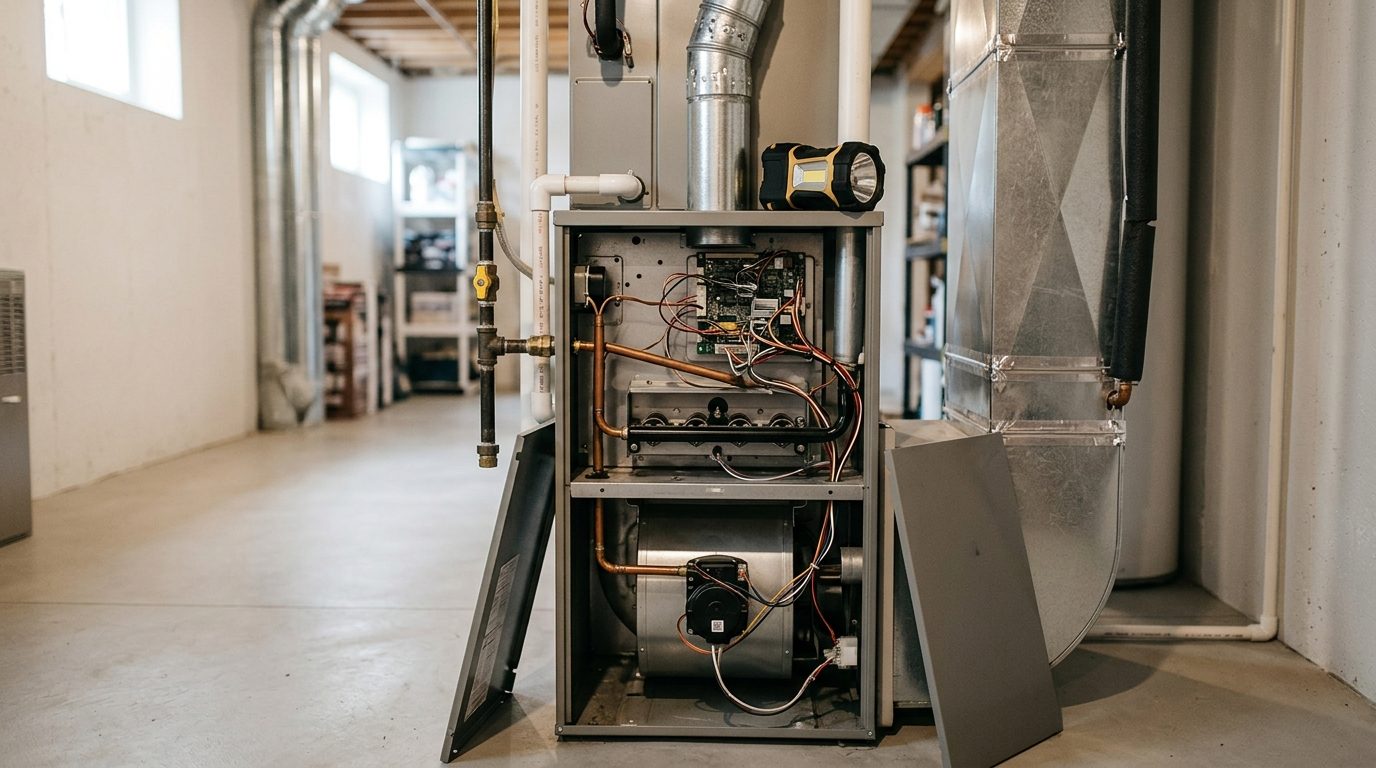
4. Make sure the access panel is closed
Most furnaces have a safety switch that cuts power when the front panel is removed. If someone changed the filter and didn’t seat the panel fully, the furnace won’t run. Remove the panel and reinstall it firmly so it pushes in the small switch behind it.
5. Replace a dirty air filter
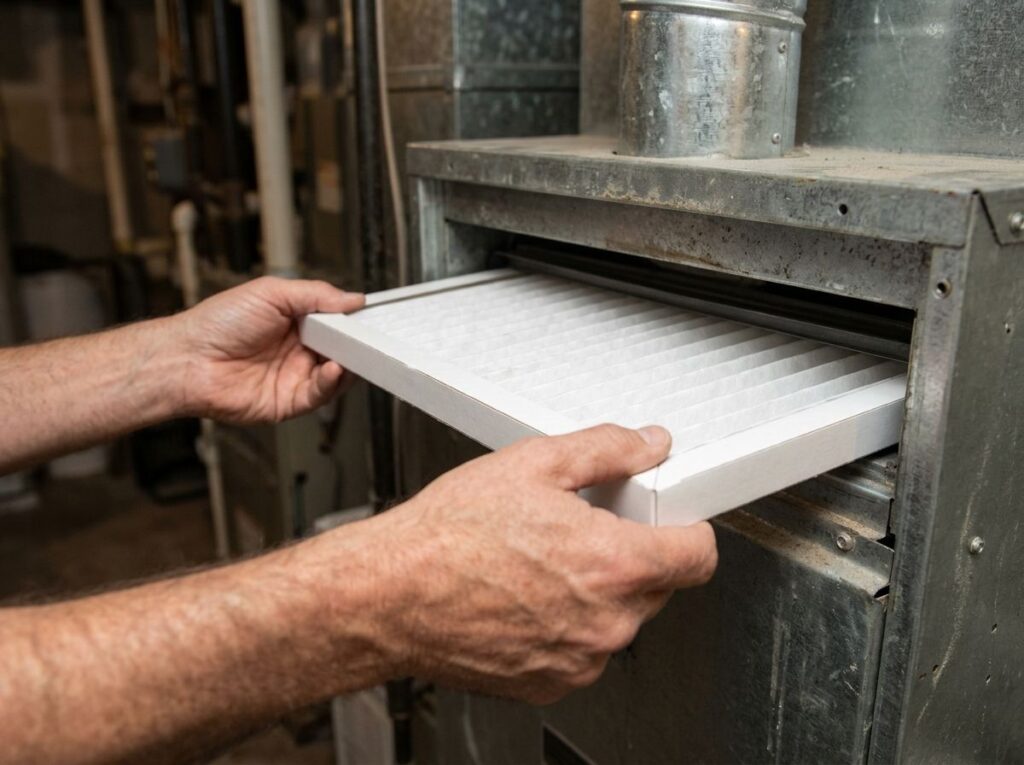
A clogged filter chokes airflow. The furnace can overheat, trip its high-limit safety switch and shut itself down, sometimes cycling on and off before stopping completely. Slide out the filter and hold it up to a light. If you can’t see light through it, replace it. Note the size printed on the frame and the airflow arrow, which should point toward the furnace.
6. Check the gas supply
Find the gas line leading into the furnace and the shut-off valve on it. When the handle is parallel to the pipe, the valve is open. If it’s perpendicular, it’s closed. Also check whether other gas appliances, like your stove or water heater, are working. If none of them are, the problem may be with your gas service, and you should contact your utility.
7. Read the status light
Most modern furnaces have a small window on the lower panel where you can see an LED on the control board. Steady or slow blinking usually means normal operation, while a specific pattern of blinks is an error code. The code chart is usually printed on a label inside the furnace door. Write down the pattern, since it can point you or your technician straight to the problem, such as an ignition failure or a pressure switch fault.
8. Clean the flame sensor
If your furnace starts, the burners light, and then shut off after a few seconds, the flame sensor is a prime suspect. It’s a thin metal rod that sits in the burner flame and confirms that gas is burning. When it gets coated with residue, the furnace can’t “see” the flame and shuts off the gas as a safety measure.
- Turn off power at the furnace switch and close the gas valve.
- Remove the access panel and locate the sensor near the burners. It’s usually held by a single screw.
- Remove it carefully and gently clean the metal rod with a fine abrasive pad or fine-grit emery cloth. Don’t touch the rod with bare fingers more than you need to.
- Reinstall it, restore gas and power, and test.
If you’re not comfortable working near the burner assembly, this is a quick and inexpensive job for a technician.
9. Check the condensate line (high-efficiency furnaces)
High-efficiency furnaces produce water as they run. It drains through a plastic tube, sometimes into a small pump. If the line clogs or the pump fails, a safety switch can stop the furnace. Look for water around the furnace, a full condensate pump reservoir, or a kinked line. Clearing the line, or emptying and cleaning the pump, can get the furnace running again.
10. Clear the intake and exhaust vents
High-efficiency furnaces often vent through two plastic pipes on an outside wall or the roof. Snow, ice, leaves or a bird’s nest can block them, and the furnace will refuse to run. After a snowstorm, check these pipes and gently clear any blockage. Never block them with decorations, firewood or snow piles.
Symptoms and likely causes
| What’s happening | Likely cause | What to try |
|---|---|---|
| Nothing at all, thermostat blank | Dead batteries, tripped breaker | New batteries, reset breaker |
| Thermostat on, furnace silent | Switch off, panel loose, no power | Furnace switch, reseat panel |
| Starts, then shuts off in seconds | Dirty flame sensor | Clean flame sensor |
| Runs a few minutes, then stops | Clogged filter, overheating | Replace filter, open vents |
| Blower runs, air is cold | Ignition or gas problem | Check gas valve, status light |
| Water around the furnace | Clogged condensate line or pump | Clear line, check pump |
Prevent furnace problems before winter
- Replace the air filter every 1 to 3 months during heating season.
- Schedule a professional tune-up every fall, before the first cold snap.
- Keep the area around the furnace clear of storage, laundry and anything flammable.
- Keep supply and return vents in your rooms open and unblocked by furniture.
- Test your carbon monoxide alarms monthly and replace them according to the manufacturer’s guidance.
- Clear outdoor vent pipes after snow or storms.
When to call an HVAC professional
Some problems are not DIY territory. Call a licensed technician if:
- The furnace locks out repeatedly or keeps tripping the breaker.
- You hear loud banging, grinding or screeching from the unit.
- You see soot, scorch marks or a yellow, flickering burner flame instead of a steady blue one.
- The status light shows an error code you can’t resolve with the basic checks.
- You suspect a problem with the igniter, gas valve, blower motor, control board or heat exchanger.
- The furnace is old and needs frequent repairs. A technician can tell you whether repair or replacement makes more sense.
How furnace ignition works (and why it matters)
Knowing which type of ignition your furnace uses helps you troubleshoot. Older furnaces often have a standing pilot light, a small flame that burns all the time. If it goes out, the burners can’t light. You can usually see it through a small window, and relighting instructions are printed on a label inside the door. Follow them exactly, and if the pilot won’t stay lit, the thermocouple may need replacing.
Most furnaces built in the last couple of decades use electronic ignition instead. A hot surface igniter glows bright orange, or an intermittent pilot sparks, only when the furnace calls for heat. A hot surface igniter is fragile and eventually wears out. If you can see the igniter not glowing during startup, or it shows a visible crack, it needs to be replaced, which many homeowners leave to a technician because the part must match the furnace exactly.
On either type, listen to the startup sequence: the draft inducer fan hums first, then you’ll hear the igniter click or see it glow, the burners light, and finally the main blower kicks on. Noting where that sequence stops is one of the most useful things you can tell a technician.
Frequently asked questions
Why does my furnace turn on and then shut off right away?
The most common reasons are a dirty flame sensor, a clogged air filter that causes overheating, or a blocked vent. Start with the filter, then the flame sensor.
Is there a reset button on a furnace?
Some furnaces have a reset button on the blower motor or control board, and turning the power off and on can also reset the control board. Don’t reset a furnace over and over. If it keeps shutting down, something is causing it, and repeated resets can make things worse.
How long should a furnace last?
Many gas furnaces last 15 to 20 years with regular maintenance. Annual tune-ups and regular filter changes help it reach that range.
Can a dirty filter really stop a furnace?
Yes. Restricted airflow causes the heat exchanger to overheat, and a safety switch shuts the burners off. A new filter is one of the cheapest and most common furnace fixes.
What temperature should I set my furnace to in winter?
Around 68°F while you’re home and awake is a common recommendation for balancing comfort and energy use. Lowering it while you sleep or are away saves more.
The bottom line
When your furnace won’t turn on, work through the simple checks first: thermostat, batteries, power, panel, filter and gas. Those solve a large share of no-heat calls. If the furnace lights and immediately shuts off, the flame sensor is the next suspect. And if anything involves a gas smell, repeated lockouts or internal parts, call a licensed HVAC pro. Your safety is worth more than the service fee.