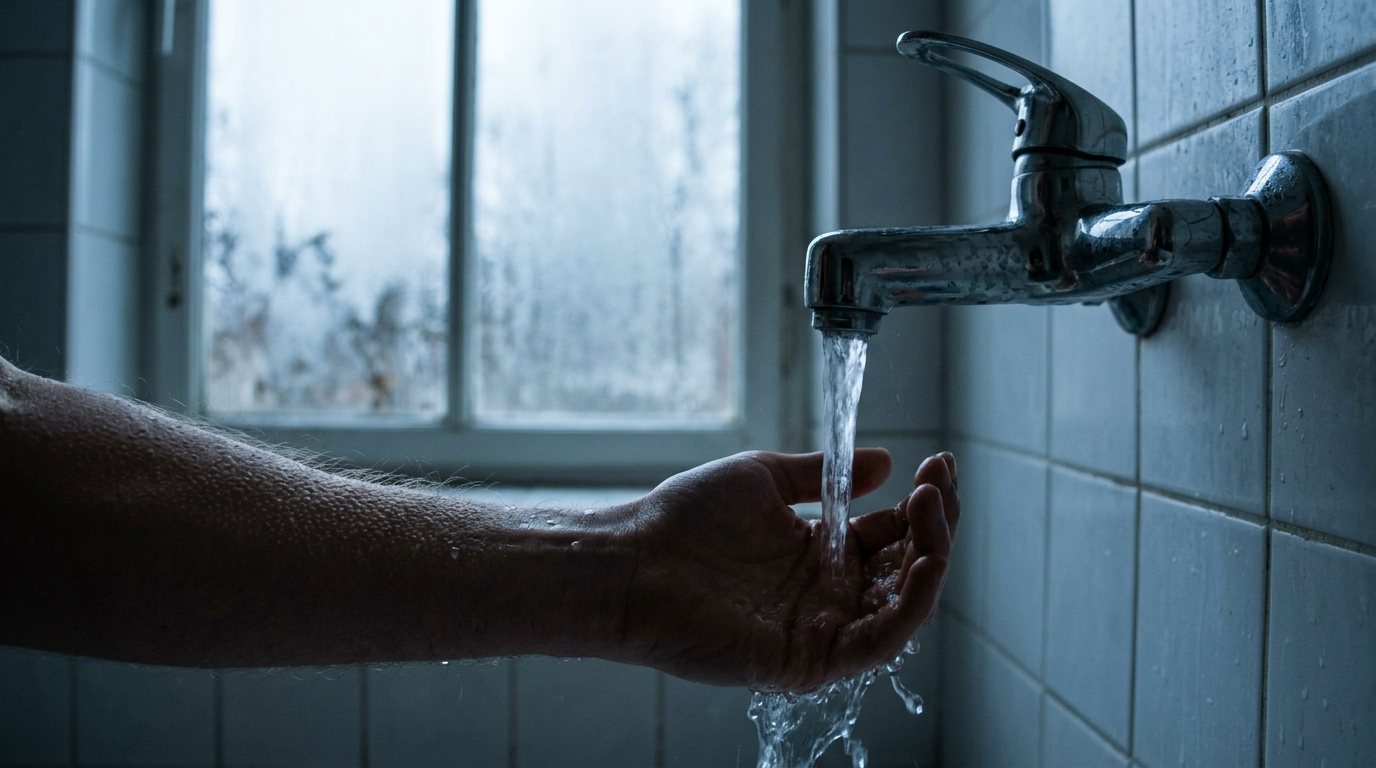
You step into the shower, wait, and the water never warms up. Or the kitchen tap runs lukewarm for a minute and then goes cold. No hot water is one of those problems that turns a normal morning upside down, especially as the weather gets colder and incoming water gets colder too.
Many causes are simple and safe to check yourself, like a blown-out pilot, a tripped breaker or a reset button. This guide walks you through troubleshooting gas and electric tank heaters, the basics for tankless units, what to do if you smell gas, and how to tell when the heater is simply worn out and needs replacing.
Quick answer: On a gas heater, check that the gas valve is on and the pilot or burner is lit; relight it by following the label on the tank. On an electric heater, check the breaker, then turn the power off and press the red reset button behind the upper access panel. If the pilot won’t stay lit, the reset keeps tripping or you smell gas, stop and call a pro.
Safety note: If you smell gas (a rotten egg or sulfur odor), don’t relight anything. Massachusetts’ gas safety guidance says to leave the building right away, avoid switching lights or appliances on or off, and call 911 or your gas company once you’re outside.
First checks for any water heater
Before you open any panels, rule out the quick stuff. These take a couple of minutes and solve more problems than you’d expect.
- Is it every tap or just one? If only one faucet or shower has no hot water, the problem is that fixture’s valve or cartridge, not the heater.
- Is the heater leaking? Water around the base or a dripping relief valve changes the plan. Turn off the power or gas and the cold supply valve before you go further.
- Is the thermostat turned down? Someone may have set it to vacation mode or bumped the dial.
- How old is it? The serial number on the label usually encodes the manufacture date. A tank near the end of its life may not be worth repairing.
| Symptom | Gas heater: likely cause | Electric heater: likely cause |
|---|---|---|
| No hot water at all | Pilot out, gas valve off, failed thermocouple | Tripped breaker, tripped high-limit reset, failed upper element |
| Lukewarm water only | Thermostat set low, sediment, broken dip tube | Failed lower element or thermostat |
| Runs out of hot water fast | Sediment buildup, undersized heater, dip tube | Failed lower element, sediment |
| Pilot lights but won’t stay lit | Thermocouple, dirty pilot, draft or vent problem | Not applicable |
| Reset button keeps tripping | Not applicable | Bad thermostat, shorted element, loose wiring |
| Rusty water or leaking tank | Corroded tank, end of life | Corroded tank, end of life |
Gas water heater: no hot water
Check the gas supply and control knob
Make sure the gas shutoff on the supply line is open (the handle runs in line with the pipe). Then look at the control knob on the front of the heater. It should be set to “On,” not “Pilot” or “Off.” If other gas appliances in the home aren’t working either, the issue may be your gas service, so call the utility.
Relight the pilot
Older heaters have a standing pilot you can see through a small window near the bottom. Many newer models use an electronic igniter instead. If the pilot is out, follow the lighting instructions printed on the label on the tank, since steps vary by model.
- Turn the control knob to “Off” and wait at least 5 to 10 minutes, or as long as the label says, for any gas to clear.
- Set the knob to “Pilot,” then press and hold it (or the separate pilot button).
- Press the igniter button until the pilot lights, and keep holding the knob for about a minute so the thermocouple heats up.
- Release slowly. If the pilot stays lit, turn the knob to “On” and listen for the main burner to light.
A healthy pilot and burner flame are mostly blue. A lazy, yellow or sooty flame points to a combustion or venting problem and needs a technician.
If the pilot won’t stay lit
The most common cause is a worn thermocouple (or thermopile on some models), the metal rod that sits in the pilot flame and tells the gas valve it’s safe to stay open. When it fails, the gas valve shuts off as soon as you let go of the knob. Other causes include a dirty pilot orifice, a draft blowing the flame out and a failing gas control valve.
Many newer gas heaters also have a sealed combustion chamber with a flammable vapor sensor. If that sensor trips, the burner locks out and usually needs a qualified technician to diagnose. Replacing a thermocouple is a common DIY job on older open-burner heaters, but if you’re not comfortable working around gas lines, it’s a quick service call.
Check the venting
Gas heaters need to vent exhaust safely outside. Look at the vent pipe on top: it should be firmly connected and sloped upward. Power-vented models have a fan that needs electricity, so check that it’s plugged in and its outlet works. A blocked or disconnected vent can shut the heater down and is a carbon monoxide hazard, so call a pro if anything looks loose, rusted or blocked.
Electric water heater: no hot water
Check the breaker
Most electric water heaters run on a dedicated 240-volt double breaker. Find it in your panel and see if it’s tripped. Reset it once by pushing it fully off, then on. If it trips again right away, there’s a short in the heater or wiring, and our guide to a circuit breaker that keeps tripping explains why you shouldn’t keep resetting it.
Press the high-limit reset button
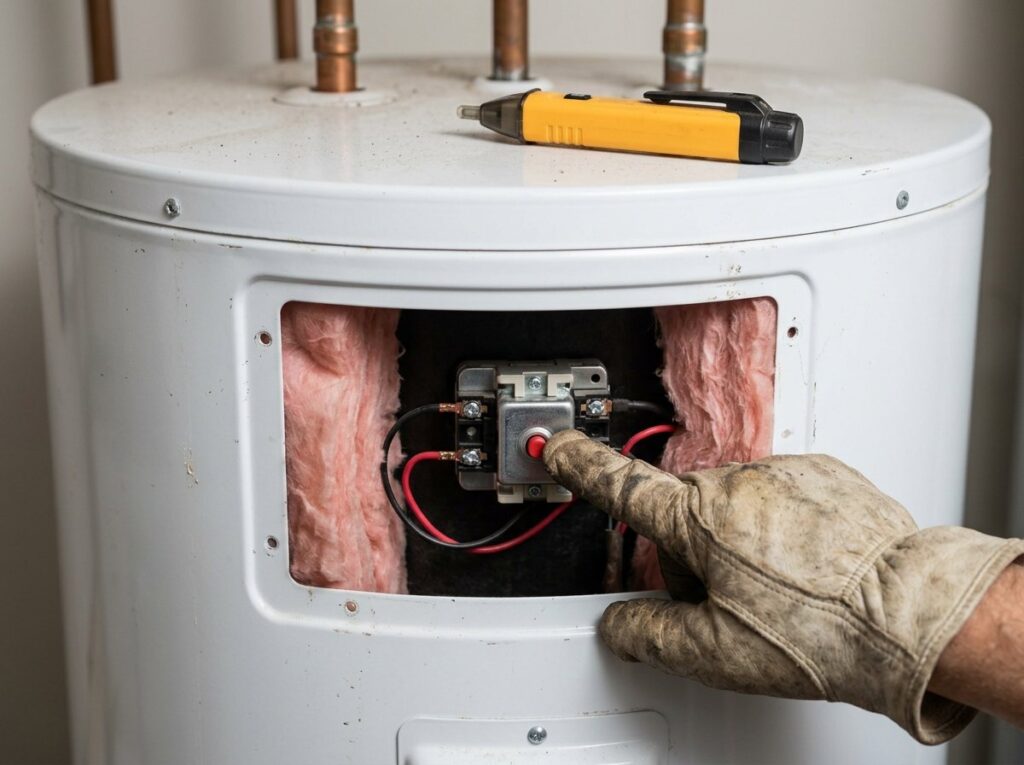
Electric heaters have a safety switch, often called the high-limit or ECO, that cuts power if the water gets too hot. It sits behind the upper access panel, usually with a red button.
- Turn off the breaker for the water heater, and confirm the power is off.
- Remove the upper access panel and fold back the insulation without touching any wires.
- Press the red reset button firmly. You may hear a click.
- Replace the insulation and cover, turn the breaker back on, and wait an hour or so for the water to heat.
If it trips again within days, something is causing it, such as a stuck thermostat, a shorted element or a loose connection. Resetting it over and over won’t fix the cause.
Test the heating elements
Electric tanks have an upper and a lower element. If the upper element fails, you usually get no hot water at all. If the lower one fails, you get a small amount of lukewarm water that runs out quickly.
With the power off and the wires disconnected, a multimeter set to ohms should show a reading across each element’s two terminals. No reading means the element is burned out. If you’re new to meters, our guide on how to use a multimeter covers the basics.
Replacing an element requires draining the tank and working near 240-volt wiring. If you’re not comfortable with that, a plumber or electrician can handle it quickly.
Tankless water heater basics
Tankless units heat water only when you open a tap. According to Energy Saver from the U.S. Department of Energy, they typically supply about 2 to 5 gallons per minute, so running several showers and appliances at once can overwhelm one unit.
- Check the display for an error code and look it up in the manual. Codes often point to ignition, flame or overheating problems.
- Open the tap wider. Tankless heaters need a minimum flow to fire, so a barely open faucet or a clogged aerator may not trigger them.
- Clean the inlet filter. Many units have a small screen on the cold inlet that clogs with debris.
- Descale on schedule. Hard water scale on the heat exchanger reduces output and can trigger shutdowns. Manufacturers recommend periodic flushing with a descaling solution.
- Check power, gas and venting just as you would on a tank model. Gas tankless units need electricity to run.
Tools and materials
- Flashlight
- Flathead and Phillips screwdrivers
- Non-contact voltage tester and a multimeter (electric heaters)
- Garden hose for draining the tank
- Replacement thermocouple, heating element or thermostat matched to your model
- Element wrench (electric heaters)
- Work gloves and safety glasses
Pro tip: Sediment buildup is behind many “not enough hot water” complaints, and it shortens a tank’s life. Draining a few gallons once a year helps. Our step-by-step guide on how to flush a water heater shows you how.
Repair or replace? Check the age
Energy Saver puts the typical life of a storage tank water heater at about 10 to 15 years, and tankless units at about 20 years. If your tank is in that range or older and needs a major part, replacement is often the better value. Replace it right away if you see any of these:
- Water leaking from the tank itself, not a fitting or valve
- Rusty water from the hot side only
- Rumbling or popping that continues after flushing
- Repeated repairs within a year or two
When to call a pro
Call a licensed plumber, or your gas utility for gas leaks, if you notice any of these:
- You smell gas, see soot around the burner or the flame burns yellow.
- The pilot won’t stay lit after relighting it correctly.
- The high-limit reset keeps tripping or the breaker trips again right away.
- The tank is leaking, or the temperature and pressure relief valve is discharging water.
- The vent pipe is loose, rusted or blocked, or a carbon monoxide alarm goes off.
According to Angi, water heater repairs average about $603 nationally, with most falling between $90 and $1,750. Typical examples include about $150 or less for a thermocouple, $200 to $300 for an electric heating element and around $350 for a gas valve. Full replacement typically runs $850 to $1,800.
Frequently asked questions
Why do I have cold water but no hot water?
If all hot taps are cold, the heater isn’t heating. On gas models, check the pilot and gas valve; on electric models, check the breaker and the high-limit reset. If only one fixture has no hot water, the problem is in that faucet or shower valve.
How long does it take a water heater to heat back up?
After relighting or resetting, give a typical tank roughly an hour or more before judging the result. Gas heaters generally recover faster than electric ones, and larger tanks take longer. If there’s still no warmth after a couple of hours, keep troubleshooting.
Why does my water heater pilot keep going out?
The most likely cause is a worn thermocouple. A dirty pilot orifice, drafts near the heater, a blocked vent or a failing gas control valve can also cause it. If replacing the thermocouple doesn’t fix it, call a technician.
Where is the reset button on an electric water heater?
It’s behind the upper access panel, usually a red button on the high-limit switch above the thermostat. Turn off the breaker before removing the panel, then press the button firmly. If it trips again soon, there’s an underlying fault.
Is it worth repairing a 12-year-old water heater?
For a cheap fix like a thermocouple or a single element, often yes. For a leaking tank or an expensive gas valve, replacement usually makes more sense, since tanks typically last about 10 to 15 years.
The bottom line
Most “no hot water” problems start with a few simple checks: the gas valve and pilot on gas heaters, and the breaker and reset button on electric ones. If the pilot won’t stay lit, the reset keeps tripping or the tank is leaking, the heater needs a repair or replacement. Never work on a heater if you smell gas: get out and call for help from outside.