
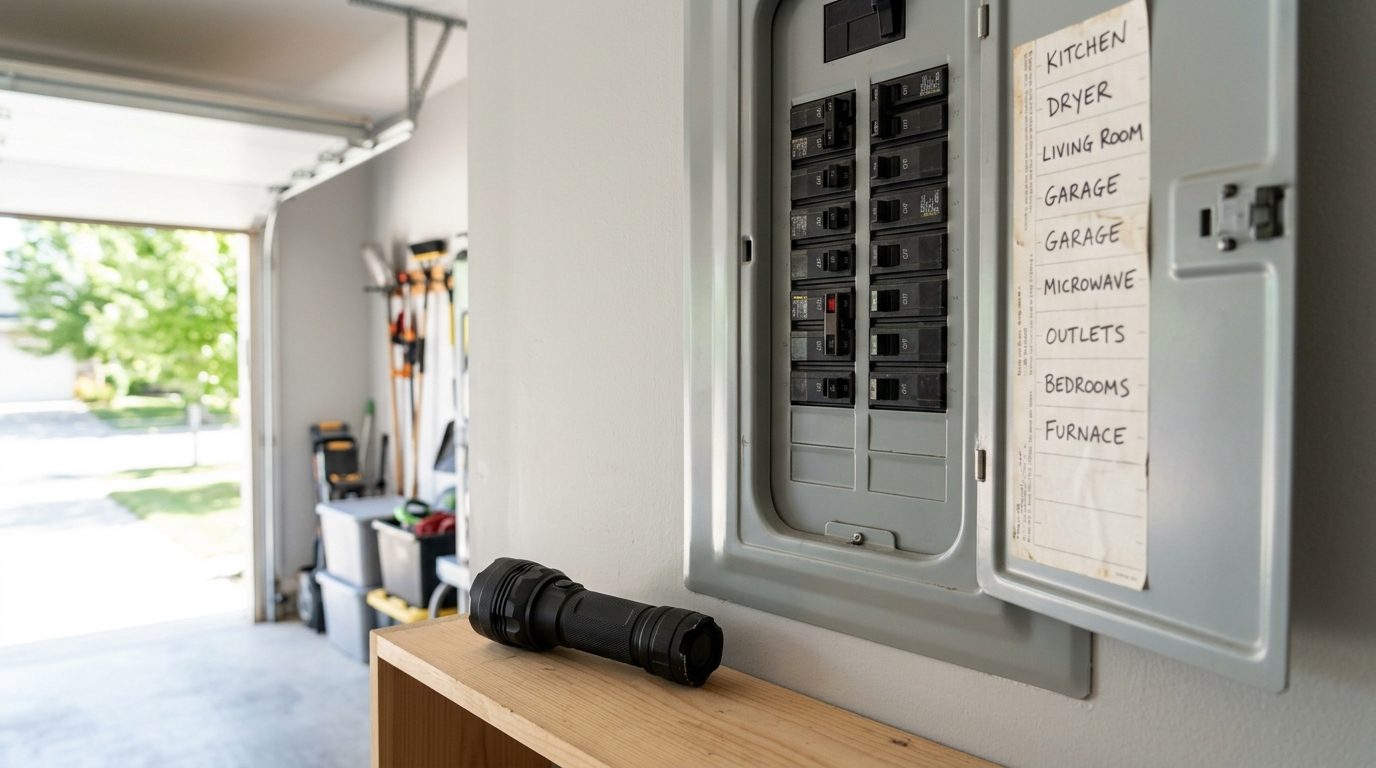
The lights go out in one room, the TV goes dark, or the microwave stops mid-cycle. You walk to the electrical panel and find a breaker sitting in the middle position again. A circuit breaker that keeps tripping is frustrating, but it’s also doing exactly what it was designed to do: cutting power before a wiring problem turns into overheating or a fire.
The key is figuring out why it’s tripping. Sometimes the fix is as simple as moving a space heater to a different outlet. Other times, a tripping breaker is a warning sign of a short circuit, a ground fault or a failing breaker that needs a licensed electrician. This guide explains the common causes, how to reset a breaker safely, how to track down the culprit, and the red flags you should never ignore.
Quick answer: Unplug or switch off everything on the circuit, then push the breaker firmly to OFF and back to ON. Plug devices back in one at a time to find the one that trips it. If high-power appliances are sharing a circuit, spread them out. If the breaker trips immediately with nothing plugged in, feels hot, buzzes, or you smell burning, stop and call a licensed electrician.
What a circuit breaker actually does
Every circuit in your home is protected by a breaker in the main electrical panel. When the current flowing through a circuit goes above a safe level, or when electricity starts flowing where it shouldn’t, the breaker “trips” and cuts power. This protects the wiring inside your walls from overheating. A tripped breaker usually sits in a middle position between ON and OFF, or shows an orange or red indicator, depending on the brand.
Most standard household circuits in the US are 15 or 20 amps. Kitchens, bathrooms, laundry rooms and outdoor outlets often have extra protection from GFCI (ground fault circuit interrupter) devices, and many newer homes use AFCI (arc fault circuit interrupter) breakers for bedrooms and living areas.
The 5 most common reasons a breaker keeps tripping
1. An overloaded circuit
This is by far the most common cause. A circuit can only safely carry so much power at once. On a 120-volt circuit, a 15-amp breaker supports about 1,800 watts in total, and a 20-amp breaker about 2,400 watts. Electricians generally recommend keeping continuous loads to around 80% of that, about 1,440 watts on a 15-amp circuit. A single space heater or hair dryer can use 1,500 watts on its own, so adding a microwave or toaster on the same circuit can easily push it over the limit.
Signs: the breaker trips when several appliances are running at once, or when you turn on one specific high-power device, and it resets without trouble once things are unplugged.
2. A short circuit
A short circuit happens when a hot wire touches a neutral wire, creating a sudden surge of current. It can be caused by damaged wiring, a loose connection in an outlet or switch, or a faulty appliance or cord. Shorts are more serious than overloads.
Signs: the breaker trips instantly, sometimes with a pop or spark, and may trip again right away when you reset it. You might notice a burning smell or dark marks on an outlet or plug.
3. A ground fault
A ground fault is a type of short where electricity takes an unintended path to the ground, often through water or a damaged appliance. Ground faults are especially dangerous in wet areas, which is why GFCI protection is required in kitchens, bathrooms, garages and outdoors.
Signs: trips happen around water, in kitchens or bathrooms, outdoors after rain, or when a particular appliance is used. A GFCI outlet may trip instead of the breaker.
4. An arc fault
Arc faults are sparks that jump across a damaged or loose connection, a pinched cord, or a nail driven through a wire. AFCI breakers are designed to detect these dangerous sparks and shut off the circuit.
Signs: an AFCI breaker trips, sometimes when a specific lamp or device is used, or seemingly at random. Damaged cords and loose outlets are common culprits.
5. A worn-out or faulty breaker
Breakers don’t last forever. An old or damaged breaker can become weak and trip at loads it used to handle, or fail to trip when it should.
Signs: the breaker trips frequently with normal use, feels warm, buzzes, looks scorched, or won’t stay reset. Breaker replacement is a job for a licensed electrician.
How to reset a tripped breaker safely
- Make sure your hands and the floor are dry. Bring a flashlight if the area is dark.
- Turn off or unplug devices on the affected circuit. This prevents an instant re-trip and protects electronics from a power surge.
- Find the tripped breaker. Look for the one that’s out of line with the others, in the middle position or showing a colored indicator.
- Push it firmly to OFF first, until it clicks. Many breakers won’t reset unless you do this.
- Then push it back to ON. Stand slightly to the side of the panel, not directly in front of it, as a general precaution.
- Restore devices one at a time and watch whether the breaker holds.
Safety note: Never remove the panel’s inner cover (the “dead front”), never tape or hold a breaker in the ON position, and never replace a breaker with a higher-amp one to stop the tripping. The breaker size is matched to the wire size, and a bigger breaker can let wires overheat inside your walls.
How to find what’s causing the trips
Once the breaker is reset, play detective:
- Map the circuit. With the breaker off, note which outlets, lights and appliances lose power. Label the panel while you’re at it; it pays off in every future emergency.
- Add devices back one at a time. Wait a minute or two after each. If the breaker trips when a particular device is plugged in or switched on, that device is the likely problem, or it’s simply too much for the circuit when combined with others.
- Test the suspect elsewhere. Plug the suspect appliance into an outlet on a different circuit. If it trips that breaker too, the appliance or its cord is likely faulty.
- Inspect cords and outlets. Look for frayed cords, cracked plugs, scorch marks, loose outlets or outlets that feel warm.
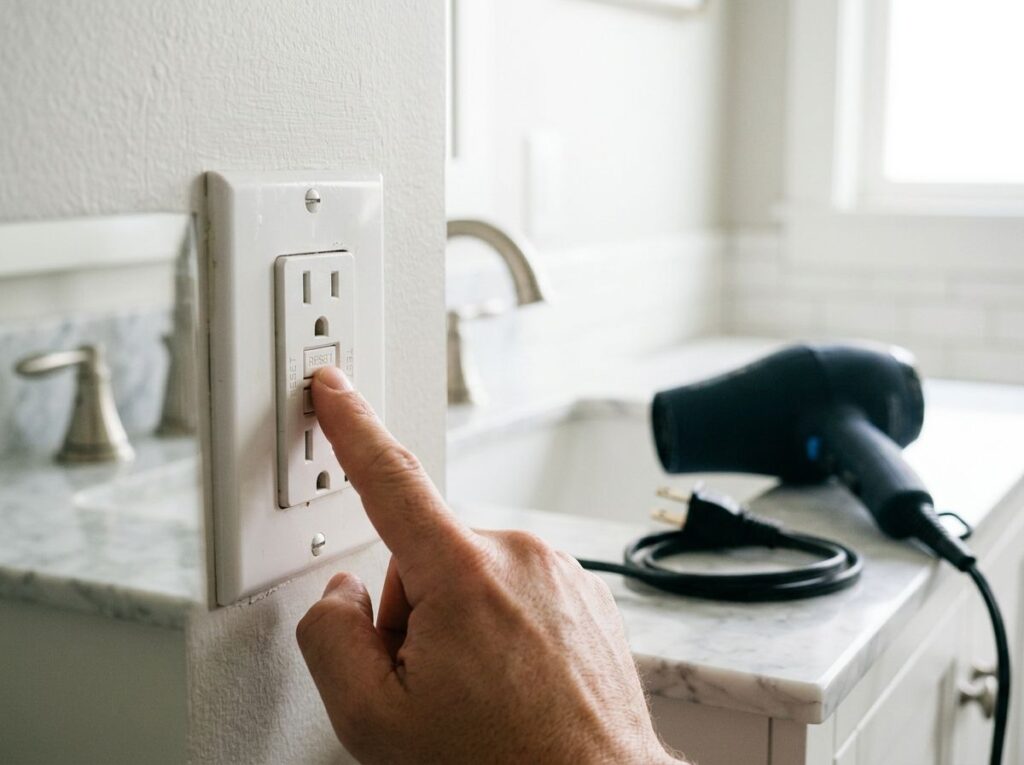
- Check GFCI outlets. One GFCI outlet can protect several other outlets downstream. If outlets in a kitchen, bathroom or garage are dead, press the RESET button on the nearest GFCI.
Common power draw of household appliances
| Appliance | Typical wattage | Tip |
|---|---|---|
| Space heater | Up to about 1,500 W | Give it a circuit of its own; never use an extension cord |
| Hair dryer | About 1,200 to 1,875 W | Avoid running other heaters on the same bathroom circuit |
| Microwave | About 1,000 to 1,500 W | Don’t share an outlet with a toaster or kettle |
| Electric kettle or toaster | About 800 to 1,500 W | Use one high-power countertop appliance at a time |
| Vacuum cleaner | About 500 to 1,400 W | Watch for trips when a space heater is also running |
| Window AC unit | About 500 to 1,500 W | Larger units may need a dedicated circuit |
Wattage varies by model. Check the label on your appliance for its exact rating.
Simple ways to stop overload trips
- Spread out high-power appliances across different circuits, especially in kitchens and bathrooms.
- Don’t run space heaters on the same circuit as other heavy loads, and plug them directly into a wall outlet.
- Avoid daisy-chaining power strips or using extension cords as permanent wiring.
- Unplug appliances you aren’t using, particularly heat-producing ones.
- Consider adding a circuit. If one area trips constantly with normal use, an electrician can add a dedicated circuit for a heavy appliance.
Troubleshooting at a glance
| What happens | Likely cause | What to do |
|---|---|---|
| Trips when several things run at once | Overload | Spread appliances across circuits |
| Trips when one appliance is turned on | Faulty appliance or heavy load | Test the appliance on another circuit |
| Trips instantly, even with nothing plugged in | Short circuit in wiring | Leave it off and call an electrician |
| Trips around water or outdoors | Ground fault | Check GFCIs and appliances; call a pro if it continues |
| AFCI breaker trips randomly | Arc fault from damaged cords or connections | Inspect cords; have an electrician check wiring |
| Breaker is hot, buzzing or won’t reset | Failing breaker or panel issue | Call an electrician right away |
When to call a licensed electrician
Call a pro, and stop resetting the breaker, if any of the following happen:
- The breaker trips immediately after resetting, even with everything unplugged.
- You smell burning or see scorch marks, melted plastic or sparks at an outlet, switch or the panel.
- The breaker or panel feels hot, or you hear buzzing or crackling.
- Lights flicker or dim regularly, or outlets feel warm to the touch.
- The breaker won’t stay in the ON position.
- You have an older home and frequent trips, which may mean the electrical system needs an upgrade.
If you see smoke or fire, leave the house and call 911. Don’t try to fight an electrical fire with water.
Frequently asked questions
How many times can I reset a breaker?
Resetting once after unplugging the likely cause is reasonable. If it keeps tripping, don’t keep resetting it. Repeated trips are a warning that something needs to be fixed.
Can a circuit breaker go bad?
Yes. Breakers can wear out over time and trip too easily or fail to trip. A licensed electrician can test and replace a faulty breaker safely.
Why does my breaker trip at night?
Often it’s a space heater, electric blanket or dehumidifier running on a circuit that’s already carrying other loads. It can also point to a device with a fault that develops after it warms up.
Is a tripping breaker dangerous?
The trip itself is a safety feature working correctly. The danger is in ignoring it, overriding it, or installing a larger breaker. Find and fix the cause.
What’s the difference between a GFCI and a breaker?
A standard breaker protects wiring from overloads and shorts. A GFCI detects ground faults and shuts off power very quickly to protect people from shock. They work together, and some breakers combine both functions.
The bottom line
A breaker that keeps tripping is your home’s electrical system asking for attention. Most of the time, the answer is an overloaded circuit, and spreading out high-power appliances solves it. Reset safely, test devices one by one, and check your GFCIs. But if the breaker trips with nothing plugged in, gets hot, buzzes or smells like burning, stop there and call a licensed electrician.