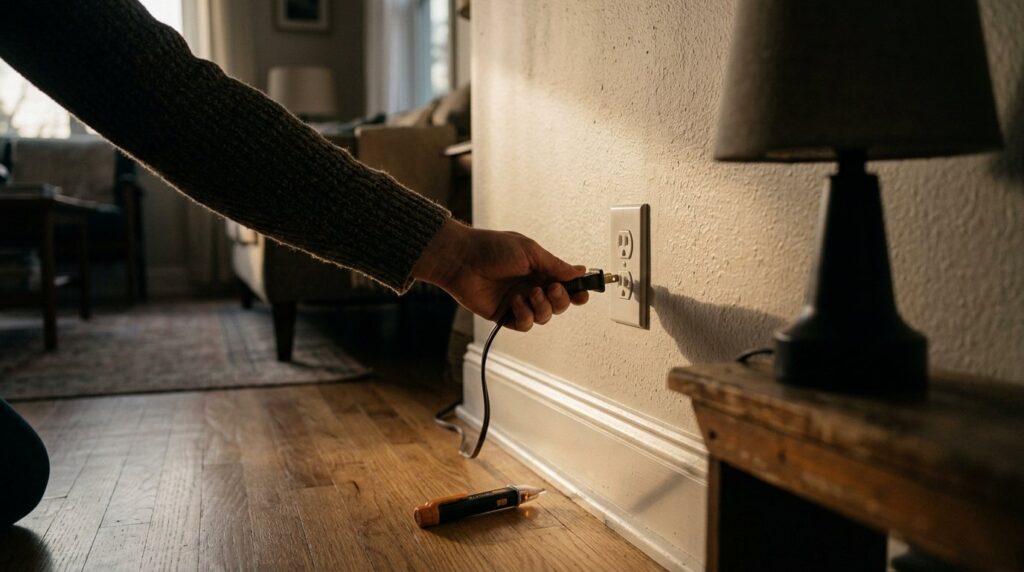
An outlet stopped working, a string of holiday lights went dark, or you’re not sure whether a battery is dead or just weak. A multimeter can answer all of those questions in seconds, but the dial full of symbols can look intimidating, and a mistake near household wiring can be dangerous.
This beginner’s guide explains what a multimeter measures, how to choose a safe one, and how to test outlet voltage, continuity, batteries and fuses step by step. It also covers the safety habits electricians rely on and the situations where you should stop and call a licensed electrician instead.
Quick answer: Plug the black lead into COM and the red lead into the V/Ω jack. Set the dial to AC volts to test an outlet, DC volts for batteries, and the continuity or ohms setting for fuses, switches and cords, with power off. Use a meter rated at least CAT III for household wiring, keep your fingers behind the probe guards, and never test inside an electrical panel unless you’re qualified.
What a multimeter measures
A digital multimeter combines several meters in one tool. The settings you’ll use at home are these:
| Dial setting | What it measures | Common home use |
|---|---|---|
| V with a wavy line (V~ or VAC) | AC voltage | Outlets, light switches, appliance cords |
| V with a straight line (VDC) | DC voltage | Household batteries, car batteries, low-voltage adapters |
| Ω (omega) | Resistance in ohms | Heating elements, sensors, comparing parts |
| Speaker or diode symbol | Continuity | Fuses, switches, extension cords, light strings |
| A or mA | Current in amps | Low-voltage DC circuits only; rarely needed at home |
Many beginner meters are auto-ranging, which means you choose the type of measurement and the meter picks the scale. With a manual-ranging meter, choose the next range above what you expect, such as 200V for a 120-volt outlet.
Safety first: before you test anything
Check the CAT rating
A meter’s CAT rating tells you how well it’s protected against voltage spikes, which can cause a cheap meter to fail violently. According to one meter maker’s safety guide, CAT II covers receptacle-connected loads like appliances and outlets, CAT III covers fixed wiring and circuits fed from the panel, and CAT IV covers the service entrance and utility connections. Choose a meter rated for the highest category you might use it in, and look for an independent lab mark such as UL or CSA.
For household use, a meter rated CAT III 600V is a sensible minimum. Avoid unrated bargain meters for anything plugged into the wall.
Inspect the meter and leads
Never use a meter with a cracked case or leads with nicked insulation or exposed metal. Make sure the probe plugs seat fully in their jacks, and replace the meter’s internal battery when the low-battery icon appears, because a weak battery can cause false readings.
Use the one-hand habit
When probing anything live, electricians keep one hand away from the circuit, often in a pocket or behind the back, so current can’t take a path across the chest. Hold both probes in one hand when practical, or clip the black lead in place first, and keep your fingers behind the probe guards at all times.
Prove your meter works
Use the live-dead-live method: test a known live outlet, test the circuit you plan to work on, then test the known live outlet again. If the meter reads zero on the last check, your “dead” reading can’t be trusted.
Safety note: Never put the red lead in the A or 10A jack and then touch an outlet. The current setting is nearly a dead short, and on a household circuit it can blow the meter’s fuse, cause an arc flash or burn you. Move the red lead back to V/Ω before every voltage test.
Choosing a multimeter for home use
You don’t need a professional meter to test outlets and batteries, but a few features make a beginner’s meter safer and easier to use:
- Auto-ranging: You pick volts, ohms or continuity and the meter chooses the scale, which removes a common source of confusion.
- CAT III 600V or higher: Printed near the input jacks, along with an independent lab mark.
- Fused current inputs: An internal fuse protects you and the meter if the leads end up in the wrong jack.
- Audible continuity: A beep lets you keep your eyes on the probes instead of the screen.
- Shrouded leads and a backlit display: Helpful in dim basements and behind appliances.
An auto-ranging, CAT III meter also makes a practical holiday gift for a new homeowner, especially paired with a non-contact voltage tester.
Tools and materials
- Digital multimeter rated CAT III 600V or higher, with fused current inputs
- Probe leads in good condition (alligator clip adapters are helpful)
- Non-contact voltage tester for quick live-wire checks
- Insulated screwdrivers if you’ll remove cover plates
- Safety glasses
How to test outlet voltage
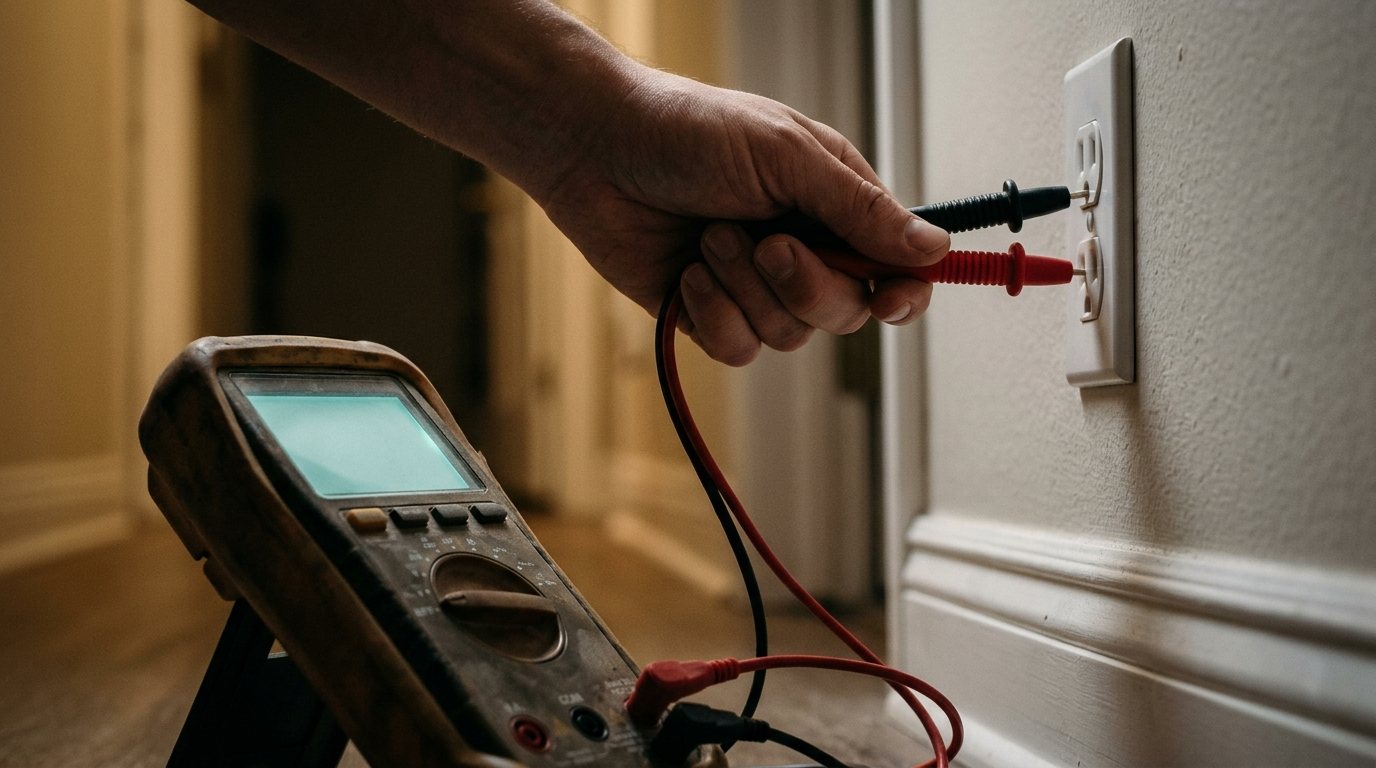
- Plug the black lead into COM and the red lead into V/Ω.
- Set the dial to AC volts (or 200V AC on a manual meter).
- Hold the probes by their insulated grips. Insert the black probe into the wider neutral slot, then the red probe into the narrower hot slot.
- Read the display. A standard US outlet should read close to 120 volts.
- For a fuller check, measure hot to ground (the round hole), which should also read near 120 volts, and neutral to ground, which should read near zero.
- Remove the red probe first, then the black.
A reading of zero means the outlet isn’t getting power. Check for a tripped breaker or a GFCI outlet elsewhere on the circuit, and see our guide to an outlet not working for the next steps. If the breaker keeps tripping, read circuit breaker keeps tripping before resetting it again.
How to test continuity
Continuity tells you whether electricity has a complete path, such as through a fuse, switch or cord. Always test with the power off and the item unplugged or disconnected.
- Set the dial to continuity (the speaker symbol) or the lowest ohms setting.
- Touch the probes together. The meter should beep and read close to zero.
- Touch one probe to each end of the part you’re testing.
- A beep and a near-zero reading means the path is complete. No beep, a very high reading or “OL” means the path is broken.
For a wall switch, disconnect its wires before testing, because nearby live circuits can affect the reading. A good switch shows continuity when on and none when off. For an extension cord, test each prong to its matching slot at the other end.
How to test batteries
- Set the dial to DC volts, choosing a range above the battery’s rating if your meter isn’t auto-ranging.
- Touch the red probe to the positive terminal and the black probe to the negative terminal.
- Compare the reading with the voltage printed on the battery. A fresh alkaline battery usually reads slightly above its label, while one that reads noticeably below it is getting weak.
A fully charged 12-volt car battery reads about 12.6 volts at rest, according to one renovation site’s multimeter guide. Keep in mind that a meter tests a battery without a load, so a borderline battery can read fine and still fail in a power-hungry device. If the display shows a minus sign, the probes are reversed, which won’t harm a digital meter.
How to test a fuse
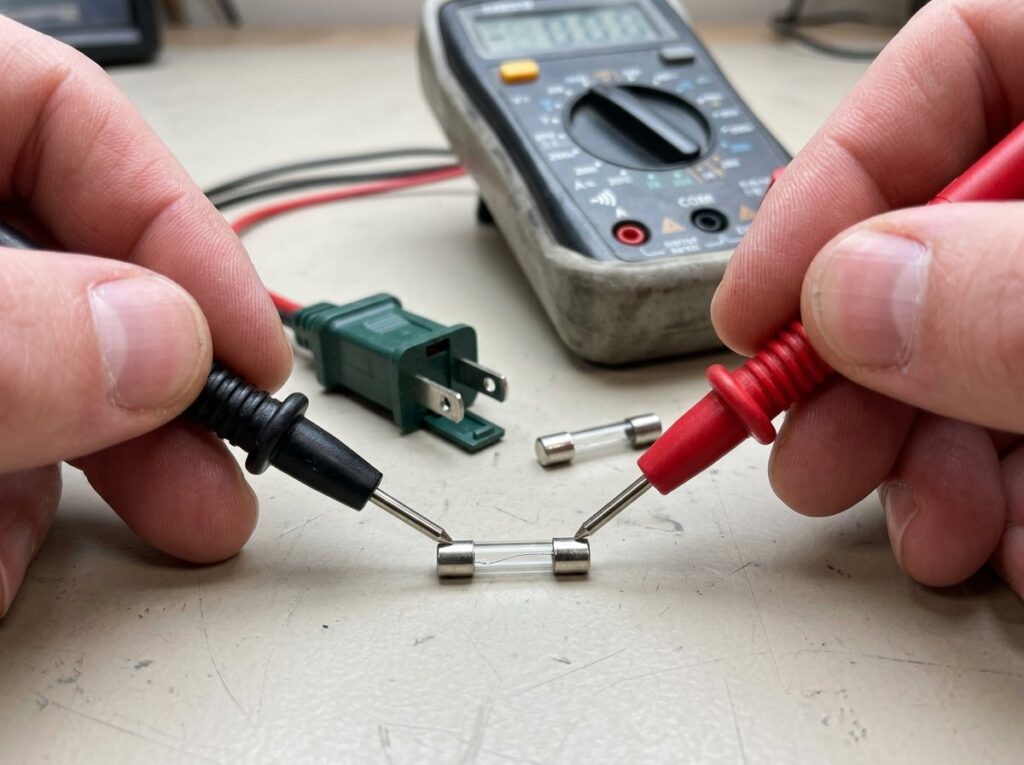
- Remove the fuse from the device, appliance or plug, with the power disconnected.
- Set the meter to continuity.
- Touch a probe to each metal end of the fuse.
- A beep means the fuse is good. No beep or “OL” means it’s blown and needs replacing with one of the same type and rating.
This is handy during the holidays, since many light strings have tiny replaceable fuses inside the plug. Before you stretch lights across the house, review our holiday lights electrical safety tips.
Common beginner mistakes
- Leaving the red lead in the amps jack after a current test
- Measuring resistance or continuity on a live circuit
- Using DC volts on an outlet, which gives a meaningless reading
- Trusting a “dead” reading without testing a known live source afterward
- Touching the metal probe tips while measuring
- Using a meter with no CAT rating on household wiring
When not to DIY: call an electrician
A multimeter helps you diagnose, but it doesn’t make every repair safe. Stop and call a licensed electrician if:
- The problem is inside the main panel or involves the service wires
- You smell burning, see scorch marks, or an outlet or switch feels warm
- A breaker trips again right after you reset it
- Readings are erratic, far from 120 volts, or show voltage where there shouldn’t be any
- Your home has aluminum branch wiring or knob-and-tube wiring
- The work involves 240-volt circuits, such as a dryer, range or water heater
According to Angi, licensed electricians typically charge about $50 to $100 per hour, and emergency visits can run about $100 to $200 per hour. If you plan to do the repair yourself afterward, our guide on how to replace an outlet walks through it with power off.
Frequently asked questions
What setting do I use to test an outlet?
Use AC volts, marked V with a wavy line. On a manual-ranging meter, choose the 200V or 600V AC range so the meter can read 120 volts.
What CAT rating do I need for home use?
CAT III 600V is a sensible minimum for household outlets and branch circuits. CAT II meters are meant for plug-in loads, and work at the service entrance calls for CAT IV, which is a job for an electrician.
Why does my meter show voltage on a wire that should be dead?
Sensitive digital meters can pick up “ghost” voltage induced from nearby live wires, which often reads as a low, unstable number. Treat every unexpected reading as real until a known-good tester or an electrician confirms otherwise.
Can I measure amps at an outlet with a multimeter?
No. Inserting the probes into an outlet on the current setting creates a short circuit. Most multimeters measure current only in low-voltage circuits; a clamp meter is the safe tool for household current.
Is a multimeter better than a non-contact voltage tester?
They do different jobs. A non-contact tester is fastest for checking whether a wire is live, while a multimeter gives exact readings and tests continuity, batteries and fuses. Many homeowners keep both.
The bottom line
The basics of how to use a multimeter are simple: black lead in COM, red lead in V/Ω, AC volts for outlets, DC volts for batteries and continuity for fuses and switches with the power off. Buy a meter rated CAT III or higher, prove it works before and after testing, and leave panels, burning smells and repeat breaker trips to a licensed electrician.