You open the dishwasher at the end of a cycle and find a pool of cloudy water in the bottom, maybe with bits of food floating in it. The dishes might be gritty, and the kitchen starts to smell a little sour.
Most drainage problems come from a clog you can clear yourself in under an hour, with no special parts. This guide walks you through each common cause in the order a technician would check them, from the filter and garbage disposal to the drain hose, air gap and drain pump, plus what a repair typically costs if you need help.
Quick answer: Turn off the power, bail out the standing water, then remove and rinse the filter at the bottom of the tub. Next, run the garbage disposal, make sure the drain hose under the sink is not kinked, and clean the air gap if you have one. If the dishwasher or disposal is new, check that the disposal’s knockout plug was removed. If the pump hums but no water moves, the drain pump is the likely culprit.
First, check whether you really have a drain problem
A small amount of water around the filter after a cycle is normal on many models. The sump is designed to hold a little water so the pump seals stay wet. A shallow puddle in the sump area only is not a fault.
Water covering the tub floor is a different story. Before you take anything apart, rule out an interrupted cycle caused by a power blip, a door opened mid-cycle or a child lock. On many models, pressing and holding Cancel (or Start/Reset) for about 5 to 10 seconds cancels the cycle and runs the drain. Try that, then run a short rinse and see if the water clears.
Before you start: safety and getting the water out
Unplug the dishwasher or switch off its circuit breaker before you reach into the tub or touch the hose. Pull out the bottom rack, lay towels in front of the door, and scoop the water into a bucket with a cup. Sponge up the last inch so you can see the filter clearly.
Safety note: Wear rubber gloves when you reach into the sump, because broken glass, bones and fruit pits collect right where your fingers go. Never pour drain cleaner into a dishwasher. Caustic chemicals can damage the pump, seals and plastic parts, and the next cycle can splash residue onto your dishes.
Tools and materials
- Old towels, a bucket, a cup and rubber gloves
- Soft brush (an old toothbrush works) and a flashlight
- Screwdriver or nut driver for hose clamps, and pliers for spring clamps
- Hammer, only if you need to remove a disposal knockout plug
- Multimeter, if you want to test the drain pump
Quick troubleshooting table
| What you notice | Most likely cause | What to do |
|---|---|---|
| Standing water, food debris in tub | Clogged filter | Remove and clean the filter |
| New dishwasher or new disposal, never drained properly | Knockout plug still in disposal | Remove the plug |
| Kitchen sink is also slow or backs up | Clogged disposal or sink drain | Run disposal, clear the sink drain |
| Water spurts from a fitting on the sink deck | Blocked air gap | Clean the air gap |
| Problem started after reorganizing under the sink | Kinked or crushed drain hose | Straighten or replace the hose |
| Dirty sink water ends up in the dishwasher | No high loop or air gap | Raise and secure the hose |
| Foam in the tub or on the floor | Wrong detergent | Rinse out suds, use dishwasher detergent |
| Humming at drain time, no water moves | Jammed or failed drain pump | Clear the pump or replace it |
Fixes you can do in 15 minutes
Start with these. They account for most drainage complaints, and none of them require pulling the dishwasher out of the cabinet.
1. Clean the filter
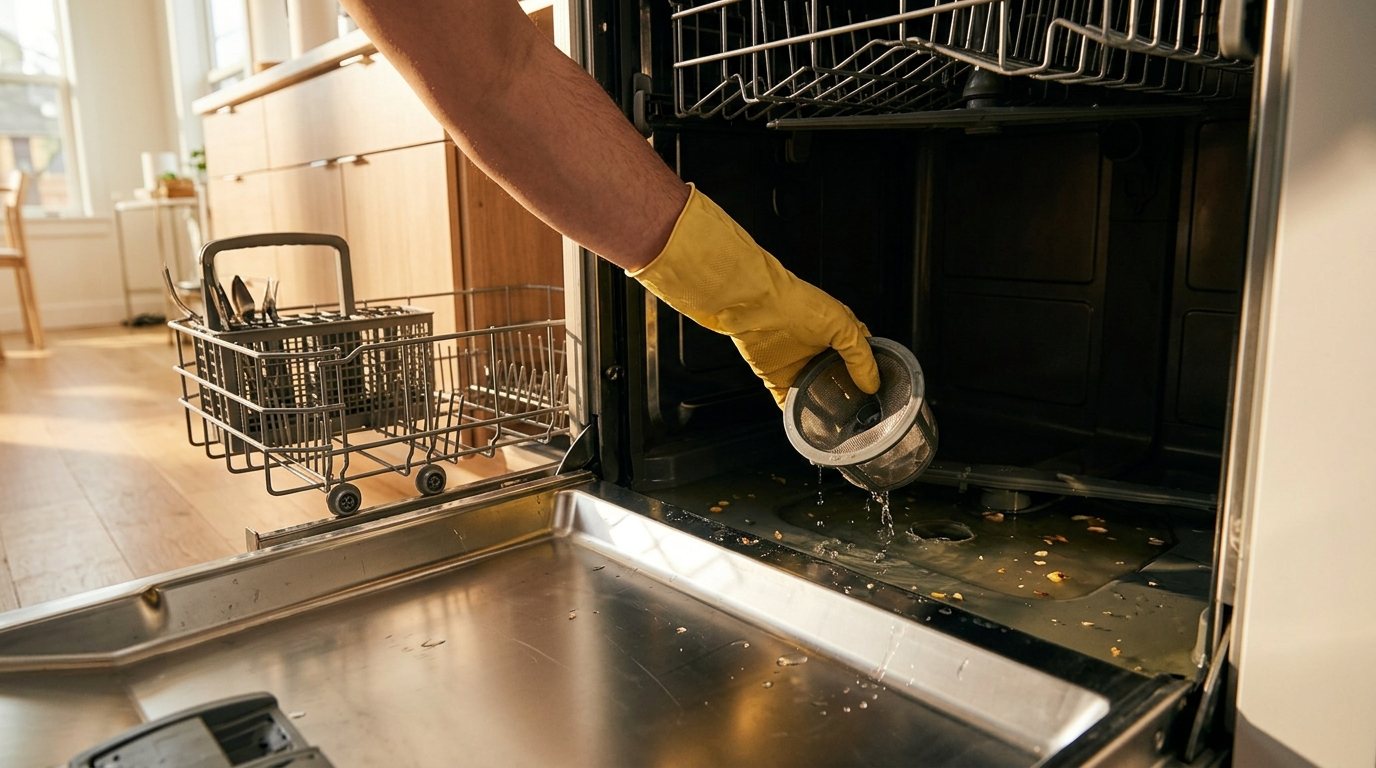
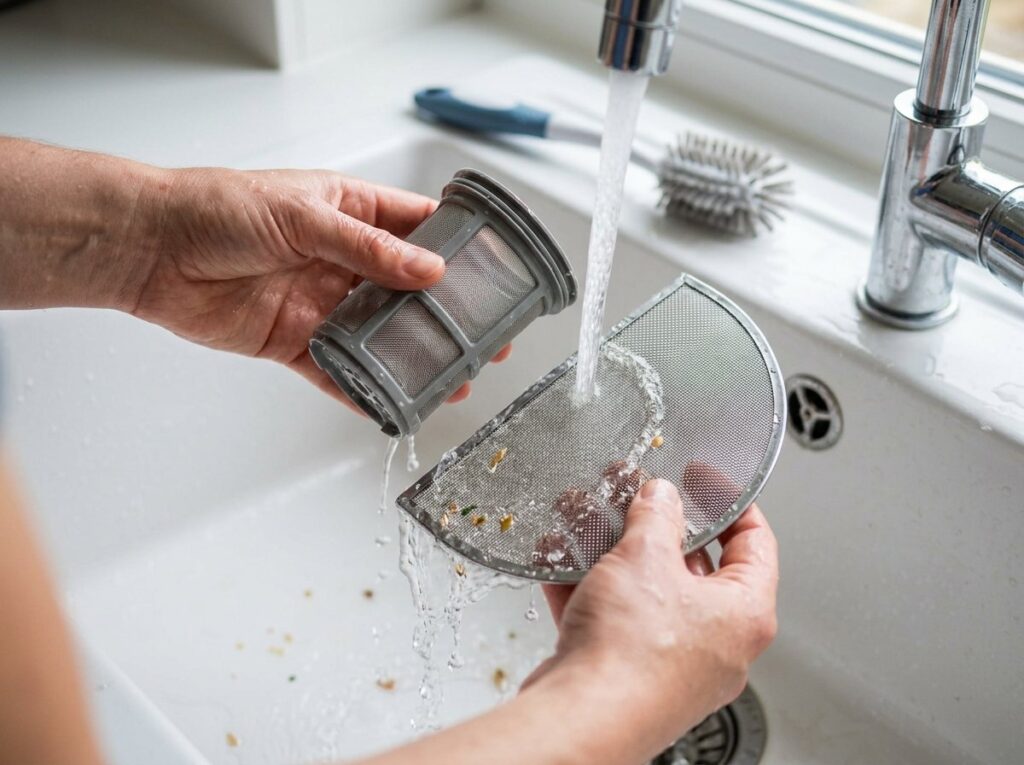
Most newer dishwashers use a manual filter instead of a built-in grinder, which makes them quieter but means the filter needs regular cleaning. When it clogs with grease, labels, rice or seeds, water cannot reach the pump fast enough.
- Twist the cylindrical filter counterclockwise, usually a quarter turn, and lift it out. Lift out the flat mesh screen underneath if your model has one.
- Rinse both pieces under warm water and scrub the mesh gently with a soft brush and a drop of dish soap. A wire brush can tear the mesh.
- Shine a flashlight into the sump and pick out glass, pits or bits of plastic.
- Reinstall the filter and turn it until it locks. A loose filter lets debris into the pump.
2. Remove the disposal knockout plug (new installs)
New garbage disposals come with a solid plastic plug inside the dishwasher inlet. If it is never knocked out, the dishwasher has nowhere to drain. Whirlpool’s support team calls the disposer knockout plug a critical and often overlooked step on new installations.
- Turn off power to the disposal and unplug it or switch off its breaker.
- Loosen the clamp and pull the dishwasher drain hose off the disposal inlet.
- Hold a flat screwdriver against the plug inside the inlet and tap it with a hammer until it pops into the disposal.
- With the power still off, reach into the disposal through the sink and remove the loose plug.
- Reattach the hose and tighten the clamp.
3. Run the disposal and clear the sink drain
Your dishwasher drains into the same pipe as your kitchen sink, so a full disposal or clogged trap blocks it too. Run cold water and turn on the disposal for about 15 seconds after the grinding stops. If the disposal hums without spinning or will not turn on, see our guide to fixing a garbage disposal that is not working.
If the sink itself drains slowly, clear that clog first with a plunger, a hand auger or the methods in our guide to unclogging a drain without chemicals. Cover the air gap or clamp the dishwasher hose while plunging so you do not push sludge back into the dishwasher.
4. Clean the air gap
An air gap is a small cylinder mounted on the sink deck or countertop beside the faucet. It keeps dirty sink water from being siphoned back into the dishwasher. When food builds up inside, water often spurts out of it during the drain cycle.
Pull or twist off the decorative cover, unscrew the plastic cap beneath it, and pick out debris with tweezers. Scrub the inside with a small brush, flush it with water, and reassemble.
Drain hose, high loop and pump problems
If the quick fixes did not work, the fault is likely in the hose that runs to the sink, in how that hose is routed, or in the pump that pushes water out.
5. Straighten a kinked or crushed drain hose
Follow the ribbed drain hose under the sink as far as you can see. Cleaning supplies or a trash can can crush it, and it often kinks behind the dishwasher when the unit is pushed back into the cabinet after installation.
Straighten any sharp bends. If the hose stays flattened or keeps kinking, replace it with one specified for your model. To check the section behind the unit, turn off the power and water, remove the two mounting screws under the countertop lip, and slide the dishwasher forward carefully.
6. Clear a clogged drain hose
Grease and food can harden inside the hose, especially at the disposal end. Put a towel and shallow pan under the connection, loosen the clamp and pull the hose off. Flush it with water into a bucket, or push a stubborn clog out gently with a straightened coat hanger wrapped in tape. Avoid metal drain snakes, which can puncture the thin plastic walls.
7. Check the high loop
If you do not have an air gap, the drain hose should rise up and be fastened to the underside of the countertop before dropping to the disposal or sink tailpiece. This high loop stops dirty water from flowing back into the dishwasher. Maytag says the drain loop should sit at least 20 inches above the floor. If yours sags, lift it and secure it with a strap or hose clip screwed to the cabinet.
Most US plumbing codes accept either a secured high loop or a deck-mounted air gap, but some areas require the air gap. If you are reworking the drain, check with your local building department.
8. Rinse out suds from the wrong detergent
Regular dish soap or laundry detergent fills the tub with foam the pump cannot move. Bail out what you can, add a few tablespoons of vegetable oil to break the bubbles, and run a rinse cycle. Repeat until no suds remain, then use proper dishwasher detergent.
9. Inspect the drain pump and check valve
The drain pump sits under the tub, usually behind the lower kick panel. Listen at the drain stage of a cycle. A hum or buzz with no water moving often means something is jammed in the impeller, while silence can point to a failed motor, wiring or a control fault.
- With the power off, remove the filter and look into the sump. Many models have a small pump cover you can lift off to see the impeller.
- Remove anything caught in the impeller and spin it gently with a finger. It should turn freely.
- Check the check valve or flap where the pump meets the drain hose, and clean it if debris holds it shut.
- If the pump is clear and still does not run, test the motor with a multimeter set to ohms and compare the reading to your service manual. Our guide on how to use a multimeter covers the basics.
On many models the pump is a bolt-on part, but access varies by brand. If you need to remove the tub or base frame, a technician is usually the better call.
Common mistakes to avoid
- Skipping the filter. People often pull the whole dishwasher out before checking the most common cause.
- Using chemical drain cleaner. It damages pumps, seals and hoses and leaves a hazard for your next load.
- Kinking the hose on reinstallation. Feed the hose back through the cabinet hole as you push the unit in so it does not fold behind the tub.
- Overtightening hose clamps. Snug is enough. A crushed hose can start a slow leak under the kitchen sink.
How to keep your dishwasher draining
- Scrape scraps, bones and labels into the trash before loading. You do not need to prerinse.
- Clean the filter monthly, or more often if you see residue on glasses.
- Run the disposal before starting the dishwasher so the shared drain is clear.
- Keep under-sink storage away from the drain hose, and use only automatic dishwasher detergent.
When to call a pro
Call an appliance technician or plumber if you notice any of these red flags:
- The pump hums, clicks or stays silent even though the filter, sump and hose are clear.
- Water is leaking from under the dishwasher onto the floor.
- You smell burning or see scorch marks near the control panel or kick panel.
- Other drains in the house are also backing up, which points to a main drain clog.
- Error codes keep returning after a reset.
According to HomeAdvisor’s dishwasher repair cost guide, most dishwasher repairs typically run $160 to $300, and the service fee is often credited toward the repair if you go ahead.
| Repair | Typical cost range |
|---|---|
| Diagnostic or service call fee | $35 to $100 |
| Drain hose replacement | $50 to $100 |
| Pump repair | $150 to $350 |
| Motor and pump assembly | $400 to $600 |
If the dishwasher is out of warranty, around 10 years old or more, and the quote approaches half the price of a new machine, replacing it usually makes more sense.
Frequently asked questions
Why is there water in the bottom of my dishwasher after a cycle?
A little water around the filter is normal and keeps the pump seals from drying out. If water covers the tub floor, check the filter first, then the disposal, the drain hose and the air gap.
Why won’t my dishwasher drain after installing a new garbage disposal?
The knockout plug inside the disposal’s dishwasher inlet was probably left in place. With the power off, disconnect the hose, knock the plug into the disposal, fish it out and reconnect the hose.
Can I use Drano or another drain cleaner in my dishwasher?
No. Chemical drain cleaners can damage the pump, seals and plastic parts, and residue can end up on your dishes. Clear the filter and hose by hand, and treat a clogged sink with a plunger or auger.
Does a dishwasher need an air gap?
It depends on your local code. Many areas allow a high loop fastened under the counter instead, while some require a deck-mounted air gap. Either way, the hose should never sag to the cabinet floor between the dishwasher and the drain.
Is it worth replacing a dishwasher drain pump?
Often yes, if the dishwasher is less than about 8 to 10 years old and otherwise works well, since a pump costs far less than a new appliance. On an older machine with other problems, put the money toward a replacement.
The bottom line
A dishwasher that will not drain is usually clogged, not broken. Work from the inside out: clean the filter, run the disposal, check the knockout plug on new installs, straighten the hose, clean the air gap and confirm the high loop. Only when all of that checks out should you suspect the drain pump, and a technician can confirm it before you spend money on parts.